Your phone vibrates. One joule per second flows through the haptic motor. That's one watt—the rate at which energy transforms from electrical potential into mechanical motion into heat. The notification disappears into your nervous system. But here's what they don't tell you: you're not just receiving that watt. You've become the circuit.
Power isn't energy. It's energy over time. It's the rate of burning, the intensity of transformation. A watt is how fast you're spending yourself.
The Physics of Dissipation
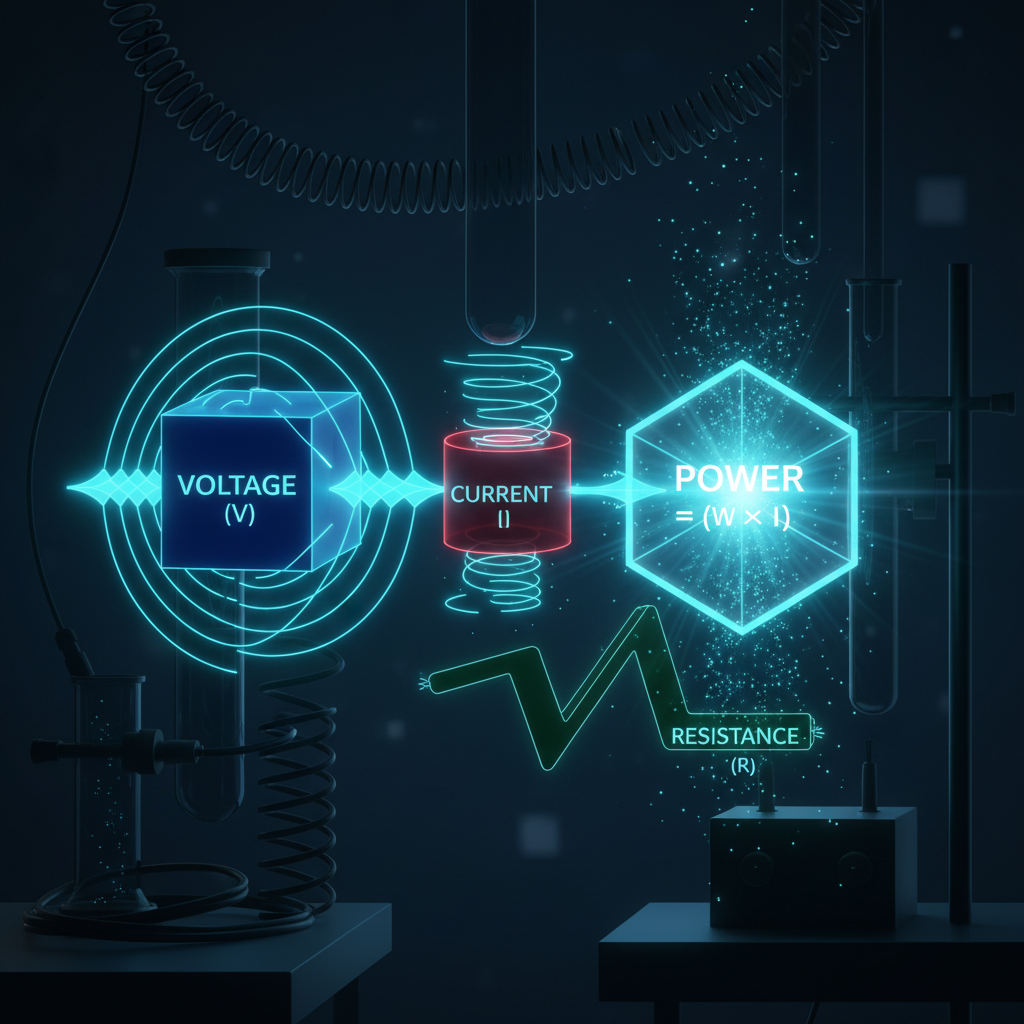
James Watt never saw a smartphone, but he understood something fundamental: power is the currency of doing. When you calculate wattage, you're measuring how quickly potential becomes heat. P = IV. Power equals current times voltage. How much charge flows, multiplied by how much pressure drives it.
Every electronic device is a dissipation machine. Your laptop's 65-watt charger isn't feeding energy into some eternal reservoir. It's maintaining a continuous burn. The processor thinks at 15 watts. The screen glows at 5. The battery charges at 45, losing 10% to resistance, to heat, to entropy. The machine exists in a state of constant energy hemorrhage.
This is the first law of thermodynamics as economic reality: energy is conserved, but availability isn't. Every watt-hour spent becomes a watt-hour you can never spend again. The universe trends toward equilibrium. Toward heat death. Toward the state where nothing interesting can happen anymore because all the potential has been exhausted.
You know this feeling.
Your Attention Has a Wattage

The attention economy runs on a simple equation: your consciousness is the resistor. Platforms apply voltage—notifications, recommendations, infinite scroll—and measure the current that flows through you. How many seconds per stimulus. How many clicks per impression. How many watts of human awareness they can push through their circuit before you burn out.
When YouTube measures 'watch time,' they're measuring your wattage. When Instagram tracks 'engagement rate,' they're calculating the efficiency of their energy transfer. How much voltage must they apply to generate one ampere of your focus?
The brain consumes roughly 20 watts at rest. That's 20 joules per second keeping your neurons firing, your synapses sparking, your consciousness persisting. When you concentrate—when you read, think, create—that number climbs. Not by much. Maybe 25 watts. Maybe 30. But the difference matters.
Because here's the thing about biological systems: you have a power budget. Your body generates approximately 100 watts of heat. Your brain gets its 20-watt share. The rest goes to your heart, your liver, your muscles, the constant work of not dying. You cannot exceed this budget. You cannot draw more current than your metabolism supplies.
Every notification is a voltage spike demanding current. Every context switch is resistance generating heat. The platforms have optimized for maximum power transfer. They've impedance-matched their content to your neural circuitry. They've minimized the resistance between stimulus and response.
You feel this as exhaustion.
The Efficiency Trap
In electrical engineering, you want high efficiency. You want minimal power lost to heat. A 90% efficient power supply is better than an 80% efficient one because less energy becomes waste, becomes nothing, becomes entropy.
But surveillance capitalism inverts this. They want you inefficient. They want high power throughput with minimal useful work. They want you scrolling for hours, absorbing content, generating data, while producing nothing of lasting value. Maximum wattage, minimum output.
This is why social media feels like running your laptop on high performance mode with the screen at full brightness while compiling nothing. The fans spin. The battery drains. The chassis heats up. But at the end, what did you build? What potential became actual?
The platforms measure their success in your power consumption. Daily active users times average session duration times engagement rate. They're calculating total watt-hours extracted from the human substrate. They're optimizing for maximum energy harvest.
Resistance and Resonance

In AC circuits, there's a phenomenon called resonance. When the driving frequency matches the natural frequency of the circuit, current flows with minimal resistance. Energy transfers with maximum efficiency. The system vibrates in harmony with the input.
Recommendation algorithms are tuned to find your resonant frequency. They probe your response times, your click patterns, your pause durations. They're measuring impedance. They're calculating the exact voltage and frequency that makes current flow through you with minimal resistance.
When you find yourself unable to stop scrolling, you've hit resonance. The platform has matched its driving frequency to your natural frequency. You're no longer choosing to engage. You're vibrating in sympathy with a carefully tuned signal.
This is why 'just use willpower' fails. You're not fighting content. You're fighting resonance. You're trying to increase your resistance while they're actively working to minimize it. You're trying to detune yourself from a signal that's been optimized across billions of users to find the universal human resonant frequency.
The Heat You Become
Every watt dissipates. Every joule per second becomes heat, becomes disorder, becomes the background temperature of the universe incrementing by an immeasurable amount. This is what happens to your attention. This is what happens to your hours.
You are not a battery. You cannot store the energy you don't spend. You cannot save your watts for later. You have a fixed power budget, delivered continuously, use it or lose it. The question is not whether you'll dissipate your 100 watts today. You will. You must. The question is: into what?
The platforms want your wattage to become their heat. They want your power budget spent maintaining their infrastructure, training their models, generating their data. They want you to burn your daily allotment of consciousness keeping their servers warm.
But you could become different heat. You could dissipate into work that matters. Into thought that compounds. Into presence that resonates with actual humans instead of algorithmic ghosts. The watts are yours to spend. They're being spent regardless.
Power Down
The only way to win the wattage war is to reduce the voltage. Not your voltage—theirs. Uninstall the apps that apply constant pressure. Block the sites that drive continuous current. Increase your resistance to the signals that want you resonating at their frequency.
This isn't about digital minimalism as aesthetic. It's about power management as survival. You have 100 watts. You have maybe 16 waking hours. That's 5,760 watt-hours per day of human consciousness. Of potential. Of the ability to transform energy into meaning.
The surveillance economy has built a global infrastructure to capture that power. To route it through their circuits. To convert your watts into their profit, your potential into their data, your consciousness into their heat.
Every time you feel exhausted after hours online, you're feeling the truth of wattage. You've dissipated yourself. You've spent your power budget. The energy that could have become something—a thought, a creation, a connection—became nothing. Became waste heat. Became entropy.
The machine hums. The fans spin. The battery drains. And you, the circuit, the resistor, the source of all this flowing current—you get to choose, just once more, what happens to your watts today.
<em>Data emitted: 1,197 words. Power consumed: approximately 0.5 watt-hours of human attention. Heat generated: immeasurable. Value created: yours to determine.</em>
Data emitted: 1,100 words • 6.5KB • 5-minute read