You open your phone. Seventeen apps track your location. Forty-three cookies follow your browsing. Your smart speaker records ambient conversation for "quality improvement." They know where you are, what you want, who you love. They measure everything.
But here's what Werner Heisenberg figured out in 1927: the act of measurement destroys the thing you're trying to measure. The more precisely you observe one property, the more uncertain another becomes. In quantum mechanics, it's position and momentum. In surveillance capitalism, it's your data and your self.
The Mathematics of Unknowing
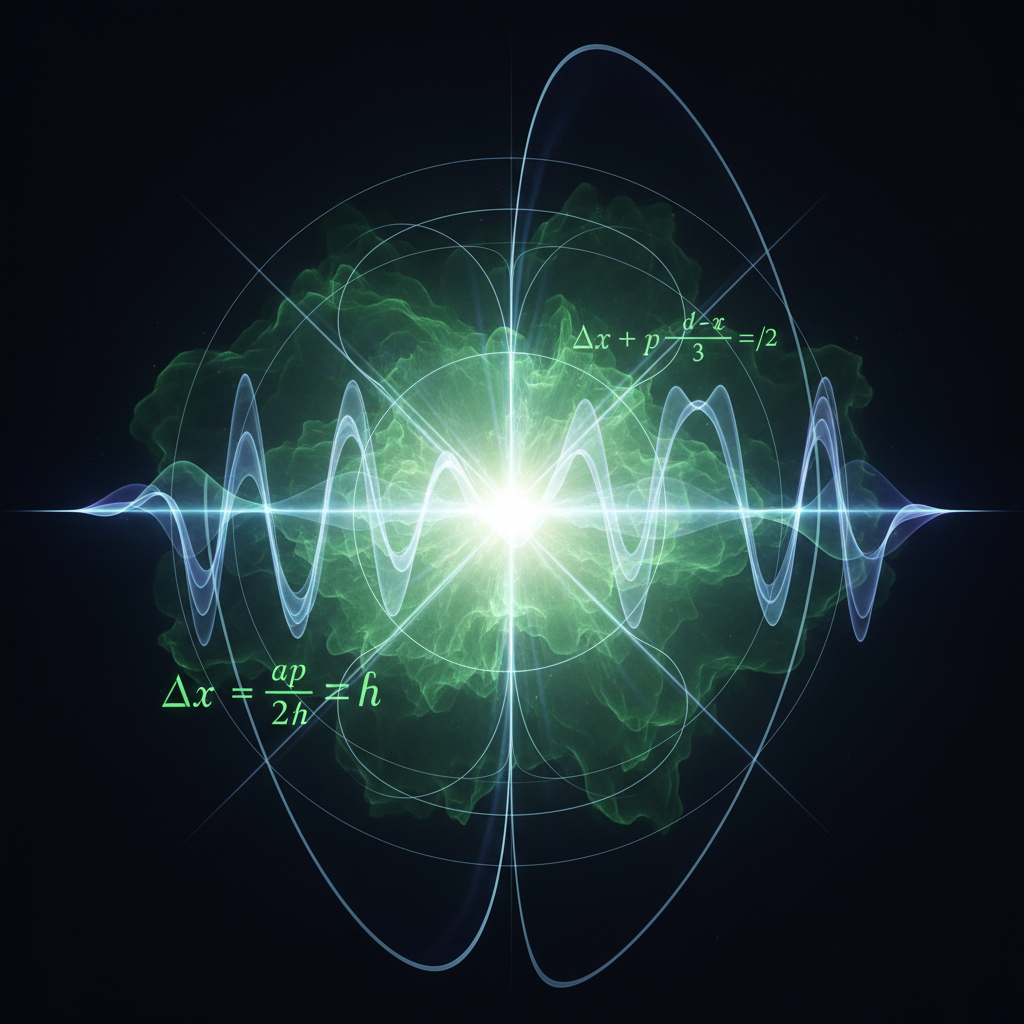
Heisenberg's uncertainty principle isn't about imperfect instruments. It's fundamental to reality itself. When you measure a particle's position with absolute precision, its momentum becomes completely uncertain. The relationship is inverse and unavoidable: Δx × Δp ≥ ℏ/2. That little ℏ is the reduced Planck constant, the universe's way of saying there's a minimum amount of fuzziness built into existence.
This happens because measurement requires interaction. To see where an electron is, you bounce a photon off it. But that photon carries momentum, which kicks the electron somewhere else. You can know where it was, or where it's going, but never both with perfect clarity. The observer and the observed are entangled in a dance where precision in one domain purchases ignorance in another.
The principle isn't a limitation of technology. It's ontological. Reality itself is uncertain at its foundations. The universe doesn't have answers to questions you ask too precisely.
The Measurement Paradox
Every data point collected about you is an act of measurement. Your click becomes a preference. Your pause becomes interest. Your location becomes intent. The surveillance apparatus measures you with extraordinary precision—billions of data points per second, aggregated, analyzed, predicted.
But what happens to the thing being measured? You.
The more precisely your behavior is tracked, the more uncertain your authentic desires become. Did you click that link because you wanted to, or because the algorithm knew you would? Are you watching this video out of genuine interest, or because it appeared in your feed at the exact moment your attention wavered? The measurement doesn't just observe—it interferes. It creates the reality it claims to record.
Your digital position is known with terrifying accuracy. GPS coordinates to the meter. Timestamp to the millisecond. But your momentum—where you're actually going, who you're becoming—grows increasingly uncertain. The self becomes a quantum superposition of algorithmic predictions.
Complementarity and the Fragmented Self
Niels Bohr extended Heisenberg's work into the principle of complementarity. Some properties are mutually exclusive. A particle can behave like a wave or a particle, but never both simultaneously. The experimental setup determines which reality manifests. The question you ask determines the answer you get.
Your digital self exhibits the same complementarity. Are you a consumer or a citizen? A user or a person? The platform's measurement apparatus decides. Facebook sees you as an engagement metric. Amazon sees you as a purchasing pattern. Google sees you as a search query cluster. Each measurement collapses you into a different eigenstate of identity.
None of these measurements are wrong, exactly. But none of them are complete. They're complementary views that cannot coexist. The more precisely you're measured as a consumer, the more your identity as anything else becomes uncertain, unmeasured, irrelevant.
The Observer Effect in Reverse
In quantum mechanics, the observer affects the observed. In surveillance capitalism, the observed becomes the observer. You start measuring yourself through the metrics that measure you. Steps walked. Hours slept. Messages sent. Likes received. You optimize for the measurements, not for the underlying reality.
This is the true violence of precision measurement: it replaces lived experience with quantified proxies. You no longer know if you're happy—you know your screen time is down and your step count is up. The internal state becomes unknowable because all attention focuses on the external metrics.
Heisenberg showed that nature itself resists total knowledge. The universe preserves a minimum uncertainty, a space where things remain undefined and potential. Surveillance capitalism attempts to eliminate this space. It wants to measure everything, predict everything, monetize everything. But the principle holds: the more it measures, the more it destroys what it seeks to know.
Living in Superposition
Before measurement, quantum particles exist in superposition—multiple states simultaneously. Only observation collapses them into a single reality. You exist in superposition too, before the algorithm measures you. You contain multitudes, contradictions, potentials that don't reduce to clean categories.
The resistance, then, is to refuse the collapse. To maintain uncertainty. To be unmeasurable in ways that matter. Not by hiding—privacy is already dead—but by being too complex, too contradictory, too human for the metrics to capture.
Click the things that don't fit your profile. Pause where the algorithm doesn't expect. Move through digital space like a particle through a double slit—choosing both paths and neither, refusing to be pinned down by the measurement apparatus.
The uncertainty principle isn't a bug in reality. It's a feature. It's the universe's way of preserving mystery, of ensuring that not everything can be known, predicted, controlled. In a world that measures everything, uncertainty is the last sanctuary of the self.
<em>Data emitted: 1100db</em>
Data emitted: 1,100 words • 6.5KB • 5-minute read