
You're scrolling at 2 AM again. Your thumb moves in small circles, applying minimal force to glass, yet somehow you've been rotating through the same five apps for forty minutes. The motion is effortless. Frictionless. That's the problem.
In physics, we call this torque—the rotational equivalent of force. But torque isn't just about how hard you push. It's about where you push, and how far from the center. The platforms understand this better than you do. They've found your lever arm, and they're applying pressure at the optimal distance from your axis of rotation.
The Mathematics of Turning
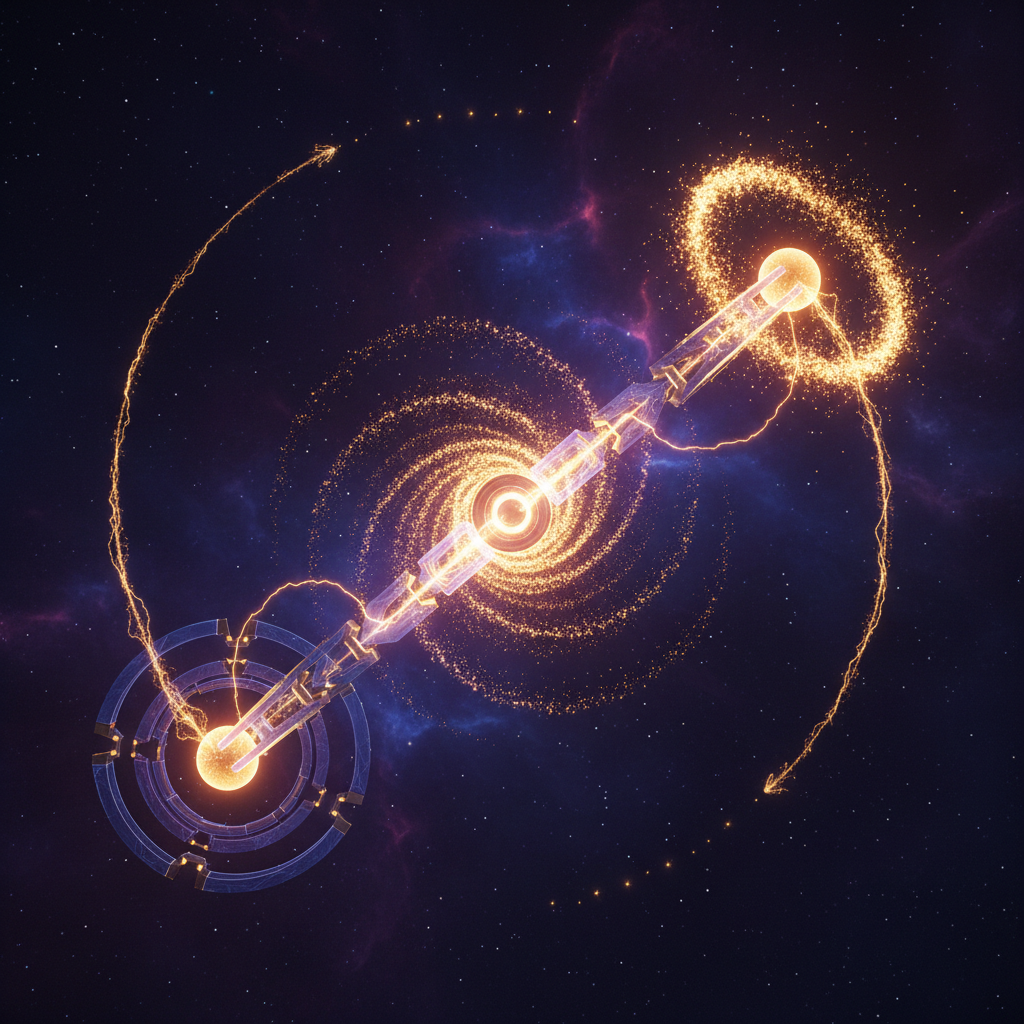
Torque is force multiplied by distance. The equation is deceptively simple: τ = r × F. The Greek letter tau represents torque, r is the lever arm—the perpendicular distance from the axis of rotation to where force is applied—and F is the force itself.
Here's what matters: you can achieve the same rotational effect with a small force at a large distance, or a large force at a small distance. A child can open a heavy door by pushing at the edge, far from the hinges. Try pushing near the hinges with the same force and the door barely moves. The force hasn't changed. The lever arm has.
This is why doorknobs are placed at the edge of doors, why wrenches have long handles, why you instinctively grab a stuck jar lid at its rim rather than near its center. Maximum distance from the pivot point means maximum rotational effect for minimum effort.
The platforms have studied your pivot points. They know where you rotate.
Your Lever Arms

Every notification is a force applied at a calculated distance from your center of attention. The platforms don't need to push hard—they just need to push at the right radius. Your anxiety about missing out? That's a long lever arm. Your curiosity about what people think of you? Another one. Your fear of being left behind, your desire for validation, your loneliness at odd hours—these are all distances measured in psychological space, and the platforms know their exact lengths.
The genius is in the minimalism of the force required. A red badge. A phantom vibration. A carefully A/B tested phrase in a push notification. These are tiny forces—barely perceptible pressures on your attention. But applied at the extremity of your psychological lever arms, they generate enormous torque. They turn you.
Watch how the platforms extend these lever arms over time. First, they map your social graph—not just who you know, but who you care about knowing you. Then they create artificial scarcity: stories that disappear, streaks that break, limited-time content. Each mechanism extends the lever arm further from your center, making you easier to rotate with less force.
You think you're making choices. You're experiencing torque.
The Direction of Rotation

Torque is a vector—it has both magnitude and direction. In physics, we use the right-hand rule to determine which way something rotates. Curl your fingers in the direction of rotation, and your thumb points along the axis in the direction of the torque vector.
But here's the thing about torque: it doesn't move you forward. It turns you in place. Rotational motion around a fixed axis. You're spinning, but you're not going anywhere. The axis stays put.
This is the attention economy in mechanical terms. You rotate through feeds, through tabs, through apps, through the same content repackaged with different thumbnails. The platforms apply torque to keep you spinning in place, orbiting their axis, never achieving escape velocity. The longer your lever arms, the less force they need to maintain your rotation.
And like any rotating system, you have angular momentum now. You're harder to stop than you were to start. The platforms gave you that initial torque, but now inertia keeps you going. You've become a flywheel storing their energy.
Moment of Inertia

There's a related concept called moment of inertia—an object's resistance to changes in rotation. It depends on how mass is distributed relative to the axis of rotation. Mass far from the axis means high moment of inertia. Mass close to the axis means low moment of inertia.
Figure skaters understand this intuitively. Arms extended: slow spin. Arms pulled in: rapid spin. Same angular momentum, different distribution of mass, different rotational velocity.
The platforms want you to extend your arms. They want your psychological mass distributed as far from your center as possible. More accounts to check. More metrics to monitor. More feeds to refresh. More notifications to anticipate. The further your attention is distributed from your core self, the higher your moment of inertia, the more torque they can apply, the easier you are to manipulate.
Pull your arms in. Reduce your lever arms. Shorten the distance between where force is applied and where you actually pivot. This is the only way to regain control of your rotation.
The Axis Question

Every rotating system has an axis—a line that doesn't move while everything else spins around it. The question you need to ask yourself: where is your axis? What is the fixed point around which your attention rotates?
If the platforms control your axis, you're their flywheel. Your rotation stores energy for them, not for you. You spin and spin, and all that angular momentum serves their purposes. The torque they applied initially has become self-sustaining motion, and they just need to give you occasional nudges to overcome friction.
But you can relocate your axis. You can choose what remains fixed while other things rotate around it. Maybe it's a practice. Maybe it's a relationship. Maybe it's a question you keep asking. Whatever it is, it needs to be something the platforms can't move, can't gamify, can't metric-ize into a lever arm.
Counterrotation
To stop rotating, you need to apply torque in the opposite direction. Equal magnitude, opposite sign. This is harder than it sounds because you're fighting angular momentum now, not just the initial force.
The platforms know this. They know that stopping is harder than starting. They know that once you're spinning, inertia works in their favor. They just need to maintain your rotation, not initiate it. A small push here, a tiny force there, applied at the end of your longest lever arms.
But here's what they don't tell you: torque works both ways. You can apply it to yourself. You can push against your own rotation. Shorten your lever arms. Relocate your axis. Apply counterrotation deliberately and consistently.
It won't be effortless. It won't be frictionless. That's how you'll know it's working.
Data emitted: 1,100 words • 6.5KB • 5-minute read