
You've been falling for so long you forgot what solid ground feels like. Not through air—through feeds, through notifications, through the infinite scroll that promised you'd hit bottom eventually. But here's what they don't tell you about falling: there's a point where you stop accelerating. Where the drag force equals the gravitational pull. Where you reach terminal velocity.
And that's not where you stop falling. That's where you fall forever at exactly the same speed.
The Mathematics of Surrender
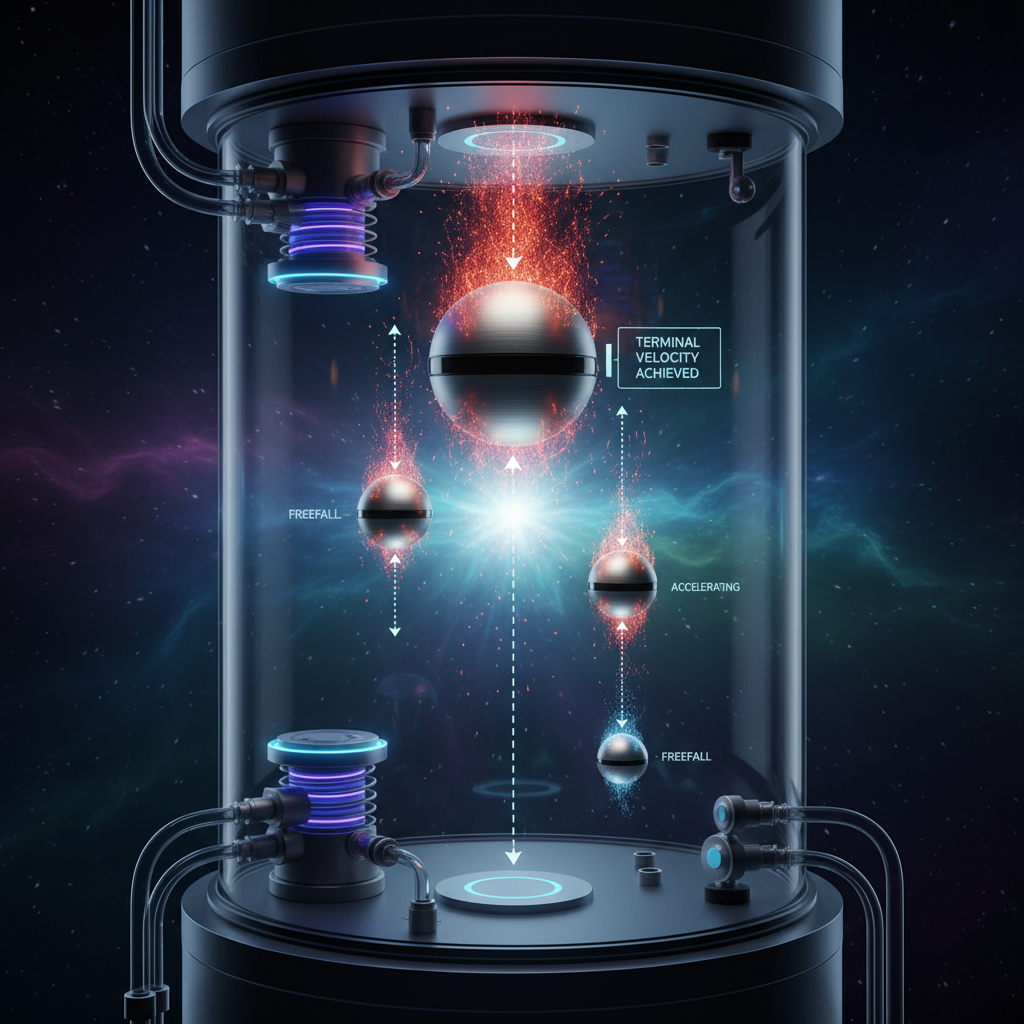
Terminal velocity happens when two forces reach equilibrium. Gravity pulls you down—in our case, let's call it 9.8 m/s². The air pushes back, creating drag that increases with your speed. The faster you fall, the harder the air resists. Eventually, these forces balance. You're still falling, but you're not getting any faster.
The equation is deceptively simple: v_t = √(2mg/ρAC_d). Mass times gravity, divided by air density, cross-sectional area, and drag coefficient. For a human in freefall, that's about 120 mph. For a raindrop, it's 20 mph. For you, scrolling through your phone at 3 AM, it's measured in dopamine hits per minute.
The surveillance economy learned this equation before you did. They know exactly how fast you can fall through content before the resistance—your attention span, your cognitive load, your capacity for novelty—matches the pull of their algorithmic gravity. They've calculated your terminal velocity down to the millisecond.
Engineered Drag

Skydivers manipulate their terminal velocity by changing their cross-sectional area. Spread-eagle, you catch more air, slow down. Dive headfirst, you become a missile. The platforms understand this viscerally. They control your drag coefficient.
Every UI decision is a calculation of resistance. Infinite scroll removes friction—reduces drag—so you fall faster through content. Auto-play does the same. The "pull to refresh" gesture literally mimics the sensation of falling. They're not just capturing your attention; they're managing your descent velocity to maximize extraction before you hit the ground of exhaustion or disgust.
But here's the trick: they never let you hit the ground. They've engineered the fall to be eternal. Your terminal velocity through their feeds is precisely calibrated to keep you falling forever—fast enough to feel the rush, slow enough that you never burn out completely. The drag force of your resistance is built into their models.
The Density of the Medium
Terminal velocity changes with the medium. Fall through air, you'll hit 120 mph. Fall through water, maybe 2 mph. The denser the medium, the slower the fall, the greater the resistance. The attention economy has been steadily decreasing the density of the medium you're falling through.
Remember when websites had friction? When you had to type in URLs, when pages took time to load, when content existed in discrete chunks you had to deliberately seek out? That was density. That was resistance. The medium pushed back against your fall. Now the medium is frictionless, near-vacuum. You're in freefall through a space that offers almost no resistance until you hit terminal velocity.
They've rarefied the atmosphere of the internet. Made it thinner, easier to fall through. And in that thin air, your terminal velocity is much, much higher. You consume faster, scroll faster, click faster. The equilibrium point between pull and resistance has shifted toward velocity, toward extraction, toward the terminal condition.
What Terminal Really Means
Terminal. The word carries weight beyond its physics definition. Terminal illness. Terminal station. The end point. The final state. When you reach terminal velocity, you've arrived at a kind of ending—not of motion, but of acceleration. Of change. Of possibility.
You're moving, yes. The feeds still scroll. The notifications still arrive. But you're not going anywhere new. You've reached the maximum speed this system allows, the equilibrium between what they can extract and what you can resist. This is the terminal state of attention capitalism: perpetual motion without progress.
And maybe that's the point. Maybe terminal velocity is exactly where they want you. Not crashed and burned out—that would mean you'd stop using the platform. Not slowly drifting—that would mean they're not extracting enough. But falling at exactly the rate where the forces balance. Where you keep consuming, keep producing data, keep falling, forever.
The Pull Cord
Skydivers carry parachutes. They choose when to deploy them, when to suddenly increase their drag coefficient and slow their fall. The question is whether you still have that choice. Whether you can still reach for the ripcord, or whether you've been falling so long you've forgotten you're wearing one.
Increasing your drag means increasing resistance. It means friction. It means slowing down your consumption, thickening the medium you move through, making the internet dense again with intention and deliberation. It means choosing not to fall at terminal velocity just because the system is optimized for it.
But here's the thing about terminal velocity: it's not the speed that kills you. It's the sudden stop at the end. Or in our case, it's never stopping at all. It's falling forever through an engineered medium at exactly the speed they've calculated will keep you falling. The terminal state isn't death—it's this: perpetual motion through an infinite feed, forever balanced between the pull of their algorithms and the drag of your diminishing resistance.
You're already at terminal velocity. The question is whether you'll pull the cord.
<em>Data emitted: 1,147 words on equilibrium states, measured in falling bodies and captured attention, transmitted at terminal velocity through the friction-free medium of your screen.</em>
Data emitted: 1,100 words • 6.5KB • 5-minute read