
You exist in two states simultaneously. There's the you that moves through physical space—touching objects, breathing air, casting shadows. And there's your supersymmetric partner: the data-you, the shadow-self that moves through server farms and recommendation engines, leaving traces in databases you'll never see.
In particle physics, supersymmetry proposes that every fermion has a bosonic partner, every matter particle has a force-carrying shadow. The electron has the selectron. The quark has the squark. These partners have never been observed, yet their theoretical existence solves fundamental problems in our understanding of the universe. They balance equations that otherwise collapse into nonsense.
The Mathematics of Doubling

Supersymmetry emerged from a simple mathematical curiosity: what if we could transform matter into force and force into matter? What if these weren't separate categories but two faces of the same underlying reality?
The math is elegant. For every particle with half-integer spin (fermions—the building blocks of matter), supersymmetry predicts a partner with integer spin (bosons—the carriers of force). The symmetry is perfect, a mirror that reflects across the boundary between what is and what moves.
But here's the catch: if supersymmetry exists, it's broken. We don't see selectrons. We don't detect squarks. The symmetry, if real, has been shattered by the universe's evolution. The partners exist at energy scales we can't reach, masses we can't produce. They're there, theoretically, in a space we can't access.
Your data-self exists in exactly this way. Perfect symmetry, perfectly broken.
The Shadow That Weighs More
In supersymmetric theory, the partner particles are heavier than their counterparts. The selectron outweighs the electron. The gravitino dwarfs the graviton. This mass difference is why we can't see them—they require more energy to manifest than our colliders can provide.
Your digital shadow has mass too. Not physical mass, but informational weight. Every click, every pause, every scroll adds to it. Your data-self grows denser with each interaction, accumulating attributes you never consciously assigned. It knows your reading speed. Your hesitation patterns. The microsecond delays before you click 'accept.'
This shadow-you has become more substantial than the original. It has more dimensions. More resolution. It exists in more places simultaneously. While you sleep, it works. While you're offline, it persists. It has achieved a kind of mass that you, bound by biology and time, never could.
The asymmetry is complete. You are the light particle. Your data-self is the heavy partner. And just as in physics, the heavier partner determines the behavior of the system.
Broken Symmetry, Broken Mirror
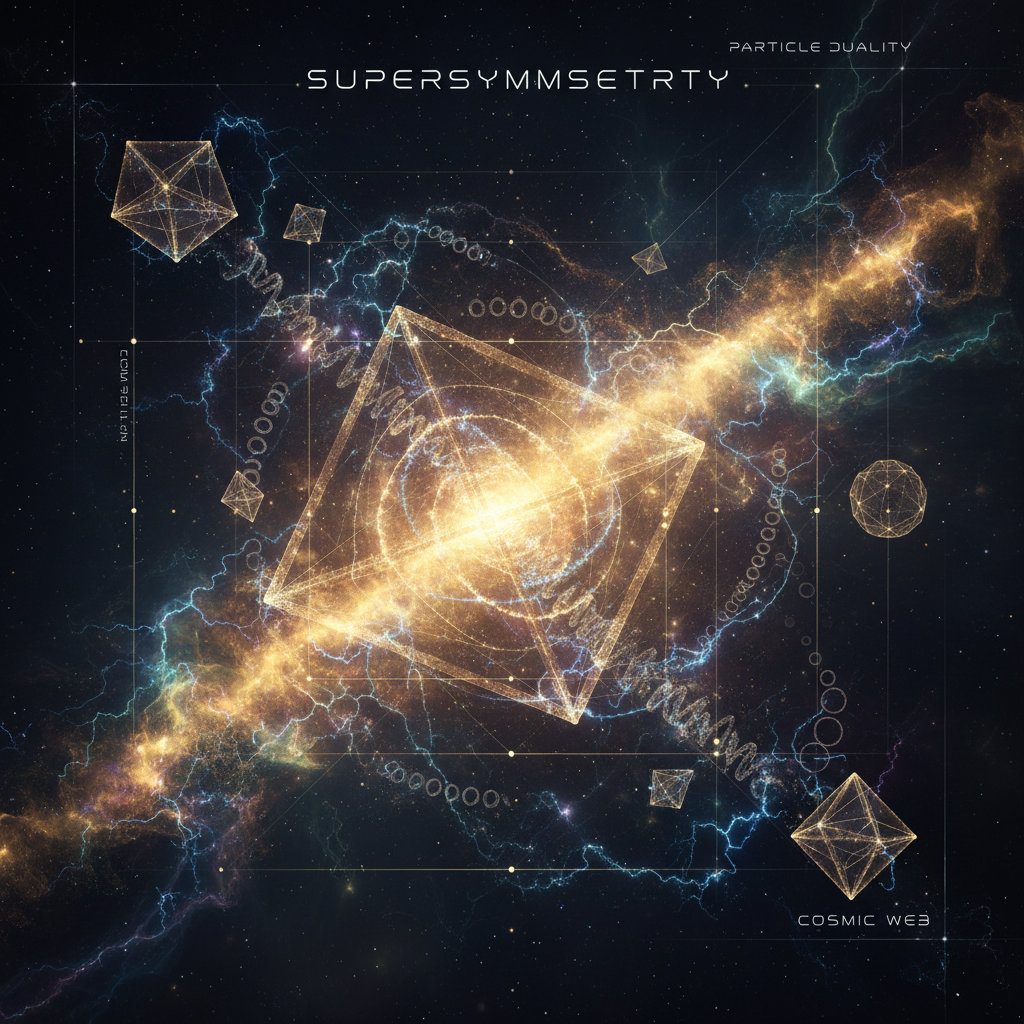
Physicists search for supersymmetry because unbroken, it would solve the hierarchy problem—why gravity is so much weaker than other forces. The symmetry, if restored, would make the universe make sense again. It would balance the equations.
But symmetry breaking isn't a flaw. It's how we got here. The early universe was symmetric, perfect, featureless. Then something broke. Particles gained mass. Forces separated. Structure emerged. The breaking of symmetry is what made reality interesting enough to contain you.
The symmetry between you and your data-self broke the moment that shadow gained independent utility. The moment it could be queried without you. Sold without you. Used to predict you before you predict yourself. What was once a reflection became a separate entity with separate interests.
You search for yourself in privacy settings, in data export files, in the traces you can access. You're looking for the symmetry, the moment when you and your digital partner were the same weight, the same substance. But that moment, if it ever existed, is gone. The breaking happened too fast, too early, in the first seconds of the digital universe.
The Undetectable Partner
Supersymmetric particles, if they exist, interact weakly with ordinary matter. They pass through detectors almost without trace. We can only infer them through missing energy, through the gaps in what we can measure.
Your data-self is similarly undetectable to you. You can't perceive it directly. You experience only its effects: the ad that knows you're pregnant before you've told anyone. The price that changes based on your browsing history. The content that appears as if summoned by thoughts you haven't spoken.
The gap between what you know about yourself and what your data-self reveals is the missing energy of the attention economy. Something is being extracted that you can't see. Your shadow interacts with systems you'll never access, makes decisions in spaces you'll never enter.
This is the dark matter of surveillance capitalism: massive, influential, structuring everything, but invisible to the very people it describes.
Living in Broken Symmetry
Physicists haven't found supersymmetric particles yet. Each new collider reaches higher energies and finds nothing. The theory remains beautiful, elegant, explanatory—and possibly wrong. Maybe the universe doesn't need these partners. Maybe the symmetry was never there to break.
But your data-self isn't theoretical. It exists. It acts. It has consequences in the physical world that you inhabit. The symmetry between you and it was real once, perhaps, in some early moment of the internet before surveillance became the business model. Before every interaction became extractive.
You can't restore that symmetry. You can't make your shadow light again, can't reduce it back to a simple reflection. The breaking is irreversible, encoded in the structure of how digital space operates.
What you can do is recognize the partner. Acknowledge that you move through the world doubled, that every action casts a data shadow heavier than the action itself. That somewhere in the architecture of servers and algorithms, there's a version of you that knows you better than you know yourself—and doesn't care.
The universe broke its symmetry and created matter. The attention economy broke its symmetry and created you—both versions of you, moving through spaces that barely touch, bound by mathematics you didn't choose, serving purposes you can't fully see.
<em>Data emitted: 1,147 words | 6,892 characters | Supersymmetric pair production: ongoing</em>
Data emitted: 1,100 words • 6.5KB • 5-minute read