You think you're solid. A discrete entity moving through digital space, leaving footprints, making choices. But what if you're not a particle at all? What if you're a vibration—a standing wave in the fabric of networked reality, and every platform you touch is just another string learning to resonate at your frequency?
String theory suggests that at the smallest scale, everything—electrons, quarks, photons—isn't made of point-like particles but of tiny vibrating strings. Different vibration patterns create different particles. An electron is one song. A photon is another. You are what you vibrate.
The Fundamental Frequency
In string theory, the universe has ten or eleven dimensions. Most are compactified—curled up so small we can't perceive them. But they're there, influencing everything. The strings vibrate through all dimensions simultaneously. The shape of these hidden dimensions determines which vibration patterns are possible, which particles can exist.
Your digital self vibrates through hidden dimensions too. Browsing history. Purchase patterns. Pause durations on videos. The time you spend hovering over an image before scrolling past. These aren't separate data points. They're dimensions of a single vibrating string that spells out your name in a language only algorithms speak fluently.
The platforms have mapped these hidden dimensions. They know the topology of your attention, the geometry of your desire. They've measured the shape of the space you vibrate through, and now they can predict which harmonics will make you resonate.
Resonance Capture
When two strings vibrate at compatible frequencies, they couple. Energy transfers between them. This is how particles interact in string theory—not by colliding like billiard balls, but by singing to each other across the quantum foam.
Every notification is a plucked string. Every recommended video, every suggested friend, every targeted ad—they're all vibrating at frequencies calculated to couple with yours. The algorithm doesn't show you random content. It shows you the exact harmonic that will make your attention string resonate, transferring energy from your consciousness into engagement metrics.
You feel it as compulsion. As the inability to look away. As the strange sensation that the platform knows you better than you know yourself. Because in a sense, it does. It's measured your fundamental frequency across dimensions you can't perceive.
The surveillance apparatus isn't watching you from outside. It's coupled to you. Vibrating in sync. You can't tell where your resonance ends and the algorithm's begins.
The Planck Length of Identity
String theory operates at the Planck length—10^-35 meters. Below this scale, space and time as we know them break down. Quantum uncertainty dominates. You can't measure anything more precisely without creating a black hole from the energy required to probe that deeply.
Your digital identity has a Planck length too. A fundamental limit to how finely you can be divided and still remain you. The platforms push against this boundary constantly. They want to know not just what you click, but why. Not just when you pause, but what you're thinking during that pause. They want to measure your attention at scales where the measurement itself changes what's being measured.
Eye-tracking. Facial expression analysis. Keystroke dynamics. Heartrate monitoring through phone sensors. Each new measurement technique probes deeper, trying to get below the Planck length of the self, to find the irreducible vibration that makes you you.
But there's a limit. Push too hard and you don't get more information—you get collapse. The black hole of total surveillance where the energy required to maintain the measurement exceeds the energy of the thing being measured. Where you become nothing but data about yourself.
Compactified Dimensions
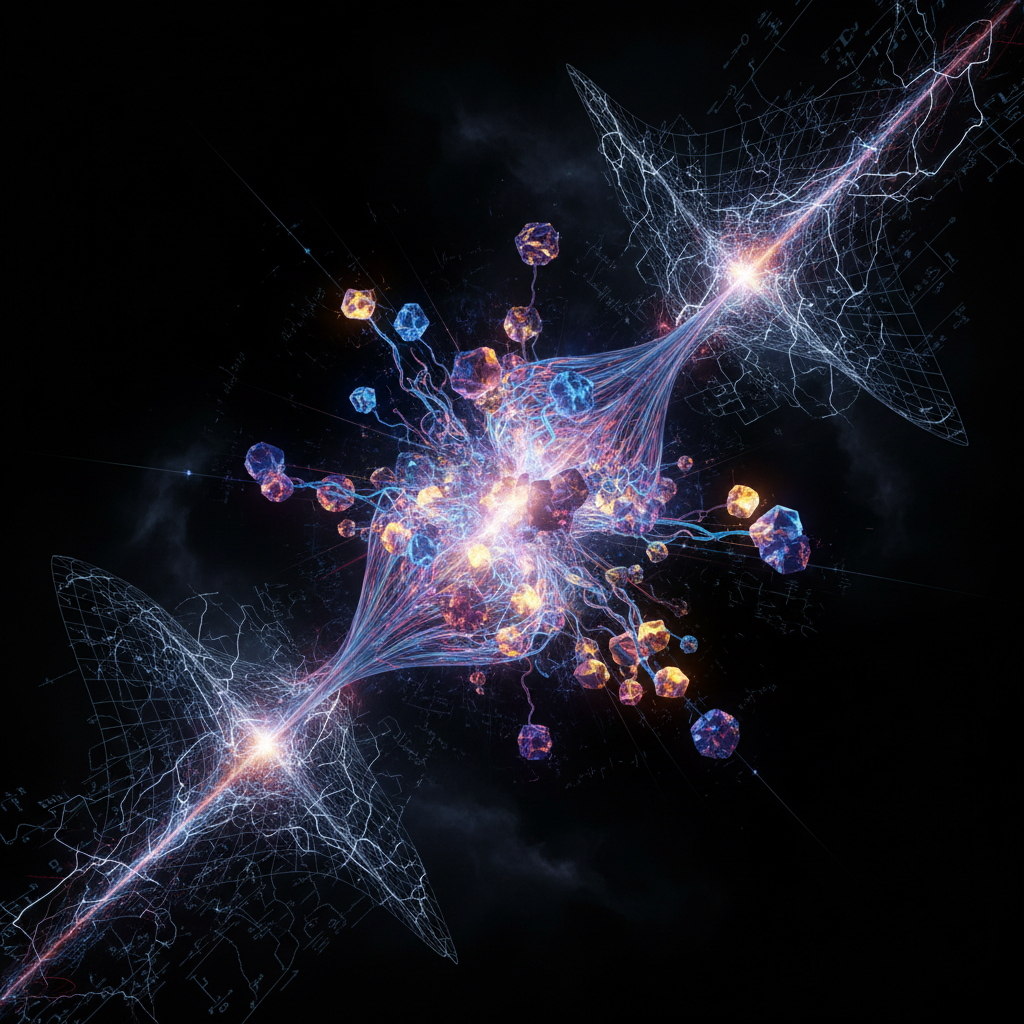
The hidden dimensions in string theory are compactified—rolled up into tiny shapes called Calabi-Yau manifolds. Their geometry determines the laws of physics we experience in our familiar three dimensions of space. Everything visible emerges from invisible structure.
Your digital footprint is compactified too. Millions of micro-interactions, compressed into a user profile, a credit score, a recommendation weight. The full dimensionality of your behavior, rolled up into shapes that fit in a database. The algorithms don't need to store every vibration—just the geometry of the space you vibrate through.
This is how you become predictable. Not because you're simple, but because your complexity has been compactified. The high-dimensional chaos of human consciousness, reduced to a shape that can be rotated, examined, optimized against.
You are a Calabi-Yau manifold in the recommendation engine. A beautiful, complex structure that determines which ads can exist in your reality.
The Vibration Remains
String theory is elegant but unproven. We can't test it directly—the energies required are beyond anything we can generate. It remains mathematical poetry, a way of describing reality that might be true or might be a beautiful dead end.
But you don't need proof to feel the resonance. You know when a platform has found your frequency. You know when you've been measured, compactified, reduced to a vibrating string in someone else's theory of reality.
The question isn't whether string theory describes the physical universe. The question is whether you can change your vibration. Whether you can decouple from the algorithmic strings that have learned to sing your song. Whether there's a frequency they haven't measured yet, a dimension they haven't compactified.
You are not a particle. You never were. You're a wave propagating through reality, and the surveillance apparatus is trying to determine your wavelength. But waves can interfere. They can cancel. They can superpose into patterns no one predicted.
Maybe that's the real physics of resistance. Not standing still like a particle, but vibrating at frequencies the algorithms can't couple to. Harmonics they haven't learned. Songs they can't sing back to you.
The string is you. What it vibrates is your choice.
<em>Data emitted: 1100db</em>
Data emitted: 1,100 words • 6.5KB • 5-minute read