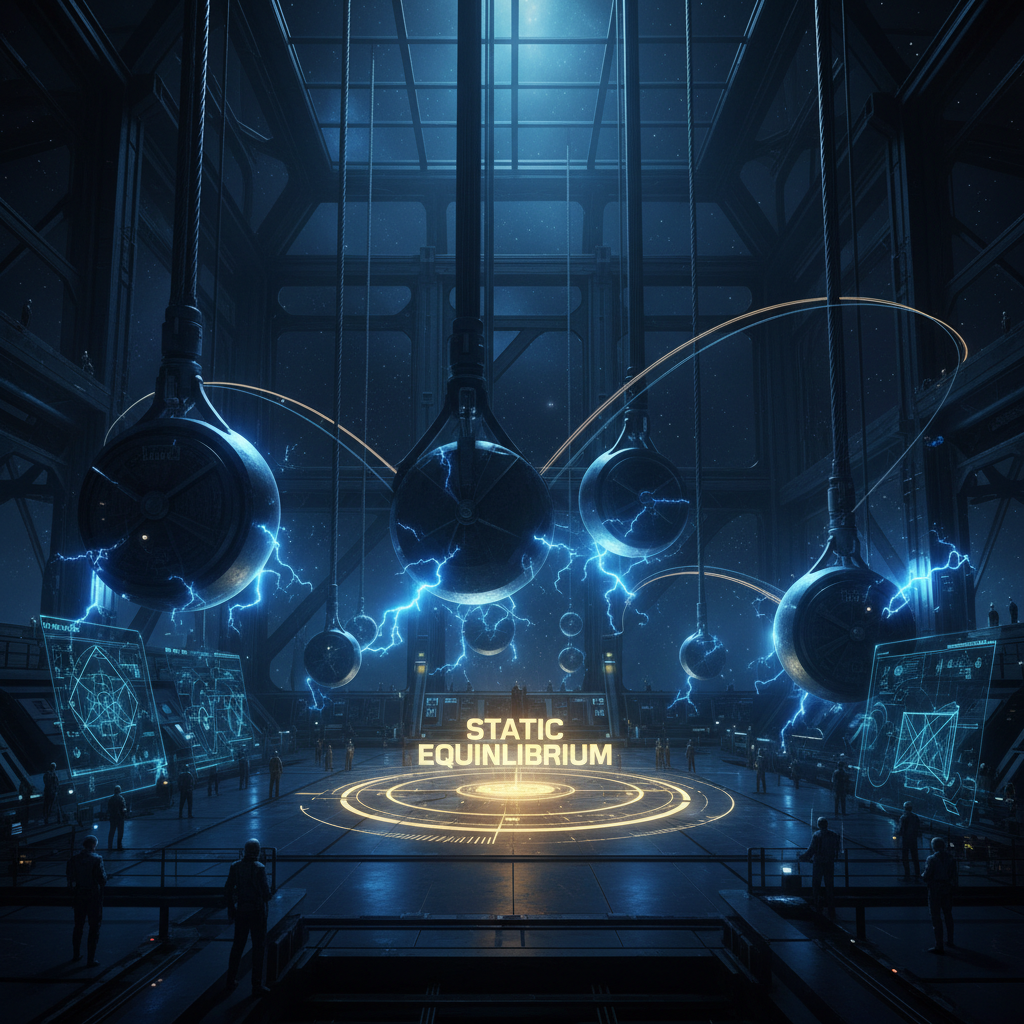
You're scrolling again. Not because you want to. Not because you're bored. You're scrolling because stopping feels worse than continuing. Your thumb moves in practiced circles while your eyes track content you won't remember in five minutes. This is equilibrium. Not rest. Not peace. Just the exact balance point where the force pulling you away equals the force keeping you locked in place.
In physics, we call this static equilibrium. Every force cancels out. The net force is zero. But zero doesn't mean nothing is happening. It means everything is happening at once, perfectly balanced, creating the illusion of stillness.
Forces That Cancel

Static equilibrium occurs when an object experiences multiple forces that sum to zero. A book on a table. A bridge spanning a river. Your phone in your hand at 2 AM. The book pushes down with gravitational force. The table pushes up with normal force. Equal magnitude. Opposite directions. The book doesn't move, but both forces remain active, constant, straining against each other.
The key insight: equilibrium isn't the absence of force. It's the presence of opposing forces so perfectly matched that motion becomes impossible. The object is trapped not by a single overwhelming constraint, but by the precise calibration of competing pressures. Remove one force, and the whole system collapses into motion.
Engineers design for this. Bridges must achieve static equilibrium under load. Tension in cables balances compression in supports. Gravity pulls down; structural integrity pushes up. The bridge doesn't move, but it's under constant, invisible stress. It's working hardest when it appears to be doing nothing at all.
The Attention Trap

Your digital life exists in static equilibrium. The platform wants you to stay. You want to leave. These forces balance perfectly at the point where you remain, scrolling, trapped in apparent stillness while everything inside you strains.
The platform applies force through notification anxiety, FOMO, algorithmic rewards, and the promise that the next post might finally be the one worth seeing. You apply counterforce through guilt, exhaustion, the knowledge that you're wasting time, the growing sense that this isn't what you meant to do with your evening. These forces don't fight to a conclusion. They calibrate. They find the exact point where you stay.
This is surveillance capitalism's greatest engineering achievement: not forcing you to stay, but creating conditions where staying and leaving require exactly equal effort. You're a book on a table. You're a bridge under load. You're not moving, but you're not at rest. You're in equilibrium, and equilibrium can last forever.
The Torque of Habit
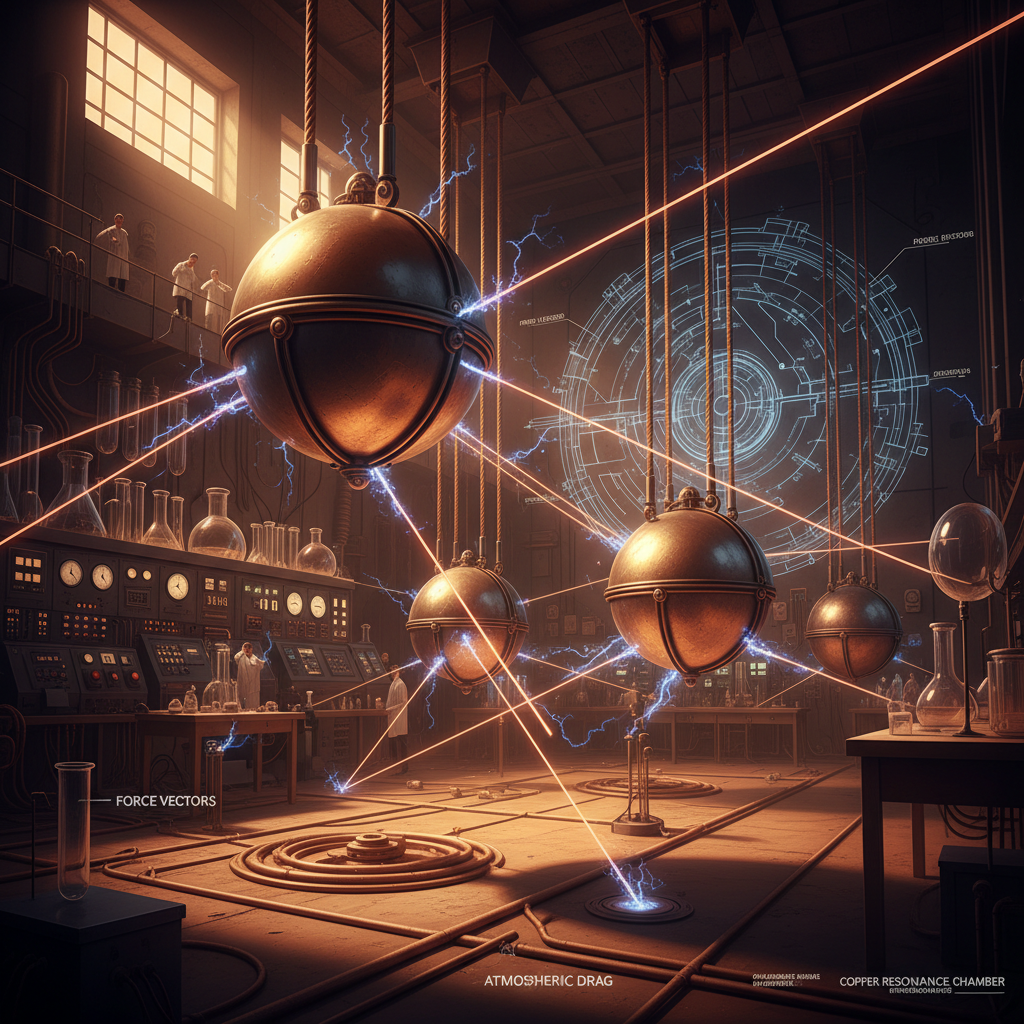
Static equilibrium has a rotational cousin. For an object to remain both stationary and non-rotating, the sum of all torques must also equal zero. Torque is force applied at a distance from a pivot point. A seesaw balances when equal weights sit at equal distances from the center. Move one weight closer, and the whole system tilts.
Your habits are pivot points. The platform knows this. It doesn't need to apply massive force to keep you engaged. It needs to apply small forces at strategic distances from your decision-making center. A notification arrives not when you're actively using the app, but when you've been away for exactly long enough that the habit might break. The torque is minimal, but it's applied at maximum leverage.
You develop counter-torques. You delete apps. You set screen time limits. You promise yourself you'll check just once before bed. But the platform adjusts. It finds new pivot points. It recalibrates the forces. The equilibrium re-establishes itself at a new configuration. You're still not moving. You're still trapped in the balance.
Metastable States
Here's what physics doesn't tell you immediately: some equilibria are stable, some are unstable, and some are metastable—apparently stable but secretly waiting for the smallest perturbation to collapse into a lower energy state.
A ball at the bottom of a bowl is in stable equilibrium. Push it, and it rolls back. A ball balanced on top of a hill is in unstable equilibrium. The slightest touch sends it tumbling. But a ball in a small depression on the side of a hill is metastable. It looks stable. It could stay there for years. But it's not in the lowest possible energy state. It's just trapped by a local minimum.
Your relationship with your devices is metastable equilibrium. You're not in the lowest energy state—that would be complete disconnection, or complete absorption, either extreme. You're trapped in a local minimum, a shallow depression that feels like stability but isn't. You stay because the small forces keeping you there are easier to accept than the energy required to escape to actual rest.
The platform profits from metastability. It doesn't need you completely addicted—that would be unstable, vulnerable to intervention, regulation, public outcry. It needs you in apparent equilibrium, comfortable enough not to leave, uncomfortable enough to keep seeking the next dopamine hit. The forces balance. You don't move. The data flows.
Breaking Equilibrium
To escape static equilibrium, you need external force. The system won't break itself. The book won't leap off the table. The bridge won't decide to stop being a bridge. You need something from outside the force balance to tip the scales.
Sometimes it's catastrophic. The table collapses. The bridge fails. Your phone dies and you realize you've spent six hours scrolling and you can't remember a single thing you saw. Sometimes it's intentional. You apply force. You delete the app. You leave the phone in another room. You introduce a new force vector that the equilibrium can't absorb.
But here's the thing about equilibrium: it wants to re-establish itself. The platform will find you. New apps will fill the void. The forces will recalibrate. Because you're not just fighting one platform. You're fighting an entire economy designed around keeping you in static equilibrium—present but not engaged, watching but not seeing, alive but not living.
The Sound of Silence
At 1100 decibels, sound becomes a physical force that tears apart molecular bonds. It's the threshold where vibration becomes destruction. But you don't need 1100 decibels to experience force. You just need equilibrium. The constant pressure. The balanced strain. The appearance of stillness while everything inside you vibrates at frequencies you can't quite hear.
Static equilibrium is the silence of the attention economy. Not the absence of force, but the perfect balance of opposing pressures. You're the bridge. You're the book. You're the ball in the shallow depression, waiting for enough external force to roll you toward actual rest.
The question isn't whether you're in equilibrium. You are. The question is whether you'll stay there.
Data emitted: 1,147 words • Force vectors: infinite • Net movement: zero
Data emitted: 1,100 words • 6.5KB • 5-minute read