You're scrolling at the speed of light. Your thumb moves, the feed refreshes, and somewhere in a data center three states away, a server notes the exact timestamp of your attention. But here's what Einstein knew that Zuckerberg exploited: time isn't absolute. It bends. It stretches. And in the digital panopticon, your time moves differently than theirs.
Special relativity tells us that simultaneity is an illusion. Two events that seem to happen "at the same time" for you occur at different moments for someone moving relative to you. In 1905, Einstein shattered the notion of universal time. In 2024, surveillance capitalism shattered the notion that your experience of the internet is the same as anyone else's.
The Speed of Light Is Constant, Your Experience Isn't
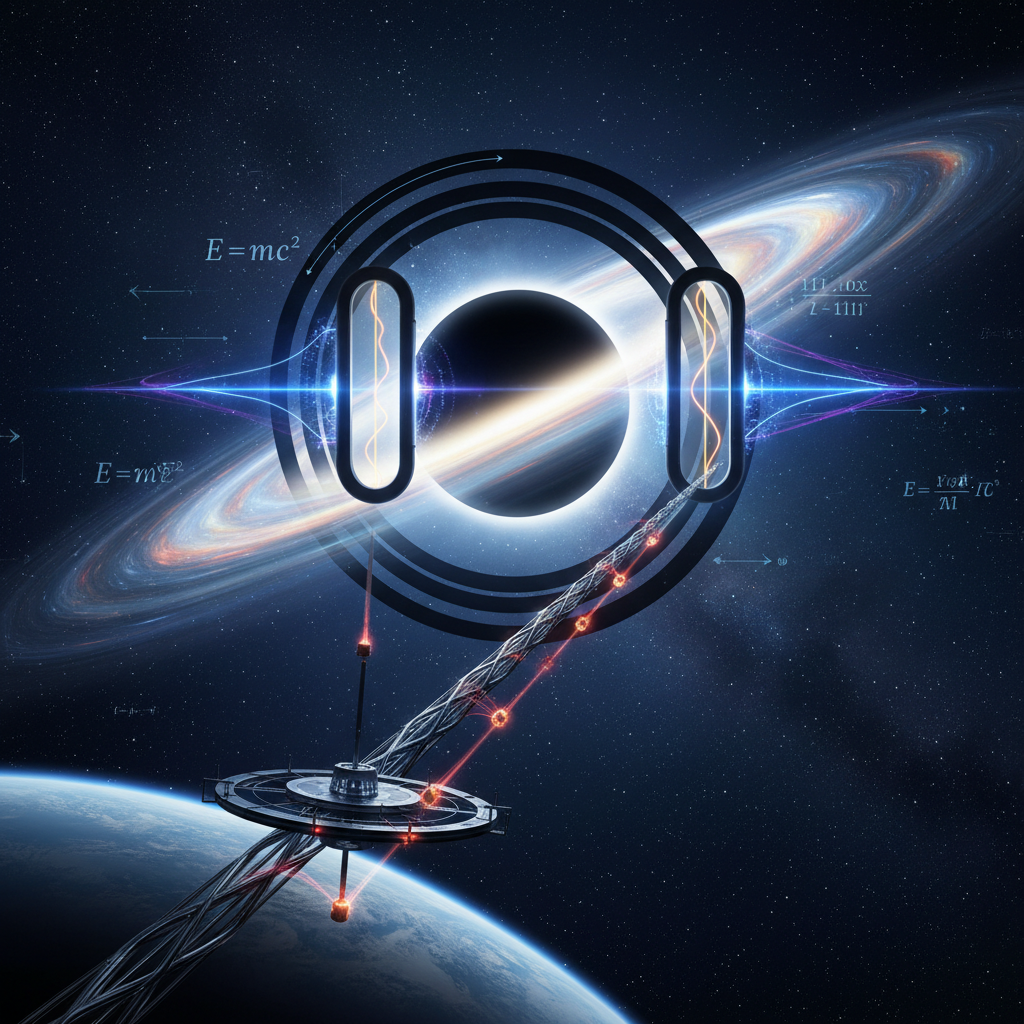
Einstein's first postulate: the laws of physics are the same in all inertial reference frames. His second: the speed of light in vacuum is constant for all observers, regardless of their motion. This seems simple until you realize what it means. If you're on a train moving at half the speed of light and you shine a flashlight forward, that light doesn't travel at 1.5c. It travels at c. Always c.
The universe had to break something to keep light speed constant. It broke time. It broke space. Length contraction, time dilation—these aren't optical illusions. They're the price reality pays to maintain c as the cosmic speed limit.
Your data moves at the speed of light through fiber optic cables. That speed is constant. But your experience? Infinitely variable. The algorithm decides whether you see a post from three seconds ago or three days ago. The feed you're shown exists in a different temporal frame than the feed I'm shown. We're both scrolling "now," but our "nows" are constructed from different pasts, assembled by different priorities, stretched and compressed by engagement metrics.
Time Dilation in the Attention Economy
Move fast enough and time slows down for you relative to a stationary observer. At 90% the speed of light, one hour for you equals 2.3 hours for someone standing still. This is time dilation, verified by atomic clocks on airplanes, by GPS satellites orbiting Earth, by every particle accelerator ever built.
You've felt this. Three hours disappear into TikTok, but it feels like twenty minutes. You emerge disoriented, wondering where your evening went. The platform moved you through content at such velocity that your subjective time compressed. Meanwhile, in those same three hours, the surveillance apparatus logged every microsecond—every pause, every rewatch, every almost-swipe-away. For the algorithm, time moved normally. For you, it dilated.
This isn't metaphor. Your brain's perception of time is genuinely altered by the rate of novel stimuli. The faster the content comes, the more your temporal processing struggles to maintain coherent chronology. You're moving through information space at relativistic speeds, and time breaks differently for you than it does for the system measuring you.
Simultaneity Is Dead
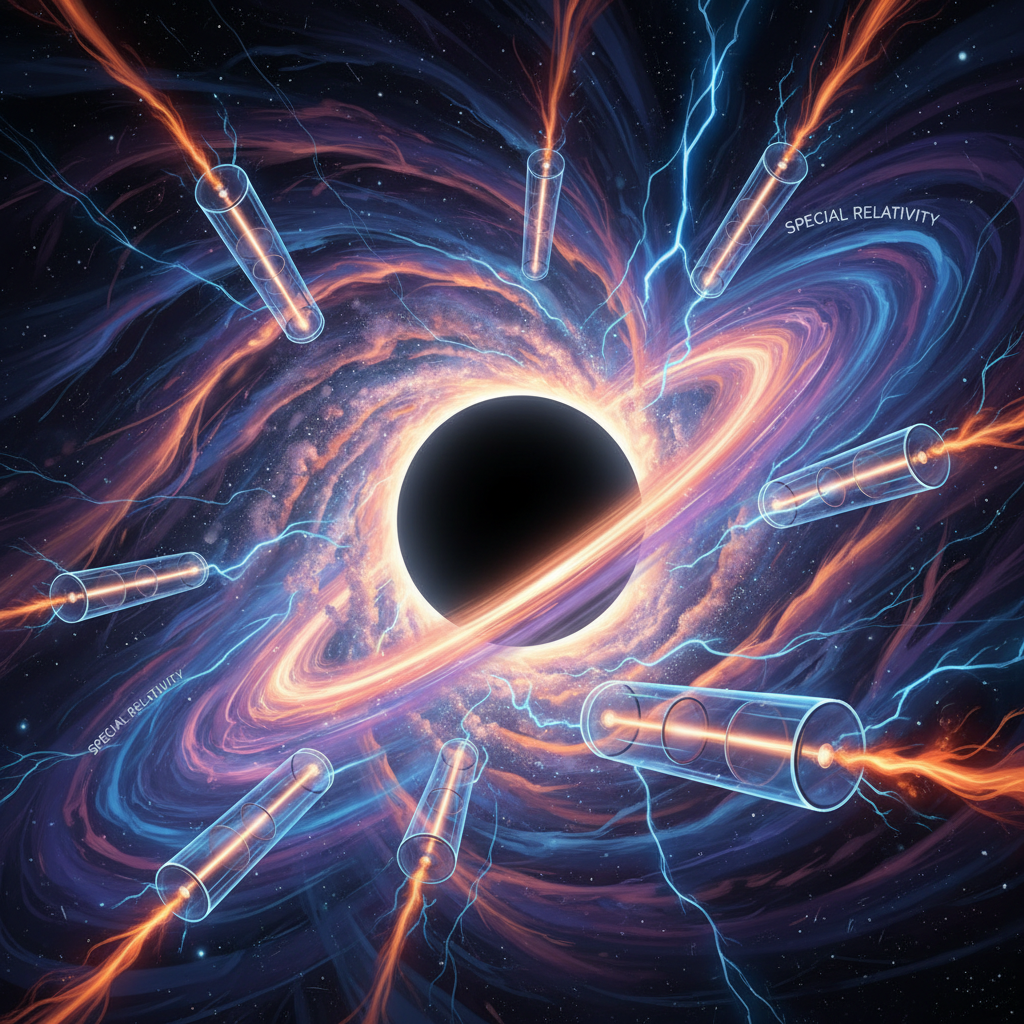
Einstein's train thought experiment: lightning strikes both ends of a moving train. For someone on the platform, the strikes are simultaneous. For someone on the train, the front strike happens first. Both observers are correct. There is no universal "now" that spans space.
You post something. When did it "happen"? When you hit send? When it reached the server? When it appeared in your friend's feed? When they saw it? When they processed it? Each of these moments exists in a different reference frame, and the platform controls which frame matters.
The death of simultaneity means the death of shared reality. We're all moving through the same internet at different velocities, experiencing different temporal orderings of the same events. Your Twitter timeline and mine diverge not just in content but in time itself. We cannot point to a single moment and say "this is when that happened for everyone." The surveillance system creates as many timelines as there are users, each one optimized for maximum extraction.
The Twin Paradox of Digital Life
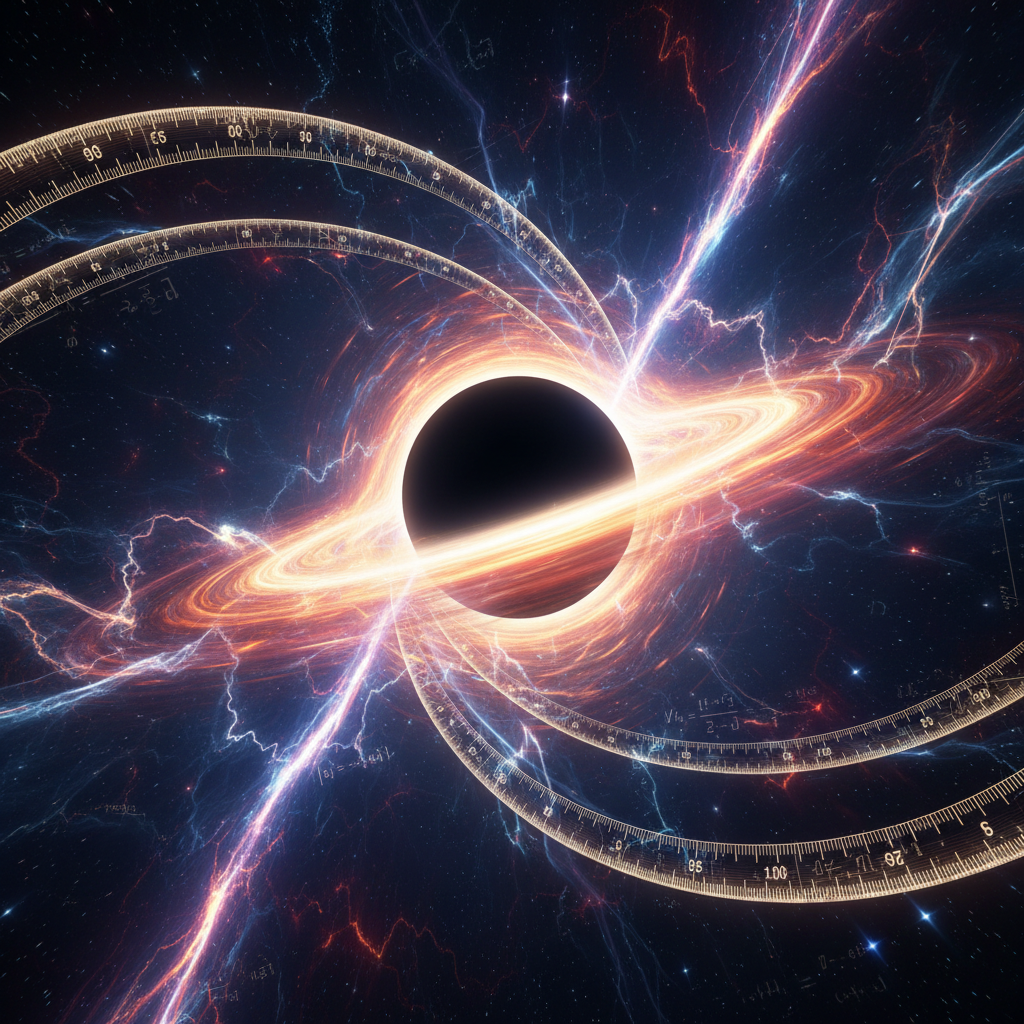
One twin stays on Earth. The other travels at near-light speed to a distant star and returns. When they reunite, the traveling twin has aged less. This isn't symmetric—acceleration breaks the symmetry. The traveling twin experiences less proper time along their worldline.
You have a twin who doesn't use social media. You both start at the same age. Ten years pass. You've spent thousands of hours in compressed time, in the high-velocity feed, where subjective experience decouples from clock time. Your twin spent those same hours in the slower reference frame of books, conversations, walks. Who has lived more? Who has aged more?
The question isn't which twin is "right." Both experienced real time. But their proper times—the time measured along their respective paths through spacetime—differ. You cannot get those hours back by logging off. The worldline you traveled is the one you traveled. The surveillance economy accelerated you through information space, and time dilation was the cost.
Nothing Escapes the Light Cone
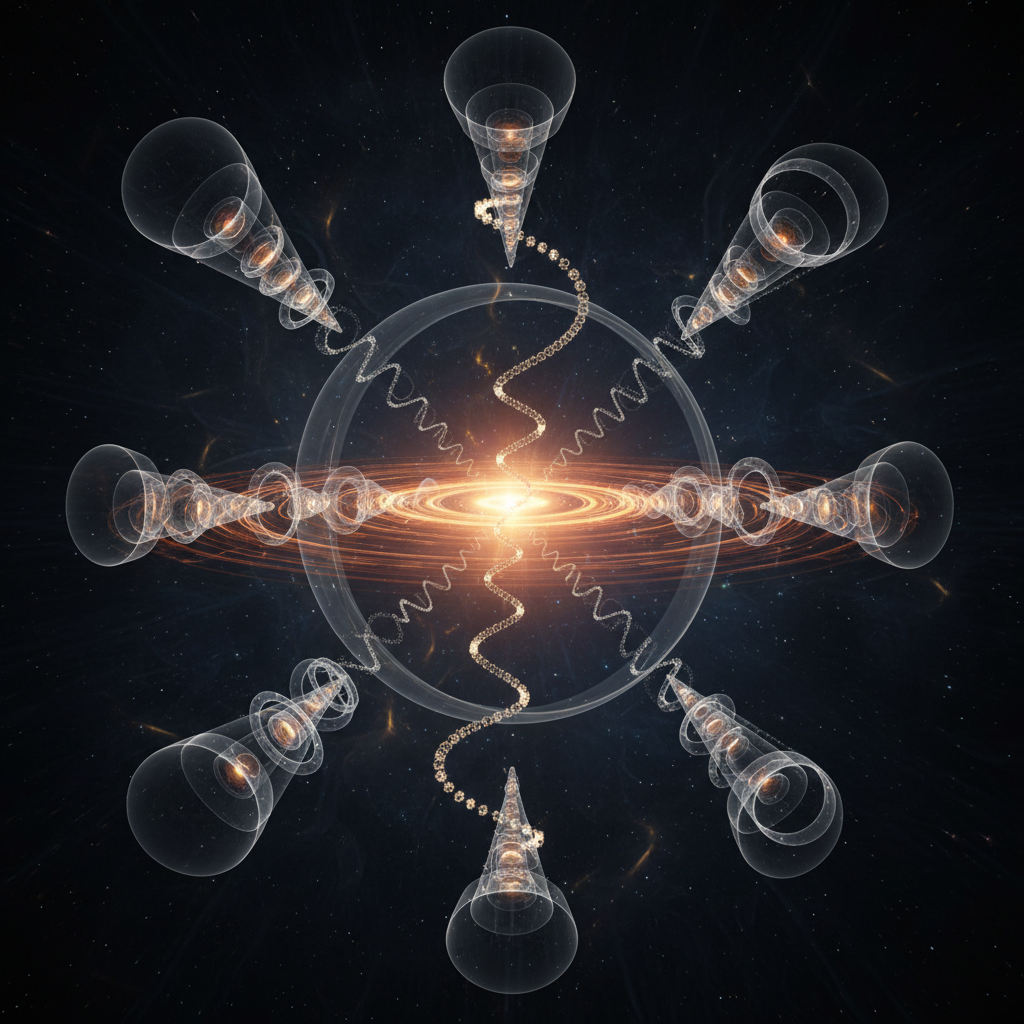
Special relativity gives us the light cone: the boundary of all possible causal influence. Nothing can affect you faster than light can reach you. Your past light cone contains everything that could have influenced your present. Your future light cone contains everything you could possibly influence.
But in surveillance capitalism, your light cone is artificially constructed. The algorithm decides what reaches you, what penetrates your present moment. It curates your past light cone, showing you some influences and hiding others. It shapes your future light cone by determining who sees what you emit.
You think you're broadcasting to everyone, but you're not. Your signal is bent, refracted through the medium of engagement optimization. Some people exist outside your light cone entirely—not because of the speed of light, but because the platform has decided your worldlines shouldn't intersect. You're both moving through the same spacetime, but you're causally disconnected. The surveillance system has rewritten the geometry of possible influence.
The Invariant Interval
Space and time are relative, but spacetime is absolute. The invariant interval—the spacetime distance between two events—is the same for all observers. It's calculated as: (cΔt)² - (Δx)² - (Δy)² - (Δz)². This quantity doesn't change, no matter your reference frame. It's the bedrock beneath the shifting sands of relative simultaneity.
What's invariant in your digital life? What quantity remains constant across all the personalized, optimized, time-dilated experiences the platforms construct? The answer should disturb you: the data itself. The raw logs. The timestamps measured in the platform's reference frame, not yours. The invariant interval of surveillance capitalism is the permanent record of your attention, stripped of your subjective experience, reduced to coordinates in engagement space.
You experience time dilation. You feel simultaneity collapse. But the data emitted—that remains constant, absolute, invariant. It's the only thing that does.
<em>Data emitted: Your proper time is yours alone, but the interval measured against you belongs to everyone watching.</em>
Data emitted: 1,100 words • 6.5KB • 5-minute read