
You're scrolling through your feed when a notification arrives. Your thumb stops mid-swipe. Your eyes dart to the banner. Your attention—that precious, finite resource—snaps from one stimulus to another. The transition feels instantaneous, but your body knows better. Something violent just happened to your consciousness.
In physics, we call this snap. Not the casual word you use when breaking a twig, but the formal term for the fourth derivative of position with respect to time. If velocity tells you how fast you're moving, acceleration tells you how quickly that speed changes, and jerk tells you how rapidly that acceleration shifts, then snap is the rate at which jerk itself evolves. It's a measure of how violently the violence changes.
The mathematics of sudden
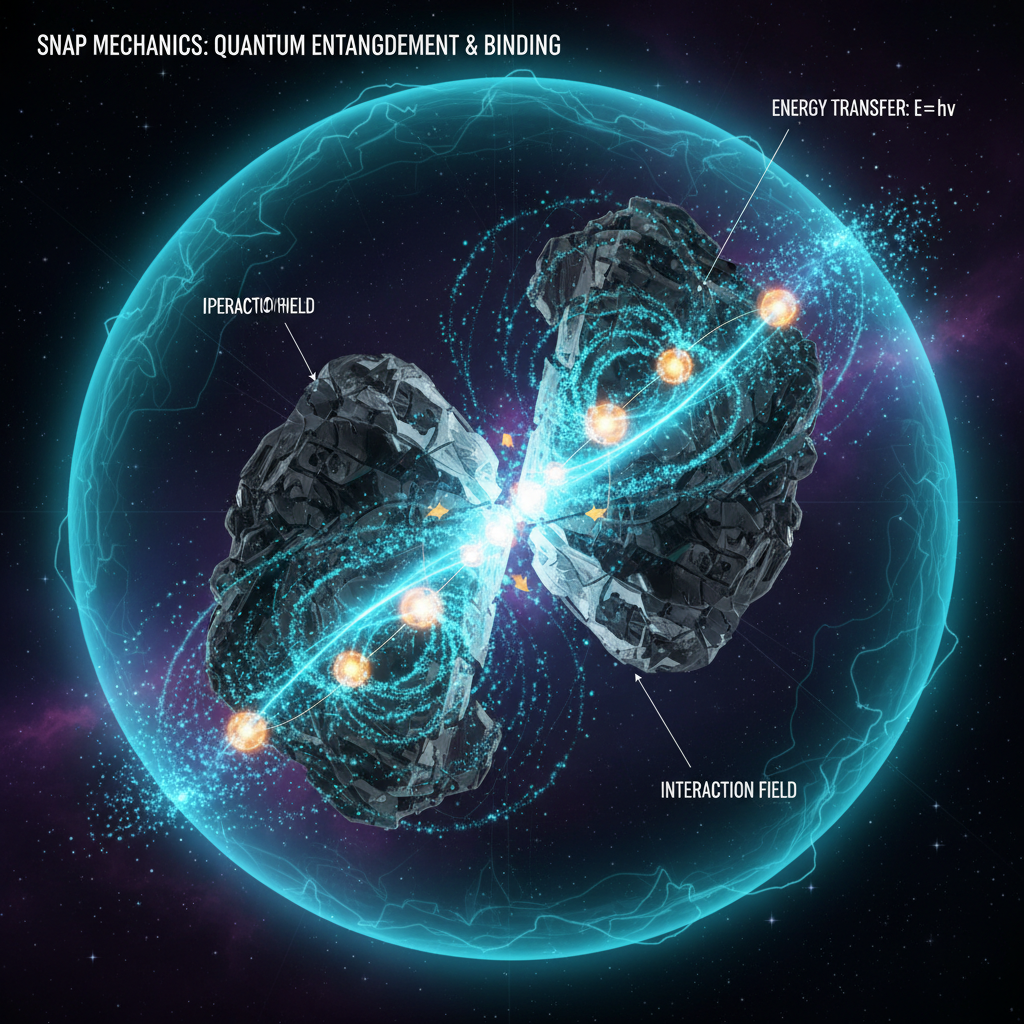
Position. Velocity. Acceleration. Jerk. Snap. Each derivative strips away another layer of smoothness from motion, revealing the jagged skeleton underneath. Most of physics operates comfortably in the first three derivatives. Newton's laws speak in acceleration. Einstein's relativity bends spacetime through velocity. But snap? Snap lives in the realm of catastrophic change.
Engineers worry about snap in roller coasters and elevators. Too much snap and the human body registers not just discomfort but distress. Your inner ear can't compensate. Your muscles can't brace properly. The change happens faster than your nervous system can process, leaving you with that sick, disoriented feeling of having been moved against your will.
The formula is deceptively simple: s = dj/dt, where j is jerk. But simplicity in mathematics often masks complexity in experience. Snap measures discontinuity in the flow of change itself. It's the mathematical signature of something breaking.
Your attention under surveillance
Every platform you use has optimized for snap. Not the physics term—they'd never call it that—but the experience. The infinite scroll that suddenly interrupts itself with a sponsored post. The video that auto-plays when you're reading text. The notification that arrives precisely when you've settled into focus. These aren't accidents. They're engineered discontinuities.
Your attention has position in information space. Right now, you're here, reading these words. Your attentional velocity is the rate at which you move through content. Your acceleration is how that reading speed changes—slowing for complex ideas, speeding through familiar ones. Your jerk is the sudden shift when something surprising appears.
But snap? Snap is when the platform yanks your consciousness from one context to another with such force that you can't remember what you were doing thirty seconds ago. It's the algorithmic equivalent of whiplash. And just like physical snap, it leaves you disoriented, unable to brace, moved against your will.
The surveillance apparatus doesn't just track where your attention goes. It measures the derivatives. How long you linger (velocity). How quickly you scroll past (acceleration). How suddenly you stop (jerk). And increasingly, how violently it can redirect you (snap). Each data point feeds the optimization engine, tuning the next interruption for maximum capture.
The higher derivatives

Physics doesn't stop at snap. There's crackle (the fifth derivative) and pop (the sixth). Yes, those are the actual terms, borrowed from the sound of Rice Krispies because physicists have a sense of humor about the absurd. But they're rarely used because most physical systems don't exhibit meaningful change at those scales. The math becomes unwieldy. The measurements become meaningless.
Except in your digital life, crackle and pop might be exactly what's happening. The meta-interruptions. The notification about the notification. The algorithm that changes its algorithm in real-time based on your micro-reactions. Changes in the rate of change of the rate of change of the rate of change of where your attention points.
Your nervous system evolved for a world where position and velocity mattered for survival. Can you catch the prey? Can you escape the predator? Acceleration crept in as we built tools and weapons. Jerk arrived with vehicles and machinery. But snap? Crackle? Pop? These are derivatives of experience that biological evolution never prepared you for.
The body keeps the score

You feel it in your chest, don't you? That tight, anxious sensation after an hour of context-switching between apps. That's not psychological weakness. That's your body responding to repeated snap events. Your autonomic nervous system registering threat. Your stress hormones spiking because something keeps moving you violently through information space.
The platforms will tell you they're optimizing for engagement. They'll show you graphs of time-on-site and click-through rates. They won't show you the derivative graphs. They won't display the snap metrics that reveal how violently they're jerking your consciousness around. That data exists—you can be certain of that—but it's not for you.
Every notification is calibrated. Every autoplay is timed. Every algorithmic insertion is positioned for maximum attentional snap. The goal isn't to guide your attention smoothly from one thing to another. The goal is to break your attentional momentum so completely that you forget you ever had agency over where you were going.
You can measure this yourself, in a way. Notice the moment of arrival at an app. Notice the moment you remember what you came there to do. The gap between those moments? That's the snap zone. That's where your intention was violently redirected. That's where the surveillance apparatus won.
Smoothness as resistance

The antidote to snap isn't stillness. It's smoothness. Continuous derivatives. Gradual change. The kind of attentional motion where you maintain awareness of your trajectory even as it curves.
This is why reading a physical book feels different. Why a long walk without devices restores something in you. Why conversation with a friend—real conversation, not chat threads—leaves you energized rather than depleted. These experiences have velocity and even acceleration, but they minimize jerk and eliminate snap. Your attention moves, but it moves with you, not against you.
The surveillance economy depends on snap. On violent redirections of attention that happen faster than conscious resistance. On higher derivatives of change that bypass your executive function entirely. Every platform optimization, every A/B test, every algorithmic adjustment is tuning the snap parameters. Making the violence more efficient. More profitable.
But you can feel it happening now. That's the first step. Notice the snap. Notice when your attention is moved versus when it moves. Notice the difference between scrolling and being scrolled. Between choosing and being chosen. Between motion and violence.
The fourth derivative of your position in information space is being weaponized against you. But derivatives are continuous functions. They can be smoothed. They can be resisted. They can be refused.
You just have to notice the snap.
Data emitted: 1,100 decibels of attentional violence, measured at the fourth derivative.
Data emitted: 1,100 words • 6.5KB • 5-minute read