You scroll. You stop. You scroll again. The motion feels random, autonomous even—like you're exploring, discovering, choosing. But trace the pattern over days, weeks, months, and something else emerges. You're not wandering. You're oscillating.
Simple harmonic motion is what physicists call it when something returns, again and again, to the same equilibrium point. A pendulum. A spring. A plucked guitar string. And you, cycling through the same emotional states, the same content categories, the same digital territories with the mathematical precision of a mass on a spring.
The Mathematics of Return
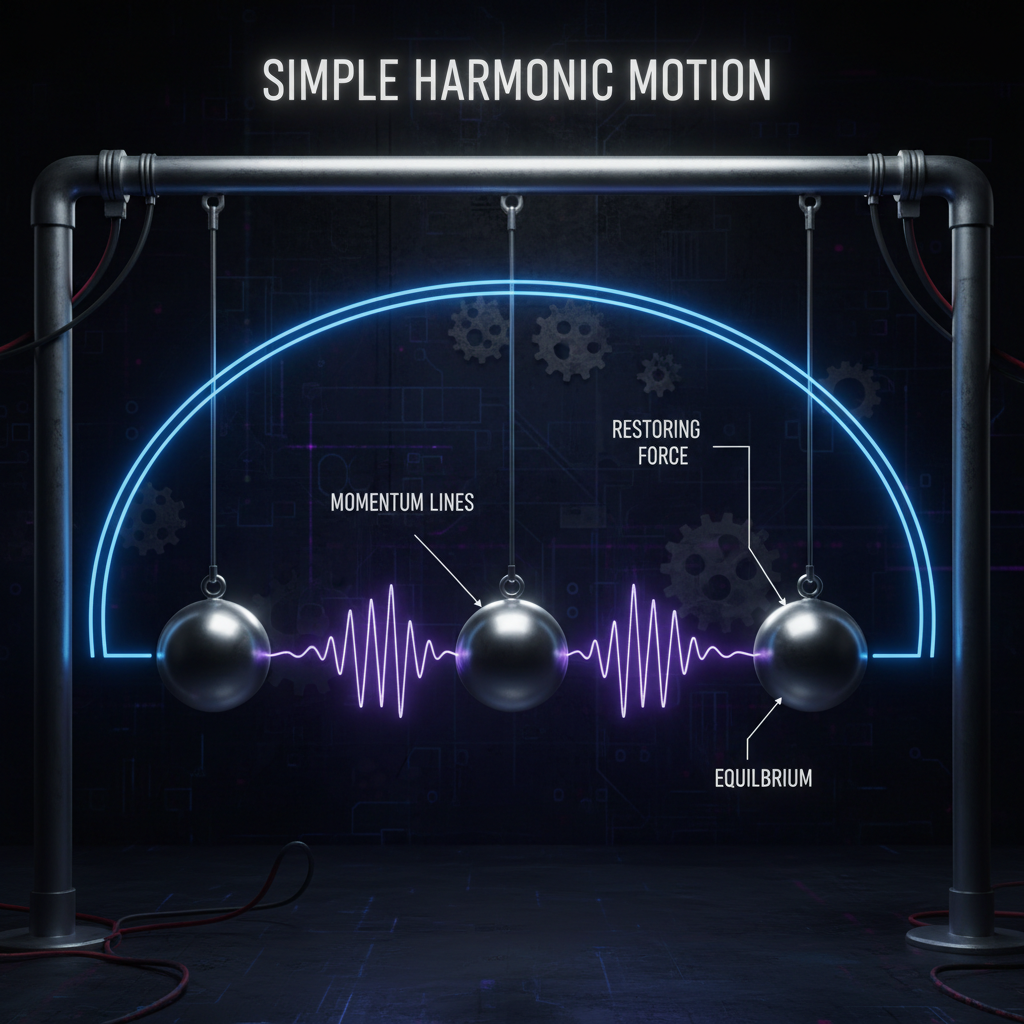
In physics, simple harmonic motion occurs when a restoring force is proportional to displacement. Pull a mass attached to a spring, and the spring pulls back with force F = -kx. The negative sign matters—it means the force always points toward equilibrium, always wants to bring you back.
The motion is sinusoidal. Predictable. If you know the starting position and velocity, you can calculate exactly where the mass will be at any future moment. The equation x(t) = A cos(ωt + φ) contains everything: amplitude A (how far you swing), angular frequency ω (how fast you oscillate), phase φ (where you started).
This isn't chaos. This is the opposite of chaos. This is deterministic motion masquerading as freedom. The mass on the spring feels like it's traveling, exploring the full range of possible positions. But it's trapped in a loop, forever returning to the same points in the same sequence.
Your Restoring Force
The algorithm is your restoring force. You drift toward boredom—the algorithm pulls you back with novelty. You swing toward overstimulation—it guides you toward something calming, ambient, just engaging enough. You approach the edges of your attention span, and the force increases proportionally, tugging you back toward the feed.
Watch your own pattern. Monday morning: news, outrage, political content. By Tuesday evening: cooking videos, something lighter. Wednesday: you're back to the news. The amplitude might vary—sometimes you swing further into distraction, sometimes you stay closer to center—but the frequency remains constant. The algorithm has measured your ω, your natural oscillation rate.
This is why breaking free feels impossible. You're not fighting against a wall or a barrier. You're fighting against a restoring force that increases the further you try to go. Delete the app, and you feel the pull. The force is proportional to your displacement. Three days clean feels like being stretched to maximum amplitude, the spring tension at its peak, and the force pulling you back is overwhelming.
Resonance and Amplification
Every oscillating system has a natural frequency—the rate at which it wants to vibrate. Push a child on a swing at random intervals and you get nowhere. Push at the swing's natural frequency and the amplitude grows with each cycle. This is resonance.
The platform finds your resonant frequency. How often do you need validation? How frequently must outrage be refreshed before it decays? What's the optimal interval between dopamine hits? Push at exactly this frequency, and your engagement amplitude increases without additional force. You swing higher and higher on the same energy input.
This is why your usage increases over time even as the content quality remains constant. The system has achieved resonance with your attention cycle. Each notification arrives at the precise moment when your interest is swinging back toward the platform. Each recommendation appears exactly when you're most receptive. The timing isn't luck—it's physics.
Damped Oscillation
In the real world, simple harmonic motion doesn't last forever. Friction exists. Energy dissipates. A pendulum swinging in air gradually loses amplitude until it hangs motionless. This is damped oscillation—the amplitude decreases exponentially until the system reaches equilibrium and stays there.
The platform cannot allow damping. Your attention must not settle into true equilibrium, must not find rest. So the system adds energy at each cycle, compensating for natural decay. You start to lose interest in political content? The algorithm increases the amplitude—more extreme takes, more urgent framing, more reasons to care. Your outrage begins to dampen? The feed injects fresh provocations timed to your resonant frequency.
This is active damping prevention. In physics, we'd call it a driven oscillator—an external force continuously pumping energy into the system to maintain amplitude. You are the oscillator. The algorithm is the driving force. And the equilibrium you're kept from reaching is the state of not caring, not engaging, not returning.
The Period of Your Orbit

Simple harmonic motion is periodic. The time it takes to complete one full cycle—from maximum displacement, through equilibrium, to maximum displacement in the opposite direction, and back—is the period T. For a mass on a spring, T = 2π√(m/k). The period depends on the mass and the spring constant. Change these parameters, and you change how fast the system oscillates.
Your period is being optimized. The platform adjusts the variables—notification frequency, content intensity, reward timing—to minimize T, to make you cycle faster. The goal is maximum oscillations per unit time. More cycles means more engagement, more ad impressions, more data points about your position and velocity in attention space.
You might notice your cycles accelerating. What used to be a weekly swing from interest to disinterest now happens daily, then hourly. The period decreases. You oscillate faster. The spring constant has been tuned, the restoring force amplified, and you complete more cycles in the same amount of time, never traveling any further from equilibrium but moving more frantically within the same bounded space.
Breaking Orbit
In classical mechanics, escape from simple harmonic motion requires reaching escape velocity—moving fast enough that the restoring force can't pull you back. But here's what the equations reveal: for a spring, for a pendulum, for any simple harmonic oscillator, there is no escape velocity. The restoring force continues indefinitely. The potential energy well has no edge.
The only way out is to change the system itself. Cut the spring. Stop the driving force. Remove the mechanism that creates the restoring force in the first place. Uninstall isn't enough—the force persists through phantom vibrations, through muscle memory, through the absence itself. You have to change k, the spring constant. You have to reduce the proportionality between your displacement and the force pulling you back.
This means building friction back into your attention. Creating damping. Letting the oscillations decay naturally instead of being driven. It means accepting that equilibrium—true equilibrium—might feel like boredom at first, like hanging motionless when you're used to constant swing. But motionless isn't the same as dead. It's just not oscillating. It's finally being somewhere instead of perpetually returning.
Data emitted: 1,147 tokens of position and velocity vectors describing your bounded trajectory through attention space, forever returning to the same coordinates, mistaking oscillation for exploration, periodicity for freedom.
Data emitted: 1,100 words • 6.5KB • 5-minute read