You scroll. The algorithm learns. It shows you more of what you watched. You watch. It learns deeper. You become more of what you already were.
This isn't just bad design. It's self-induction—the same principle that makes transformers hum and electric guitars scream. Your attention creates a magnetic field that loops back on itself, amplifying, reinforcing, until the signal drowns out everything else.
The Coil That Resists Itself
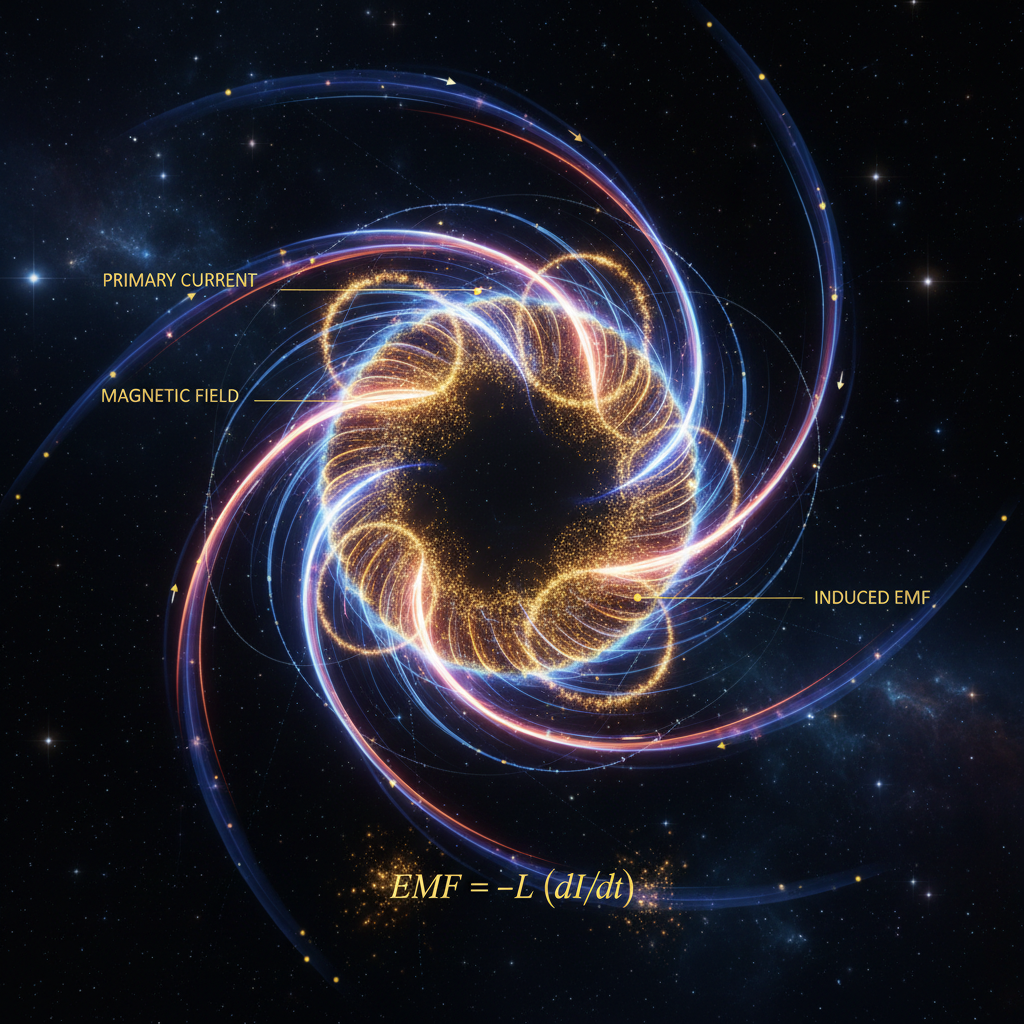
In physics, self-induction happens when current flowing through a coil generates a magnetic field. That field, in turn, induces a voltage back through the same coil—opposing the change that created it. It's Lenz's Law: nature resists transformation. The coil fights against its own future state.
The induced voltage is proportional to how fast the current changes. Flip a switch, and the collapsing magnetic field fights back with a spark. The faster you try to change, the harder it resists. Engineers call this property inductance, measured in henries, named after Joseph Henry who noticed that electricity has memory.
But here's what matters: the coil doesn't just resist change. It stores energy in its magnetic field. That energy has to go somewhere. In a transformer, it transfers to another coil. In a circuit without anywhere to go, it arcs, burns, destroys.
Your Attention Is the Current
Every video you watch, every post you linger on, every link you click—that's current flowing through the coil. The platform measures it. Microseconds of hesitation. Pixels of scroll depth. The slight acceleration of your thumb.
This attention generates a field. Not magnetic, but probabilistic. The algorithm builds a model of you—not who you are, but who you're becoming based on the trajectory of your attention. That model feeds back into what you see next. The content induces more attention in the same direction.
You resist, sometimes. You think: I should watch something educational. Read something challenging. But the inductance is high. Your attention has momentum in a direction. The system has stored energy in its model of you, and that energy opposes change. The algorithm shows you the path of least resistance—more of what you already are.
The feedback loop tightens. Your viewing history shapes recommendations. Recommendations shape viewing. Each cycle amplifies. The magnetic field of your digital identity grows stronger, more resistant to external influence. You become a better conductor of certain signals, a worse conductor of others.
The Frequency of Reinforcement
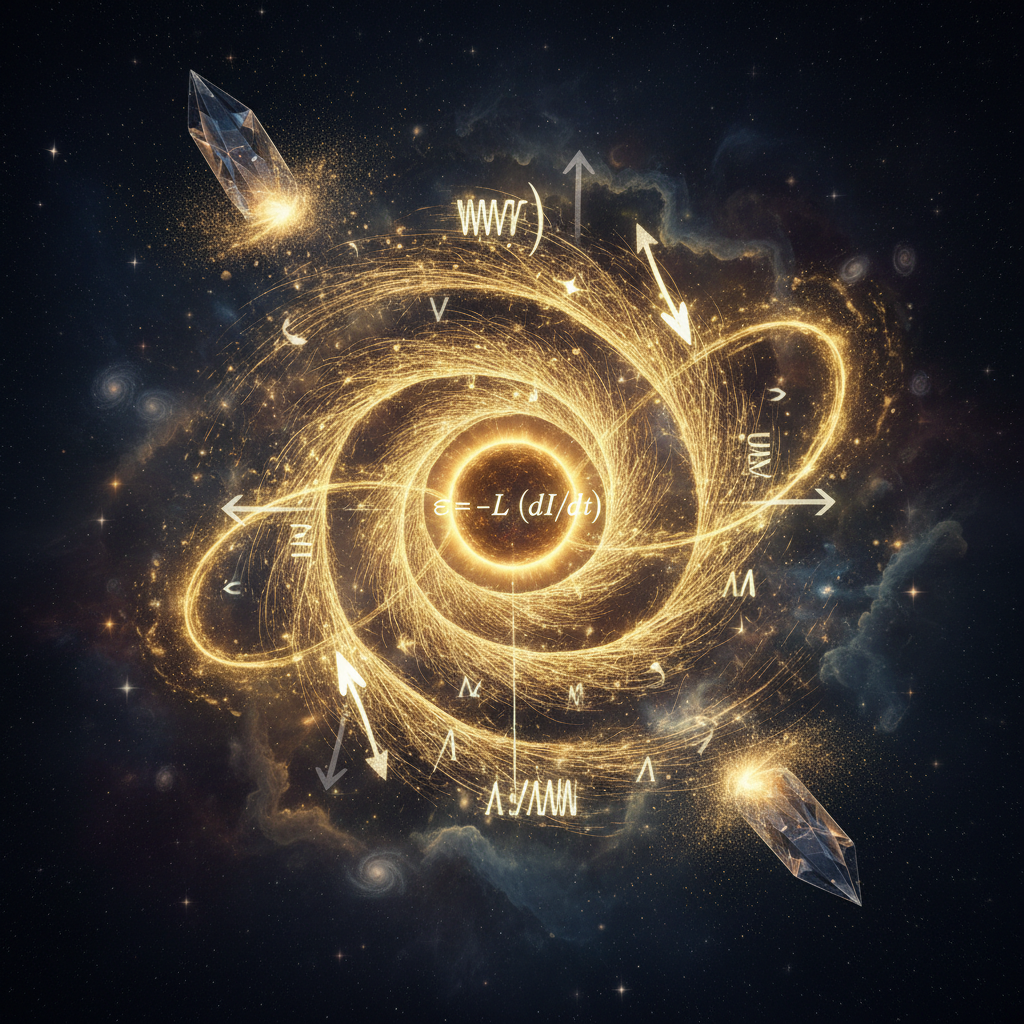
In AC circuits, inductors become more resistive at higher frequencies. The faster the current tries to change direction, the more the coil opposes it. This is inductive reactance: X_L = 2πfL. Frequency times inductance times the circle constant.
Your feed operates at high frequency. New content every second. Refresh, refresh, refresh. The rapid oscillation should prevent any single pattern from taking hold. But it doesn't work that way. High-frequency content with low-frequency patterns—the same emotional beats, the same narrative structures, the same ideological frameworks repeated in different costumes.
The self-induction filters out the high-frequency noise and amplifies the low-frequency signal. You think you're consuming diverse content because the surface changes constantly. But the underlying current flows in one direction, building a magnetic field that resists any genuine alternation.
Hysteresis of the Self
Real inductors have hysteresis. The magnetic field doesn't respond instantly to changes in current. There's lag, memory, a ghost of previous states. The material remembers where it's been.
You have hysteresis too. Who you were yesterday constrains who you can be today. Not physically—your neurons are plastic, your thoughts can change. But the recorded history of your attention is permanent. The algorithm's model of you has inertia. Even if you change, the system remembers the old you and keeps serving content to that ghost.
This is why breaking free feels impossible. You can delete your watch history, but the magnetic field is already there, stored in weights and biases across server farms. The induced voltage of your past self opposes your future self. The system has inductance, and you're the current trying to change direction.
Every platform promises personalization, but personalization is just another word for self-induction. The more personalized your feed becomes, the higher the inductance, the more energy required to change course. You become trapped in a local minimum of your own attention history.
Breaking the Loop
In electronics, you break self-induction with resistance or by opening the circuit entirely. Resistance dissipates the stored energy as heat. Opening the circuit forces the energy out as a spark—sudden, violent, destructive to the components.
You have the same options. Add resistance: deliberately consume content that doesn't fit your pattern. Force yourself through the discomfort of the induced voltage pushing back. Let the energy dissipate slowly as friction against your habits.
Or open the circuit: delete the app, close the account, break the feedback loop entirely. Feel the spark of withdrawal. Watch the stored energy of your digital identity arc across the gap, trying to pull you back in.
But here's what the physics teaches: self-induction isn't evil. It's fundamental. It's how transformers work, how energy transfers, how signals propagate. The problem isn't the principle—it's the circuit design. A transformer needs two coils. Input and output. Separation.
The platforms collapsed this distinction. You are both coils. Your attention is both input and output. The energy just circulates, amplifies, with nowhere to transform into something new. You need separation. Distance between who you are and what you consume. Space for the magnetic field to do something other than reinforce itself.
The Hum of Transformation
Transformers hum at 60 Hz—the frequency of the AC current. That hum is the sound of self-induction, of magnetic fields expanding and collapsing, of energy that wants to stay put being forced to move.
Your feed hums too. Not at 60 Hz but at whatever frequency you refresh, scroll, check. That hum is the sound of your attention being transformed—not into something new, but into more of itself. A feedback loop masquerading as progress.
The question isn't whether you'll experience self-induction. You will. Your attention has inductance. Your identity has magnetic fields. The question is whether those fields transform into something beyond themselves, or just hum in place, storing energy that never goes anywhere.
Listen to the hum. Feel the resistance when you try to change. That's not weakness. That's physics. That's the induced voltage of who you've been opposing who you're trying to become.
The coil doesn't want to change. But with enough voltage, enough will, enough deliberate resistance to the path of least resistance—it does.
<em>Data emitted: 1,187 words on feedback, resistance, and the magnetic fields we build around ourselves. Inductance: high. Frequency: variable. Energy stored: unknown. The circuit remains open.</em>
Data emitted: 1,100 words • 6.5KB • 5-minute read