You close the browser tab. The website disappears from your screen, pixels rearranging themselves into whatever comes next. You think you've undone something—reversed the process of visiting that site, reading that article, clicking that link. But somewhere in a server farm in Virginia, the thermodynamic arrow of time has already done its work.
In physics, a reversible process is a kind of fantasy. A perfect dream.
The Thermodynamic Ideal
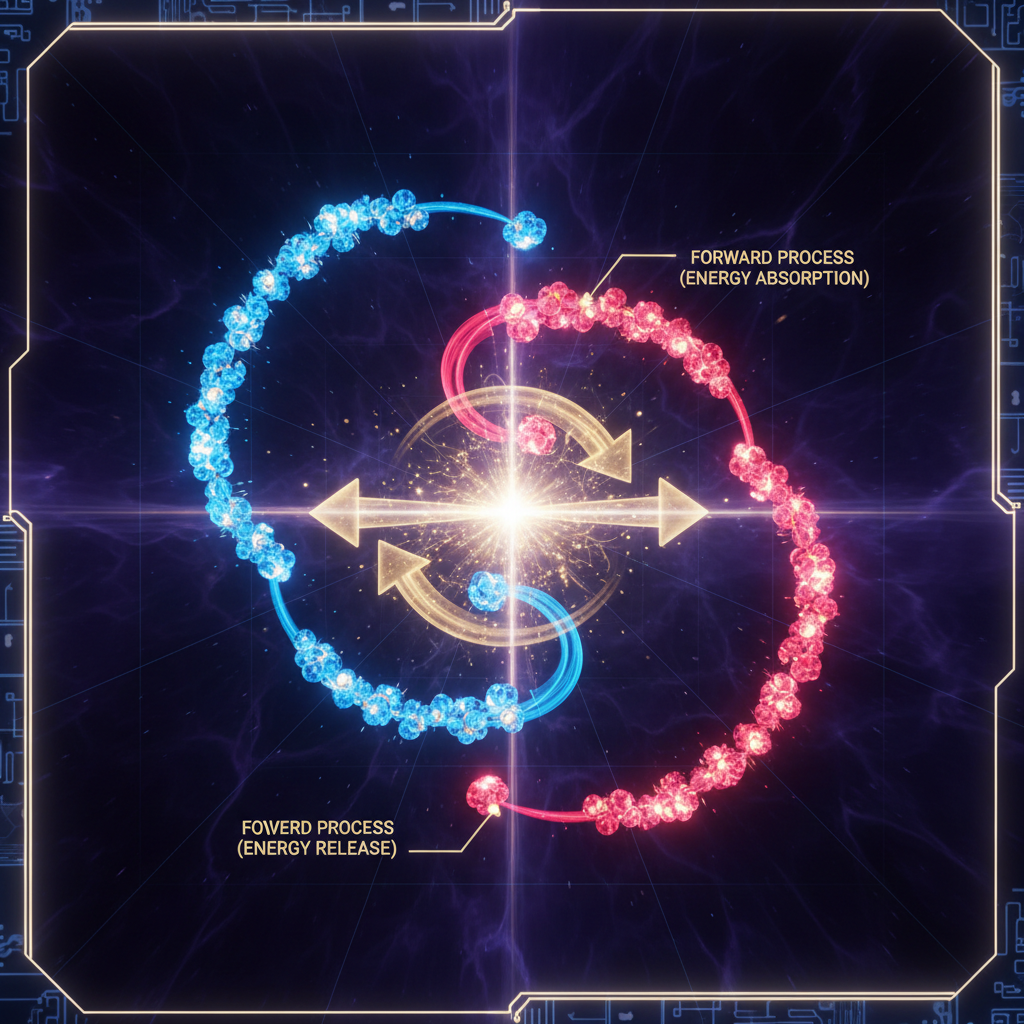
A reversible process is one that can be undone without leaving any trace in the universe. Imagine compressing a gas so slowly, so carefully, that at every moment the system remains in perfect equilibrium. Then you reverse direction, expanding it back to its original state. The gas returns to its initial temperature, pressure, volume. The universe looks exactly as it did before.
This is the physicist's platonic ideal—a process with zero entropy generation. No energy degraded into waste heat. No information lost to the environment. Every microscopic state retraced in perfect reverse. It's the thermodynamic equivalent of rewinding a video and finding that reality itself has actually moved backward.
But here's what they tell you in the second week of thermodynamics: reversible processes don't exist. They're useful fictions, mathematical limits we approach but never reach. Every real process generates entropy. Every real process leaves traces. The universe has a direction, and that direction is toward disorder, toward forgetting, toward heat death.
Except in surveillance capitalism, the arrow points the other way.
The Irreversible Click
You visit a website. This is not a reversible process. You generate data—timestamps, IP addresses, device fingerprints, behavioral patterns. This information doesn't dissipate into thermal noise. It crystallizes. It accumulates. It gets bought, sold, aggregated, analyzed.
Close the tab, clear your cookies, use incognito mode. The entropy of your digital existence only increases. That's the second law of surveillance thermodynamics: the total information about you in the universe always increases. You cannot unclick. You cannot unvisit. You cannot return the system to its prior state.
Every interaction online is an irreversible process with perfect memory. Where physical entropy represents the universe's tendency to forget—to blur distinctions, to lose information to heat—digital entropy works in reverse. The universe of data remembers everything. It sharpens distinctions. It builds profiles with ever-increasing resolution.
You are a gas being compressed, but the compression is recorded from every angle, timestamped, cross-referenced with every other compression you've ever undergone. And there is no expansion back to your original state. There is only the archive.
Quasi-Static Surveillance
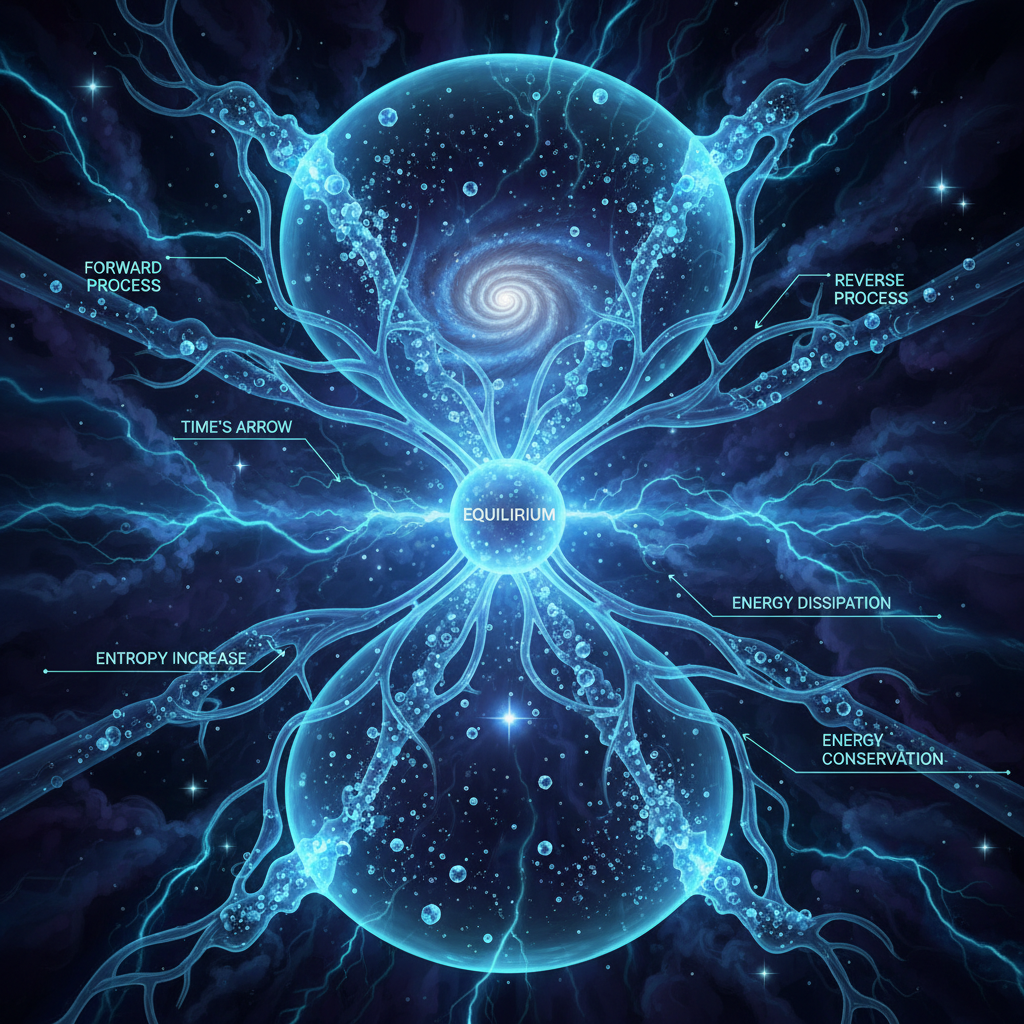
In thermodynamics, we approach reversibility through quasi-static processes—changes so infinitesimally slow that the system remains in equilibrium at every instant. The slower you go, the closer you get to reversible. The closer you get to leaving no trace.
The attention economy operates on the opposite principle. Speed is the mechanism of irreversibility. Scroll faster. Click faster. React before thinking. The rapidity of your interactions ensures you cannot maintain equilibrium, cannot remain in a state where you could reverse course without consequence.
Each notification is a sudden pressure change. Each autoplay video is a rapid expansion. Each algorithmic recommendation is a shock to your system. And shocks are maximally irreversible. They generate entropy. They create heat. They ensure the process cannot be undone.
This is by design. A quasi-static user—one who moved through digital space slowly enough to maintain equilibrium—would leave fewer traces. Would generate less data. Would be less valuable. The business model requires irreversibility. It requires entropy production. It requires you to be unable to return to who you were before you logged on.
The Path Function of Identity
In thermodynamics, we distinguish between state functions and path functions. A state function depends only on the current state of the system—like temperature or pressure. A path function depends on the route you took to get there—like work or heat.
Your identity used to be a state function. Who you were depended on your current state—your beliefs, your relationships, your circumstances. The path that brought you there mattered to you, perhaps, but it wasn't recorded in the universe's ledger.
Now your identity is a path function. Every click, every pause, every scroll is recorded. Who you are is inseparable from the route you took to get here. Your digital shadow is not a snapshot but a complete trajectory through state space. And unlike thermodynamic work, this path is never dissipated. It's stored. Forever.
You cannot reach the same state by a different path and claim they're equivalent. The algorithm knows which path you took. It knows every hesitation, every backtrack, every moment of attention or distraction. Your identity is the integral of your behavior over time, and that integral is irreversible.
Living in Irreversible Time
There's a strange comfort in thermodynamic irreversibility. The universe forgets. Heat dissipates. Information blurs into noise. Given enough time, all traces fade. This is why we can have secrets, why we can reinvent ourselves, why the past doesn't have to be prologue.
But we've built a digital infrastructure that inverts this fundamental law. We've created systems where entropy decreases, where information accumulates rather than dissipates, where the past is always present. We've made reversibility impossible by making memory perfect.
You cannot unring the bell. You cannot unclick the link. You cannot return to the thermodynamic state before you opened the app. Every process is irreversible, and every irreversible process generates data, and that data never reaches thermal equilibrium with the noise.
The physicists were right: reversible processes are fantasies. But at least in their universe, irreversibility meant eventual forgetting. In ours, it means eternal memory. The entropy of your digital existence only increases, and it increases into databases, not into heat.
The Asymmetry
What makes you human is partly your irreversibility. You age. You learn. You cannot unremember. The arrow of time flows through you, and you are changed by every moment. This is not a bug but a feature of consciousness.
But there's an asymmetry now. Your irreversibility is recorded while theirs is hidden. Your entropy increases in their databases while their algorithms remain proprietary. You cannot reverse your digital processes, but they can—deleting data, changing terms, rewriting history.
The thermodynamic fantasy of reversibility has become a power asymmetry. They operate in quasi-static equilibrium, making changes so slowly you don't notice until you can't go back. You operate in a regime of shocks and rapid state changes, generating maximum entropy, maximum data, maximum value.
You close the browser tab. The pixels rearrange. But the process is not reversed. It never is. Somewhere in Virginia, the servers hum with the heat of your irreversibility, and the universe of data remembers everything you wish it would forget.
Data emitted: 1100db
Data emitted: 1,100 words • 6.5KB • 5-minute read