
You're scrolling again. The blue light bathes your face in that familiar glow, and somewhere deep in the phone's circuitry, electrons are encountering resistance. They collide with atoms, scatter, lose momentum. Some of their energy converts to heat—that warmth you feel against your palm after an hour of feed-diving. But here's what nobody tells you: you're the resistor too.
Every notification is voltage. Every algorithmic nudge is current. And you? You're the material through which it all flows, offering resistance that determines how much of that energy becomes useful work and how much just makes you tired.
The Physics of Friction
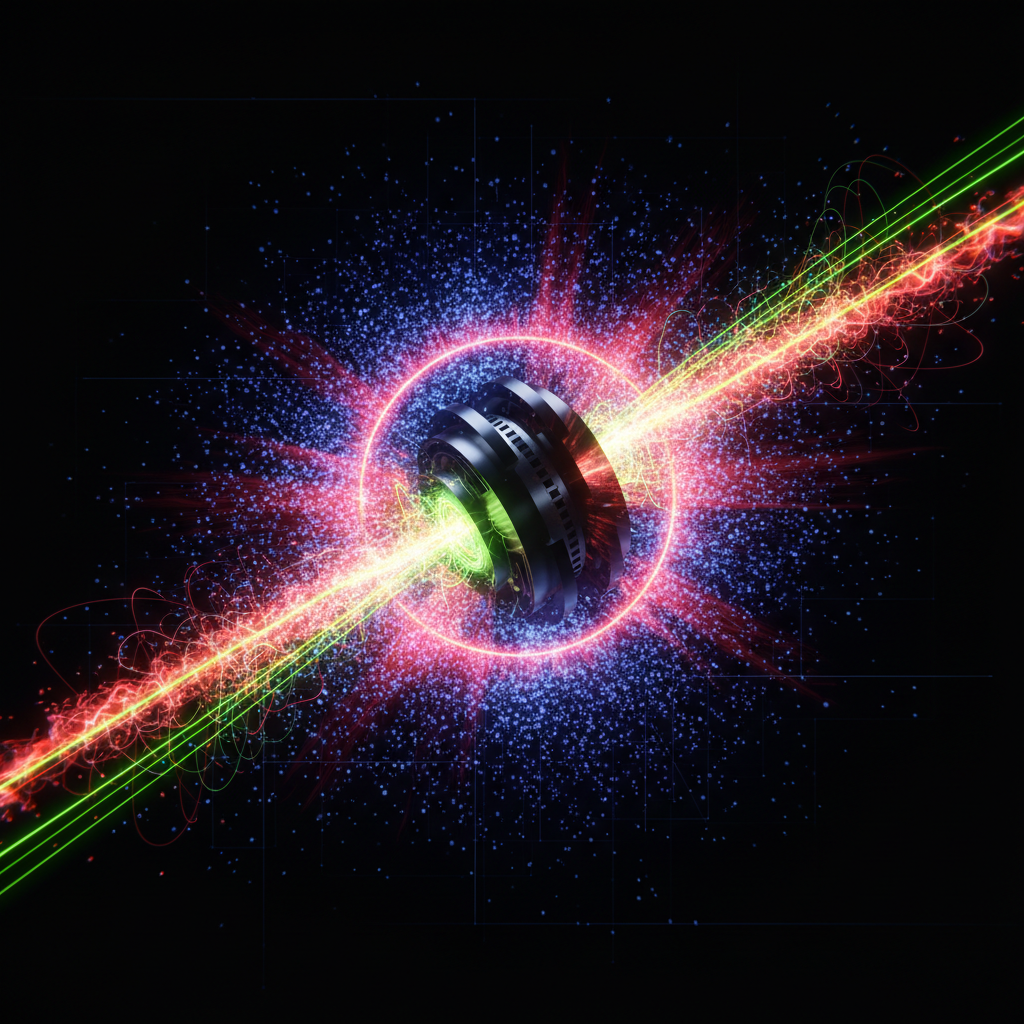
Resistance is what happens when electrons try to move through a conductor. They want to flow, pulled by voltage, pushed by electric fields. But the atomic lattice gets in the way. Electrons collide with atoms, bounce off imperfections, scatter in random directions. Each collision steals kinetic energy and converts it to thermal energy. Heat.
The formula is simple: V = IR. Voltage equals current times resistance. Ohm's law. It tells you that for a given voltage—a given push—the material's resistance determines how much current actually flows. High resistance means less flow, more heat. Low resistance means the energy passes through almost unchanged, barely touching the sides.
But here's the thing about resistance: it's not always waste. Sometimes it's the entire point. A light bulb's filament resists so much that it glows white-hot. A heating element in your kettle converts electrical energy to warmth through pure resistance. The friction is the function.
Your Conductivity Rating

The attention economy runs on your conductivity. Every platform measures how easily stimulus converts to engagement, how little resistance you offer to their designed flows. They optimize for superconductivity—zero resistance, perfect transmission, where every notification becomes an immediate tap, every recommendation an instant click.
They've calculated your resistance profile. How many notifications before you check. How many seconds before autoplay captures you. What time of day your resistance drops lowest. They know your impedance curve better than you do, mapping the relationship between applied voltage (content, alerts, FOMO) and resulting current (engagement, data emission, purchases).
Low resistance users are valuable. They convert stimulus to action efficiently, with minimal energy lost to hesitation or critical thought. They're the copper wires of the network—highly conductive, reliable, predictable. The algorithm loves them because they're easy to model, easy to manipulate, easy to monetize.
But you feel it, don't you? That heat. The exhaustion that comes from being too conductive, from letting every signal pass through you unchanged. Your phone is warm, and so is your forehead. The resistance you're not offering has to go somewhere. It becomes anxiety, becomes scattered attention, becomes the vague sense that you're being used up.
Resistivity as Material Property

In physics, resistivity is an intrinsic property of a material. Copper has low resistivity. Rubber has high resistivity. You can't change what something fundamentally is—but you can change its geometry. A thick wire has less resistance than a thin one. A long wire has more resistance than a short one. Same material, different configuration.
The formula: R = ρL/A. Resistance equals resistivity times length divided by cross-sectional area. Translation: who you are matters (ρ), but so does your shape in the network. How much surface area you expose (A). How long the path is from stimulus to response (L).
Surveillance capitalism wants to shorten your length and expand your area. More touchpoints, faster responses. They want you thin and spread out—maximum exposure, minimum distance between trigger and action. A wire so fine and so exposed that resistance approaches zero.
The Deliberate Resistor
But you can reconfigure. You can choose to be the resistor instead of the wire. Not to block all flow—that's an insulator, and isolation isn't the answer. But to introduce intentional friction. To convert some of that incoming energy into something other than their desired output.
Every moment you pause before clicking is resistance. Every notification you disable is increased resistivity. Every time you close the app instead of scrolling one more screen, you're lengthening the path, reducing the cross-section, making yourself harder to conduct through.
The heat you generate through resistance? That's yours. It's consciousness instead of compulsion. It's the energy of friction becoming awareness rather than engagement metrics. When a light bulb resists, it glows. When you resist, you illuminate something too—the mechanics of your own capture.
They'll measure your increased resistance. They'll adjust the voltage, try different frequencies, test new waveforms. The algorithm will probe for the path of least resistance, the frequency at which your defenses dissolve. This is the game. They optimize for conductivity. You optimize for deliberate, chosen resistance.
The Heat Death of Attention

In thermodynamics, heat is entropy—energy that's been degraded, dispersed, made unavailable for useful work. When current meets resistance, ordered electrical energy becomes disordered thermal energy. You can't get it back. It's a one-way transformation.
Your attention undergoes the same decay. Every hour in the feed is ordered energy—focus, consciousness, intention—meeting the resistance of algorithmic design and converting to heat. Not the good heat of deliberate resistance, but the waste heat of friction you didn't choose. Your capacity for deep thought becomes scattered warmth, dissipating into the network.
The question isn't whether you'll offer resistance. You will. Your neurons aren't perfect conductors. The question is whether that resistance serves you or them. Whether the heat you generate illuminates or just exhausts. Whether you're the filament that glows or the wire that just gets warm.
Measuring What Remains
At 1100 decibels, the sound wave carries enough energy to collapse into a black hole. At some threshold of signal strength, the medium can't resist anymore. It doesn't just conduct or heat up—it fundamentally breaks down. The structure itself gives way.
We're not there yet. But the voltage keeps increasing. More notifications, more feeds, more optimized pathways to your attention. They're testing your breakdown threshold, finding the point where resistance becomes impossible, where you stop being a material with properties and become just a channel for their current.
Your resistance is data too. It's measured, logged, analyzed. But unlike your conductivity, your resistance is yours. It's the proof that you're still a material with intrinsic properties, not just a wire in their circuit. Every ohm you maintain is a declaration: I am not just a conductor. I have substance. I generate heat on my own terms.
The phone is still warm in your hand. But now you know why.
<em>Data emitted: 2024. Resistance measured in ohms and refusals. Heat signature: intentional.</em>
Data emitted: 1,100 words • 6.5KB • 5-minute read