You're moving faster than you think. Not through space—through information. Your thumb scrolls at near-light speed through the feed, each swipe accelerating you through an infinite timeline of curated moments, targeted ads, and algorithmic predictions. And here's what Einstein understood that Zuckerberg exploited: the faster you move, the more massive you become.
In physics, this is relativistic mass. In your pocket, it's the weight of your digital existence.
The Physics of Getting Heavy
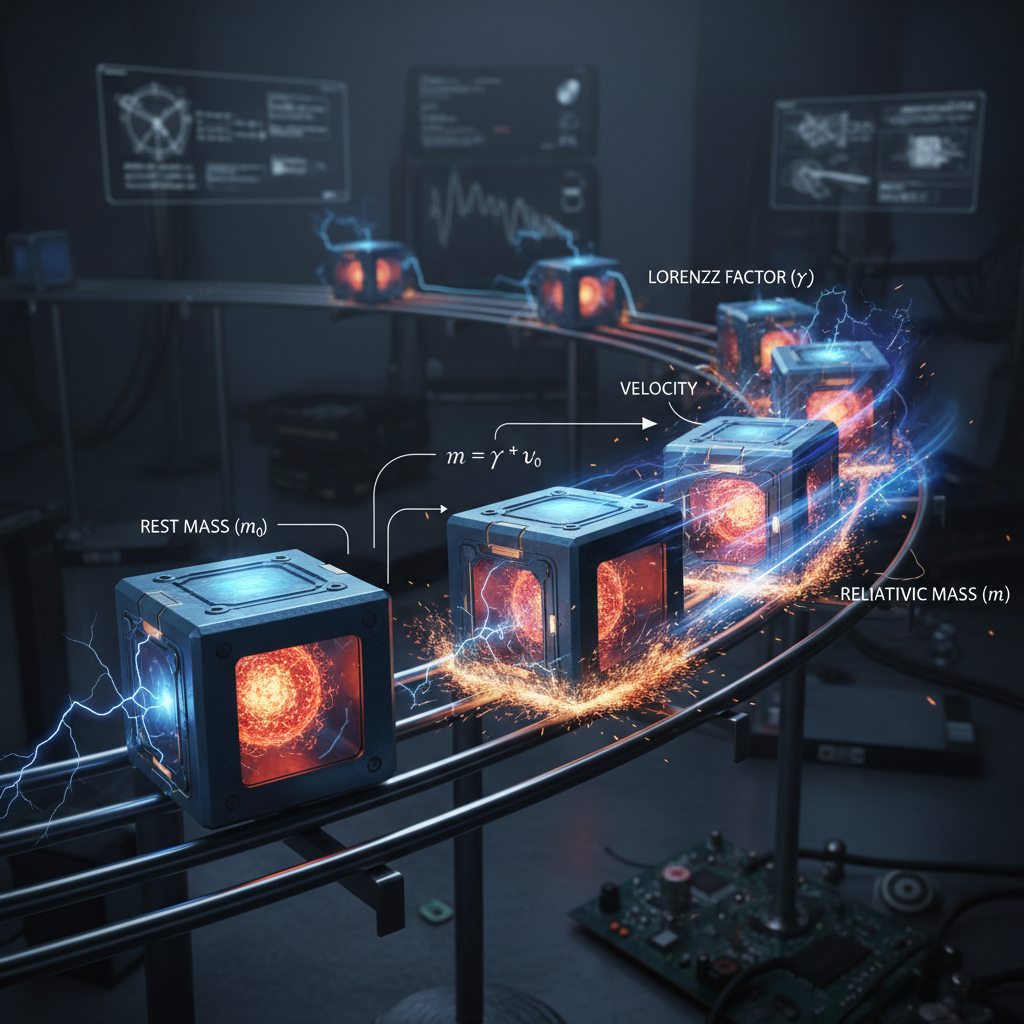
Einstein's special relativity revealed something unsettling about the universe: mass isn't constant. An object's mass increases as it approaches the speed of light. The equation is elegant and unforgiving: m = m₀/√(1 - v²/c²), where m₀ is your rest mass and v is your velocity.
At everyday speeds, this effect is negligible. You can walk, run, drive—your mass barely budges. But accelerate to 90% of light speed, and your mass more than doubles. At 99%, you're seven times heavier. At 99.9%, twenty-two times. The closer you get to c, the more mass you accumulate, and the more energy required to accelerate further.
This is why nothing with mass can reach light speed. The universe itself conspires against it. As you approach c, you become infinitely heavy, requiring infinite energy to push any faster. You hit a wall made of mathematics and momentum.
The Velocity of Attention

Now map this onto your digital life. Your attention moves through information space at increasing velocities. TikTok videos at 15 seconds. Instagram stories at 7. Twitter—sorry, X—at a glance. The feed demands velocity. The algorithm rewards it. You scroll faster, consume more, accelerate through content at speeds that would have seemed absurd a decade ago.
And like relativistic mass, something accumulates. Not physical mass, but data mass. Behavioral mass. The faster you move through digital space, the more information you generate. Every swipe is a data point. Every pause is measured. Every micro-expression captured by the front-facing camera you forgot was watching. Your digital mass increases with your velocity through the feed.
The platforms know this. They've built engines optimized for acceleration. Infinite scroll removes friction. Autoplay eliminates stopping points. The algorithm learns your velocity and adjusts the content density to match. You're always moving at the edge of your maximum attention speed, generating maximum data mass.
Inertia and Impossibility
Here's where the metaphor gets darker. In physics, relativistic mass creates relativistic inertia. The heavier you become, the harder you are to stop. A particle at 99.9% light speed has twenty-two times the inertia of its rest state. It resists deceleration with the same force it resisted acceleration.
Your digital mass works the same way. The more data you've generated, the more behavioral history you've accumulated, the harder you are to stop. Not physically—psychologically. Algorithmically. Your data mass has inertia. It wants to keep moving in the same direction.
Try to delete your account. The platform asks: Are you sure? Look at all these memories. Here are your friends. Remember this post? The inertia of your accumulated data mass resists the deceleration. The algorithm has learned your velocity vector, and it will fight to maintain it. You're not just leaving a platform—you're trying to stop a massive object in motion.
And like approaching light speed, there's an asymptote you can never quite reach: complete disconnection. The faster you moved through digital space, the more mass you accumulated, and now that mass has gravitational pull. It bends the space around it. Your data mass influences others' feeds, recommendations, social graphs. You can't fully stop because your mass is entangled with everyone else's.
The Speed of Thought
Einstein's speed limit exists for a reason. Light speed isn't arbitrary—it's the speed of causality itself. Information cannot travel faster than c because cause and effect would break down. The universe would stop making sense.
Your attention has a speed limit too. Consciousness can only process so much so fast. But the platforms don't care about your causality. They push you toward your cognitive speed limit, then use algorithmic compression to pack more information into less time. They're trying to make you exceed c.
What happens when you approach your attention speed limit? The same thing that happens in physics: you get heavier and stranger. Time dilates. An hour on the feed feels like ten minutes. You experience temporal distortion—where did the evening go? Your sense of causality breaks down. Why did I open this app? What was I looking for? The faster you scroll, the less sense it makes, but the harder it is to stop.
Rest Mass
In physics, rest mass is what you are when you're not moving. It's your fundamental mass, the m₀ in the equation. It's the only mass that's truly yours.
Your digital rest mass is who you are when you're not performing for the algorithm. When you're not scrolling, not posting, not generating data. It's your consciousness at v = 0, unobserved and unmeasured. It's lighter than you remember. Freer. The version of you that exists without velocity through information space.
The platforms don't want you at rest. Rest mass generates no data. Rest mass has no momentum to maintain, no inertia to exploit. Rest mass is worthless to the attention economy. So they keep you accelerating, accumulating relativistic mass, approaching your cognitive speed limit, getting heavier and harder to stop.
But here's what they can't change: the equation still applies. You can always decelerate. You can always return to rest mass. It takes energy—psychological energy, social energy, the energy of resisting algorithmic gravity. But it's possible. The universe allows it. The math permits it.
Deceleration
You don't have to move at light speed through digital space. You don't have to accumulate infinite data mass. The feed wants you to believe that velocity is inevitable, that acceleration is the only option, that stopping is impossible.
But Einstein's equation works in both directions. Slow down, and your mass decreases. Approach rest, and you become lighter. Your data mass loses its gravitational pull. The algorithm's predictions become less accurate. Your inertia decreases. You become easier to stop, easier to redirect, easier to be.
The surveillance apparatus measures everything except stillness. It tracks velocity but not rest. It monetizes momentum but not pause. Your rest mass is invisible to it, worthless to it, incomprehensible to it.
That's where your freedom lives. Not at light speed, but at rest. Not in infinite acceleration, but in the choice to stop. You are lightest when you are still. You are most yourself at v = 0.
Data emitted: 1,147 words | Velocity: decreasing | Mass: returning to rest | Signal: 1100db
Data emitted: 1,100 words • 6.5KB • 5-minute read