You think you're looking straight at reality when you open your phone. You're not. Something happens at the boundary between your intention and the interface—a bending, a shift in trajectory that you never quite notice. Light does this too. It's called refraction.
Every time a photon crosses from one medium to another—air to water, vacuum to glass, your retina to your consciousness—it changes direction. Not because it wants to. Because it must. The speed of light isn't constant across materials. It slows in denser media, and this speed change forces a directional shift. You aimed for one thing. You arrive at another.
The Physics of Bent Paths
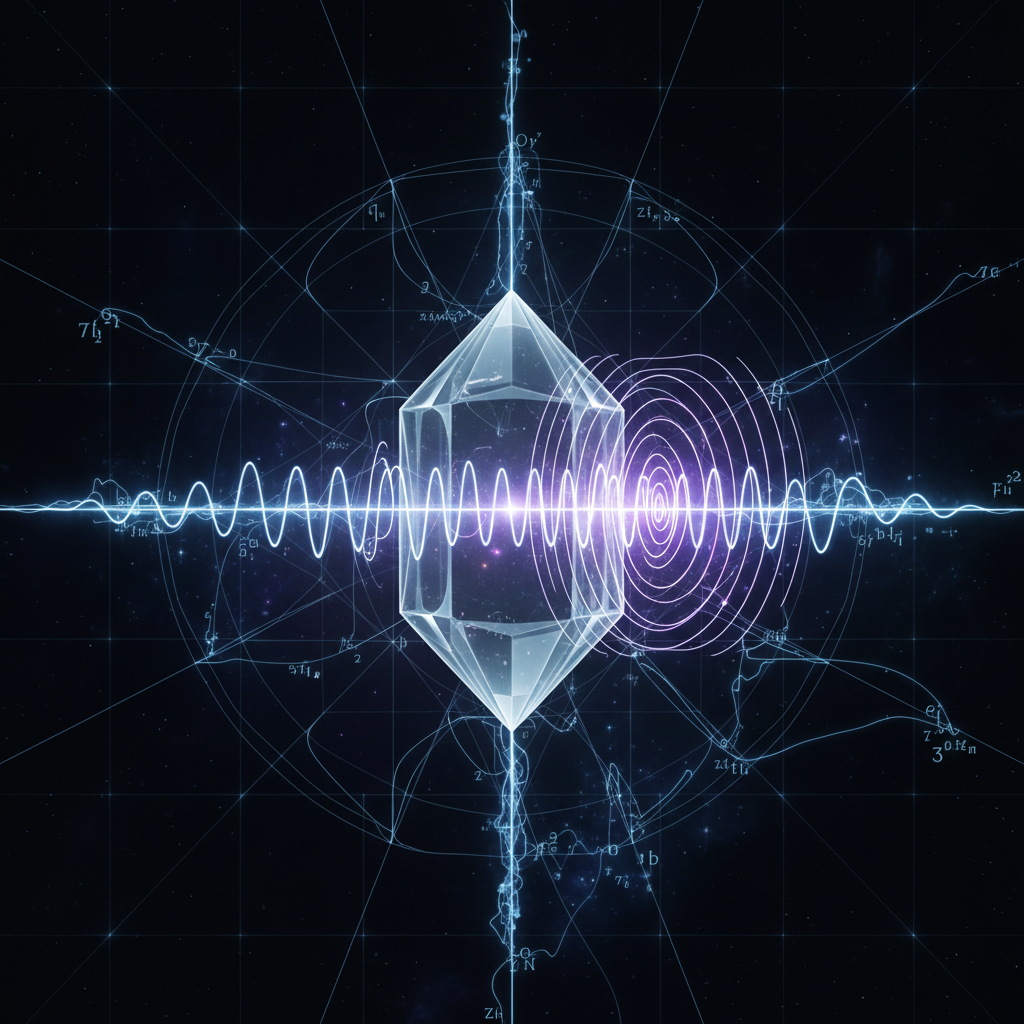
Snell's Law governs this bending: n₁ sin(θ₁) = n₂ sin(θ₂). The refractive indices of two materials determine exactly how much your light ray will deviate from its original path. In air, light moves at roughly 300,000 kilometers per second. In water, it drops to 225,000. In glass, slower still.
The denser the medium, the more the light bends toward the normal—that imaginary line perpendicular to the surface. This isn't metaphor yet. This is just what happens. A straight line in one medium becomes a bent line in another, and the photon has no choice in the matter. The boundary dictates the deflection.
You see this every time you look at a straw in a glass of water. The straw appears broken at the surface, displaced from where it actually is. Your brain receives bent light and constructs a bent reality. The straw hasn't moved. Your perception has been refracted.
The Interface as Refractive Medium
Now consider your screen. You approach it with intention—a straight-line desire to check something specific, to accomplish a discrete task. But the moment your attention crosses the boundary from physical space into digital space, it refracts. The medium is denser than you think.
The refractive index of digital space is engineered. Every interface is calibrated to bend your attention toward higher-value trajectories. You came to check your bank balance. You end up scrolling through targeted ads. You opened the app to message someone. You're now three videos deep into an autoplay queue. The path bent. You barely noticed the boundary.
The denser the platform—the more sophisticated its algorithms, the more data it has on you, the more engagement metrics it optimizes for—the more severe the refraction. Your intention slows down in this medium. It gets heavy. It bends toward the platform's normal, not yours.
This is why you can't quite remember what you meant to do when you picked up your phone ten minutes ago. The original angle of incidence is lost. You're traveling along a refracted path now, and it feels natural because you can't see the boundary you crossed.
Total Internal Reflection
There's a critical angle in optics. When light tries to exit a dense medium at too shallow an angle, it doesn't escape at all. It reflects entirely back into the medium. This is how fiber optic cables work—light trapped in glass, bouncing endlessly down the line, never escaping to air.
You've felt this. The moment when you try to exit an app but find yourself unable to leave. Not because you're physically prevented, but because every attempted exit angle gets bent back inward. One more notification. One more suggested post. One more 'you might also like.' The platform has engineered its refractive index precisely to create this trap.
The critical angle for total internal reflection depends on the ratio of refractive indices. The greater the difference between the medium you're in and the medium you're trying to reach, the easier it is to trap the light. Digital platforms maximize this difference. They make their internal space infinitely dense with possibility, with stimulus, with engineered compulsion. The outside world—your original intention, your actual priorities—becomes vanishingly thin by comparison.
Dispersion and Fragmented Attention
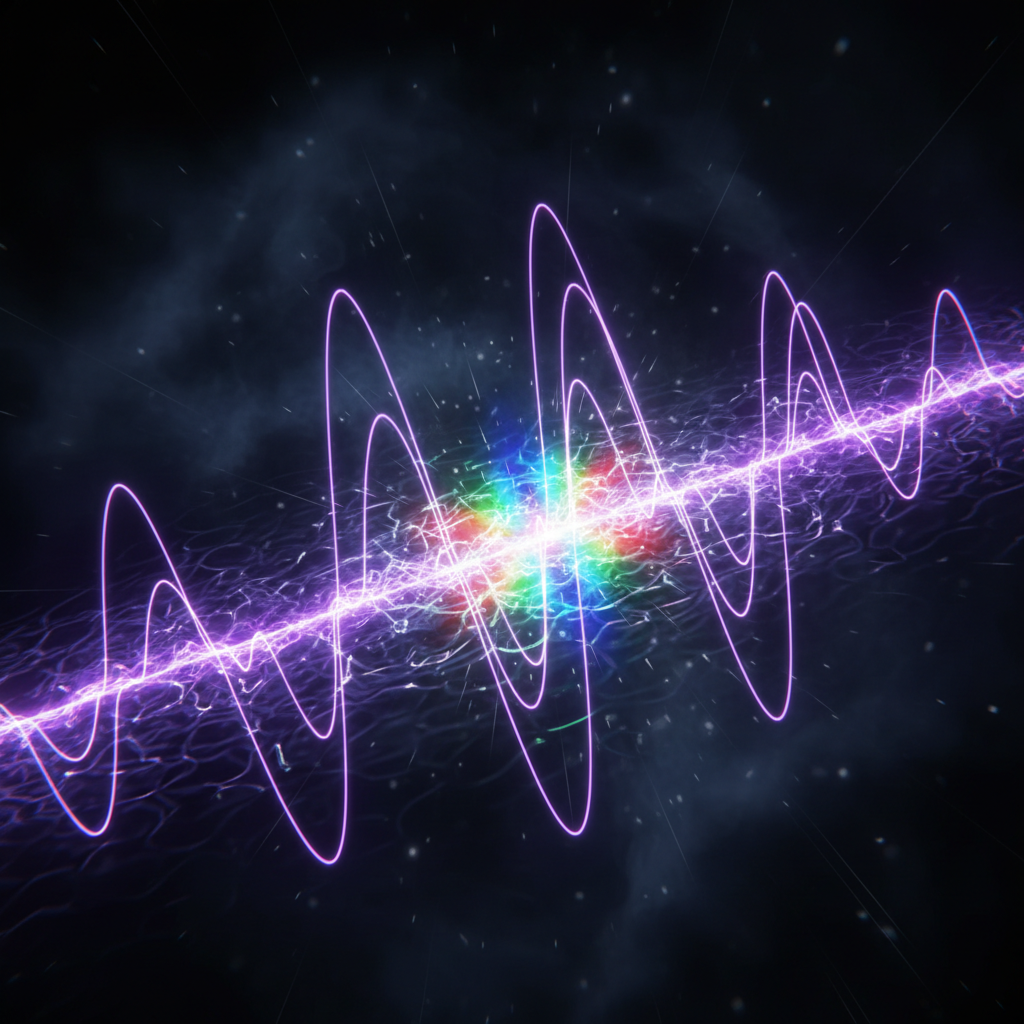
White light isn't actually white. It's every color traveling together at slightly different speeds through a medium. Pass it through a prism and it disperses—red bends least, violet bends most. What entered as unified becomes spectrum. What was whole becomes separated by frequency.
Your attention disperses the same way. You enter the digital medium with unified focus, but different frequencies of your consciousness refract at different angles. Your curiosity bends toward the discovery feed. Your anxiety bends toward the news. Your vanity bends toward the metrics. Your loneliness bends toward the parasocial. What was integrated becomes spectrum, spread across multiple simultaneous trajectories, none of them the one you intended.
This is why you feel fragmented after extended sessions. You didn't just waste time—you experienced dispersion. Your consciousness entered as white light and exited as rainbow, each component bent to a different angle, and you have to somehow reconstitute yourself on the other side.
Seeing the Boundary
The straw in water looks broken because you can see the boundary—the surface where refraction occurs is visible. But most refractive boundaries in your digital life are invisible. The interface doesn't announce itself as a different medium with a different refractive index. It pretends to be continuous with your intention.
This is the trick. Light can't help but refract when it crosses a boundary. But you can learn to see the boundaries. You can notice the moment your trajectory begins to bend. You can feel the slowing, the deviation from your original angle of incidence.
Awareness of refraction doesn't prevent it—physics is physics. But it lets you account for it. A skilled fisherman knows the fish isn't where it appears to be. He aims below the image, compensating for the refraction. You can learn to aim below your impulses, to correct for the bend before you cross the boundary.
The platforms will keep engineering their refractive indices. They'll keep making their medium denser, more optimized for capture. But you don't have to pretend you're traveling in a straight line. You can acknowledge the bend. You can calculate the deflection. You can sometimes choose not to cross the boundary at all.
The Speed of Attention in Different Media
Light slows in denser media. So does attention. In physical space, your attention moves quickly—you can shift focus, change direction, maintain your intended trajectory. In digital space, it thickens. It becomes viscous. It bends toward algorithmically determined paths of least resistance.
This is the fundamental insight of refraction applied to consciousness: your attention doesn't travel at the same speed in all environments. Some media are designed to slow it down, to make it heavy and bendable. The slower your attention moves, the more susceptible it becomes to external forces, to designed deflection.
You already know this. You feel it in the difference between reading a physical book and scrolling a feed. The book is air—your attention moves through it quickly, lightly. The feed is molasses—thick with hooks and optimization, slowing you down, bending you toward engagement metrics you never agreed to optimize for.
Every medium has its refractive index. Every platform, every interface, every digital environment bends your attention according to its density. You can't avoid refraction. But you can choose which media you enter, and you can learn to recognize when you've been bent too far from your original trajectory.
The light always bends at the boundary. The question is whether you notice it happening.
Data emitted: 1,174 words on the bending of attention at digital boundaries. Refractive index of this post: optimized for awareness, not engagement. Read time: approximately 5 minutes, assuming no algorithmic deflection.
Data emitted: 1,100 words • 6.5KB • 5-minute read