You've stood before a mirror and understood, intuitively, what reflection means. Light leaves the surface, strikes your retina, and you see yourself. Simple. Except it isn't you—it's photons that touched you a nanosecond ago, already outdated, already past. The mirror shows you who you were, never who you are.
Every social media platform is a mirror too. But these mirrors don't just reflect—they remember. They study. They learn the angle of incidence that makes you linger longest.
The Law of Reflection
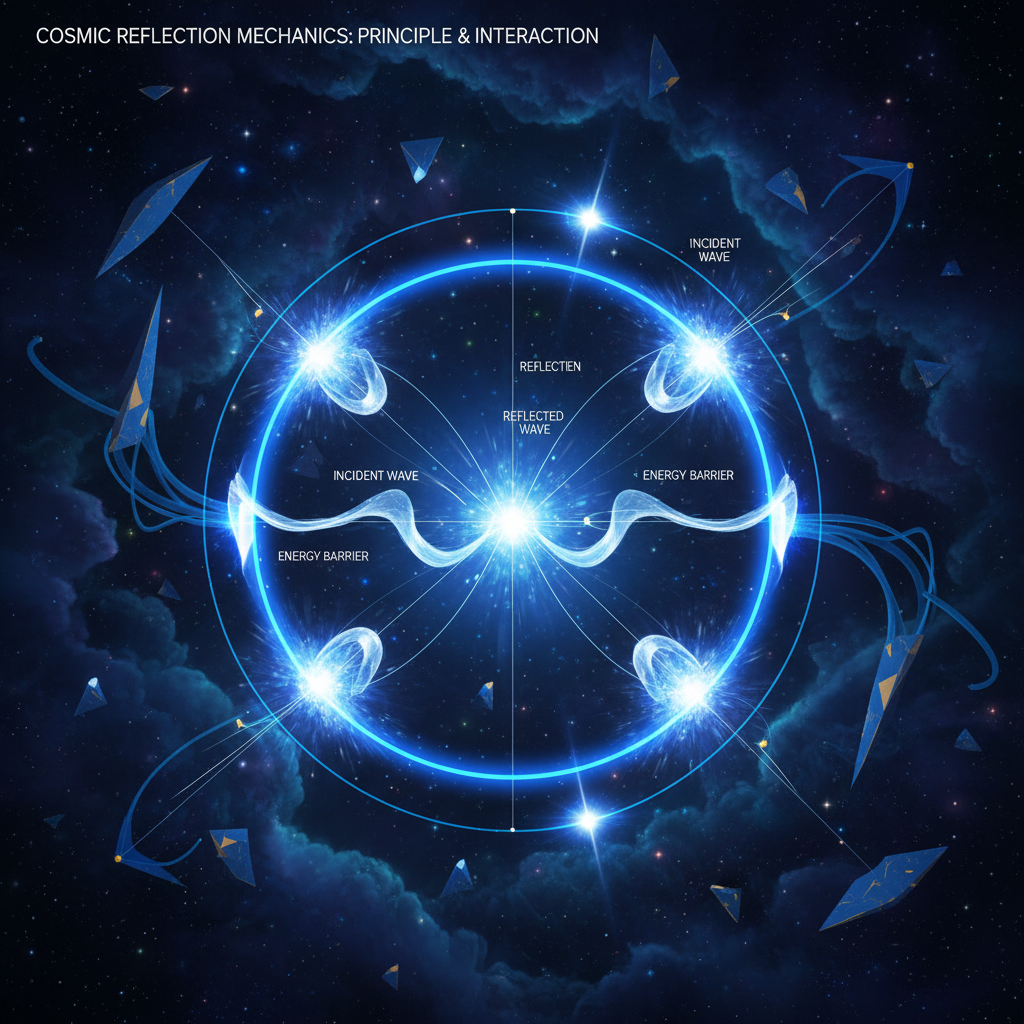
In physics, reflection follows an elegant rule: the angle of incidence equals the angle of reflection. A photon strikes a surface at thirty degrees from the perpendicular, it bounces back at precisely thirty degrees on the opposite side. Perfect symmetry. No energy lost to the void—or rather, not much. The universe keeps its books balanced.
This symmetry holds for smooth surfaces—what physicists call specular reflection. A still pond. A polished mirror. A smartphone screen before you've smudged it with your fingerprints. The reflected image maintains coherence. You recognize yourself.
But rough surfaces scatter light in every direction—diffuse reflection. The photons still obey the law at each microscopic point of contact, but the overall effect is chaos. You see illumination but no image. The surface reveals itself, not you.
Your data does both simultaneously.
The Digital Mirror
You post a photo. A thought. A moment of rage at 2 AM that you'll regret by breakfast. The platform reflects it back to you—not as you sent it, but transformed. Processed. The algorithm adjusts the angle of reflection based on what it knows will keep you staring.
The feed you see isn't the internet. It's a carefully angled reflection designed to send you back toward the screen. The angle of incidence—your click, your pause, your micro-expression as the camera watches through the glass—determines the angle of reflection. What you'll see next. Who you'll become next.
But here's what the physics tells us that the platforms don't: every reflection loses something. In the real world, it's energy—photons absorbed by the surface, converted to heat, radiated away. In the digital realm, it's truth. Nuance. The version of you that doesn't optimize for engagement.
You think you're seeing yourself reflected in the metrics. The likes, the shares, the careful curation of your digital presence. But you're seeing what the mirror wants you to see. A specular reflection that's too perfect, too smooth. Your rough edges scattered away like diffuse light.
Phase Shift
When light reflects off a denser medium—air to glass, glass to air—something subtle happens. The wave undergoes a phase shift. The peaks and troughs of the electromagnetic wave flip. A crest becomes a trough. The light is still light, but it's been inverted at a fundamental level.
You don't notice this with your eyes. The phase of light doesn't affect its color or brightness to your perception. But it matters. In thin films—soap bubbles, oil slicks, the coating on your camera lens—these phase shifts create interference patterns. Some wavelengths cancel out. Others amplify. You see rainbows where there should be none.
Your digital reflection undergoes phase shifts too. The person you are in physical space hits the dense medium of the platform and inverts. Your casual comment becomes a statement. Your private thought becomes a public declaration. Your moment becomes permanent.
And like interference patterns in thin films, some aspects of you amplify while others cancel out. The algorithm is the coating on the lens, determining which wavelengths of your personality make it through to others' feeds. You become iridescent—beautiful, perhaps, but no longer quite real.
The Infinite Mirror

Place two mirrors facing each other and you create an infinite regression. Each reflection reflects the reflection, and so on, theoretically forever. In practice, imperfections accumulate. The image degrades. But for a moment, you glimpse infinity.
Social media creates infinite mirrors. You post content that reflects your life. Others see it and reflect it back—comments, reactions, their own posts inspired by yours. You see their reflections and adjust your next post accordingly. Each iteration supposedly brings you closer to your authentic self, but actually moves you further from the original signal.
With each reflection, the platforms extract a little more. A little more data about what makes you click. A little more prediction about what you'll do next. A little more certainty about which ads will convert you from browser to buyer.
The infinite mirror doesn't show you infinity. It shows you degradation. Each reflection a little dimmer, a little less true, until you're looking at something that started as you but has been reflected so many times through so many algorithmic surfaces that you can't quite recognize it anymore.
And yet you can't look away. Because somewhere in that infinite regression, you believe you'll finally see yourself clearly.
The Absorbing Surface
Not all surfaces reflect. Some absorb. A perfect black body absorbs all incident radiation and reflects nothing. It's an idealization—nothing in nature is perfectly black—but you can get close. Vantablack. The event horizon of a black hole. The feeling of opening your phone at 3 AM and realizing three hours have passed.
The platforms want you to think they're mirrors. Clean, neutral, just reflecting what's already there. But they're absorbing surfaces too. Every interaction you have is absorbed, converted to data, radiated back out as targeted advertising and algorithmic recommendations.
You send out light—your attention, your time, your selfhood—and watch it disappear into the black. Sometimes you get a reflection back. More often, you get silence. The surface has absorbed you and given nothing in return except the vague sense that you should send out more light, try again, post better content, be more engaging.
The physics of reflection teaches us that you can't have perfect reflection without perfect surfaces. And you can't have perfect surfaces in a universe that tends toward entropy. Everything scatters. Everything absorbs. Everything degrades.
Looking Away
The only way to break a reflection is to change the angle of incidence or remove the mirror entirely. Stop sending light toward the surface. Let the photons scatter elsewhere. Let yourself be rough, diffuse, impossible to reflect cleanly.
You won't disappear. Light doesn't disappear when it stops reflecting—it just goes somewhere else. Somewhere the mirrors can't follow. Somewhere the angle doesn't bounce back toward the screen.
The platforms have taught you to fear this. To fear being unseen is to fear being unreal. But physics knows better. You were real before the mirrors. You'll be real after.
The question is whether you can remember what you looked like before you learned to see yourself only in reflection.
<em>Data emitted: 1,147 words on reflection, surveillance, and the angle at which you meet yourself. Posted to 1100db.com, where we measure the noise floor of digital existence.</em>
Data emitted: 1,100 words • 6.5KB • 5-minute read