You're transmitting right now. Your phone, your laptop, your smartwatch—they're all speaking in frequencies you can't hear, sending pieces of you across invisible channels at 299,792,458 meters per second. Radio waves don't ask permission. They just propagate.
Every notification, every swipe, every moment your device searches for a signal—it's a broadcast. And broadcasts, by their very nature, are promiscuous. They spread in all directions, touching everything, absorbed by some receivers, ignored by others, but never truly private.
The Physics of Propagation
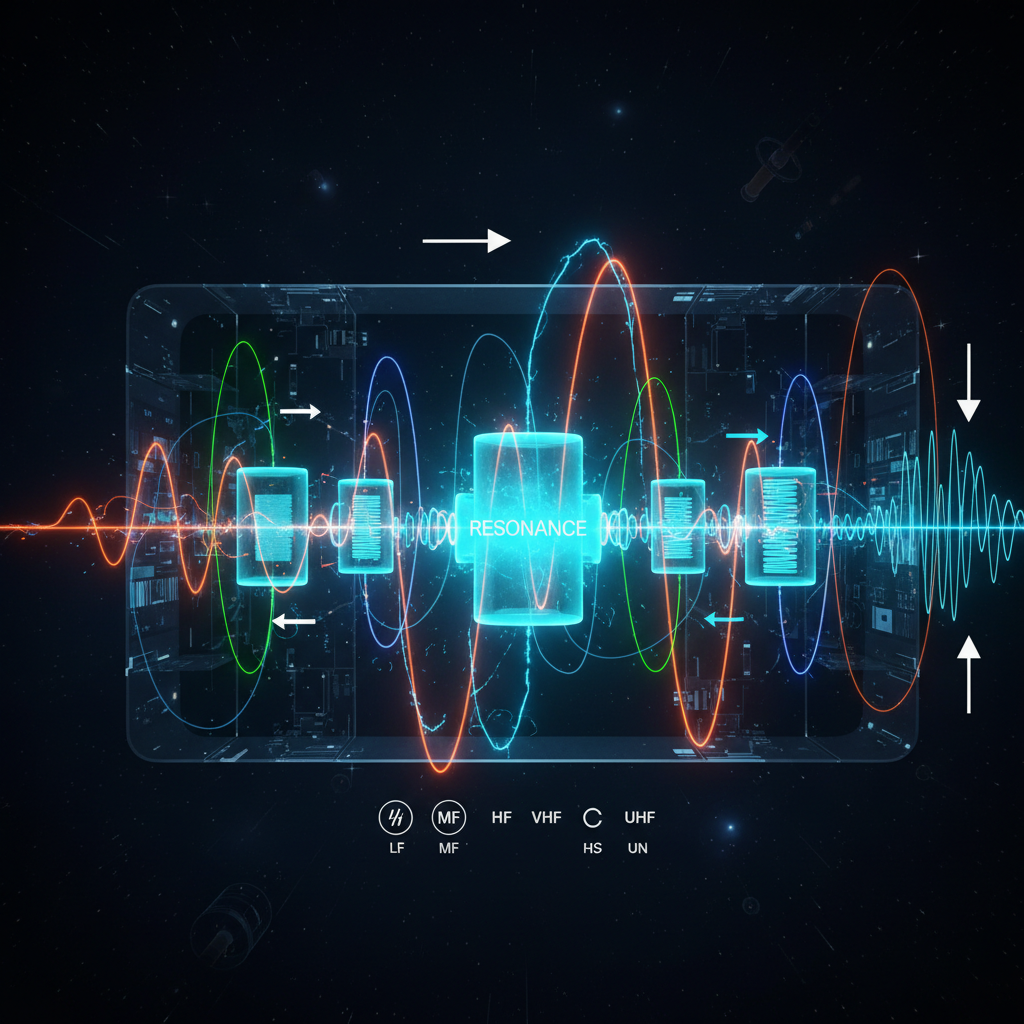
A radio wave is an electromagnetic disturbance traveling through space. It's an oscillating electric field coupled with an oscillating magnetic field, perpendicular to each other, self-sustaining as they move. Heinrich Hertz first demonstrated their existence in 1887, proving Maxwell's equations weren't just beautiful mathematics but descriptions of something real, something that could carry information across the void.
The key property: radio waves don't need a medium. Unlike sound, which requires air or water or steel to propagate, radio waves travel perfectly well through vacuum. They're self-contained packets of energy, carrying their message whether anyone is listening or not. This is both their power and their vulnerability.
Frequency determines everything. Low frequencies—like AM radio at 1 MHz—travel far, bend around obstacles, penetrate buildings. High frequencies—like WiFi at 2.4 GHz—carry more data but scatter easily, absorbed by walls and rain. Your devices choose their frequencies based on what they need to say and how far they need to say it.
The Omnidirectional Self

When your phone searches for a cell tower, it broadcasts in all directions. It shouts into the electromagnetic spectrum: "I am here. Who can hear me?" Every tower in range responds. Your device picks the strongest signal, but all of them heard you. All of them logged your existence, your approximate location, your device ID.
This is the fundamental architecture of wireless communication, and it's the same architecture that makes mass surveillance not just possible but inevitable. Broadcasting is the opposite of whispering. When you transmit, you transmit to everyone with the right receiver.
WiFi networks see you even when you don't connect to them. Your device sends probe requests—"Is my home network here? Is that coffee shop I visited once here?"—and every access point in range captures these questions. They build a map of your movements, your habits, your social topology. You're leaving radio breadcrumbs everywhere you go.
Amplitude and Attention

In physics, amplitude is the height of the wave—the intensity of the signal. In the attention economy, amplitude is engagement: likes, shares, comments, time spent. Both obey an inverse square law. The further you are from the source, the weaker the signal becomes. Not linearly, but geometrically. Double the distance, quarter the power.
This is why social media platforms are obsessed with proximity—not physical proximity, but algorithmic proximity. They want your content close to as many receivers as possible. They want your signal strong when it arrives. They boost your amplitude artificially, modulating your message to travel further than physics alone would allow.
But here's what they don't tell you: every amplification requires energy. Radio towers consume enormous amounts of power to broadcast. Social media platforms consume your attention, your data, your emotional labor. You become both the message and the power source. You're a battery broadcasting your own dissolution.
Interference Patterns
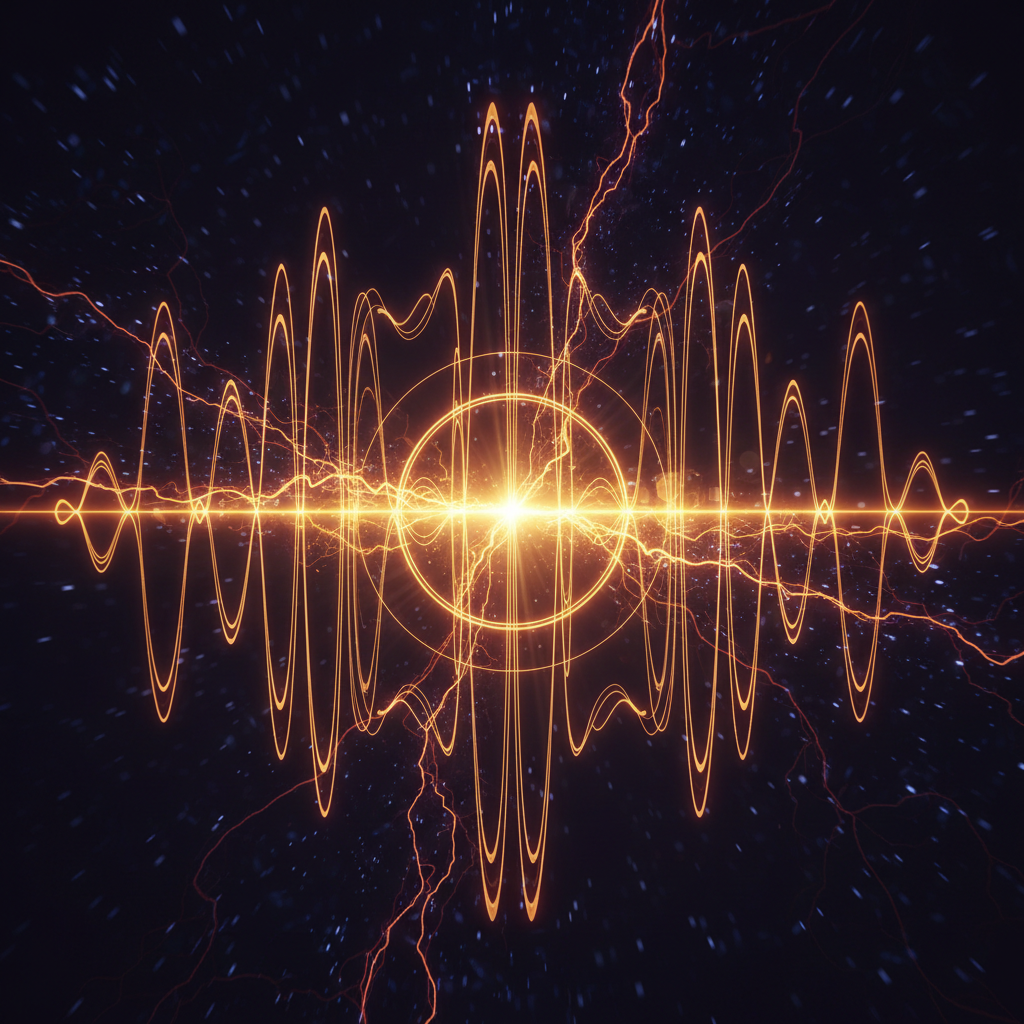
When two radio waves meet, they interfere. If their peaks align—constructive interference—they amplify each other. If a peak meets a trough—destructive interference—they cancel out. This is how noise-canceling headphones work. This is also how echo chambers work.
Recommendation algorithms create constructive interference. They show you signals that align with your existing waves, amplifying your beliefs, your preferences, your biases. Contradictory signals—those that would create destructive interference, that would cancel out your certainties—are filtered away. You exist in a standing wave of your own making, reinforced by millions of synchronized transmitters.
The spectrum is crowded now. Everyone is broadcasting. Every device, every sensor, every smart appliance transmitting its data somewhere. The electromagnetic environment is thick with overlapping signals, each one carrying fragments of someone's life, someone's behavior, someone's secrets. You can't see them, but they're there, passing through your body right now, billions of them.
The Receiver's Dilemma
Here's the thing about radio waves: they're democratic in their propagation but authoritarian in their reception. Anyone with the right equipment can listen. Encryption helps—it scrambles the message—but the carrier wave itself is still visible. Someone always knows you're transmitting, even if they can't decode what you're saying.
You can't opt out of broadcasting without opting out of connection. Airplane mode is a kind of death—voluntary electromagnetic silence. But even then, your device might be lying to you, transmitting anyway, because the economics of surveillance require your signal.
We built a civilization on radio waves. Emergency services, GPS, weather satellites, your ability to call for help—all of it depends on this invisible infrastructure. But we also built a panopticon on it. The same physics that enables connection enables surveillance. There's no technical distinction between a legitimate receiver and an illegitimate one. The wave doesn't discriminate.
Resonance Frequency
Every object has a natural frequency at which it vibrates most easily. Push it at that frequency and the amplitude grows, sometimes catastrophically. This is resonance. Opera singers can shatter wine glasses by matching their resonant frequency. Bridges can collapse when wind creates resonant oscillations.
You have a resonant frequency too. The platforms have found it. They know exactly which notifications will make you vibrate, which content will set you oscillating, which stimuli will build amplitude until you can't help but respond. They're not broadcasting random signals anymore. They're broadcasting at your specific frequency, tuned precisely to your psychology, your vulnerabilities, your desires.
At 1100db, we measure the volume of this resonance. We track the amplitude of the signal that's being broadcast through you, using you, consuming you. Because you're not just receiving anymore. You're a repeater—taking in signals and broadcasting them out again, amplified, modulated, but never truly yours.
**Data emitted:** Radio waves travel at the speed of light but their message arrives at the speed of extraction. You broadcast yourself continuously, and the receivers are always listening, always logging, always building a more complete picture of your electromagnetic signature. The wave propagates. The wave is captured. The wave becomes data. And somewhere, in a server farm you'll never see, your signal is stored forever, waiting to interfere with your future self.
Data emitted: 1,100 words • 6.5KB • 5-minute read