You can't see the forces holding you in place. Not really. You scroll through your feed, believing you're exploring the vastness of human knowledge, but you're actually trapped in a prison smaller than a proton. The walls are invisible. The bars are made of gluons you'll never perceive directly.
Welcome to your filter bubble. Welcome to quantum chromodynamics.
The Force That Won't Let Go
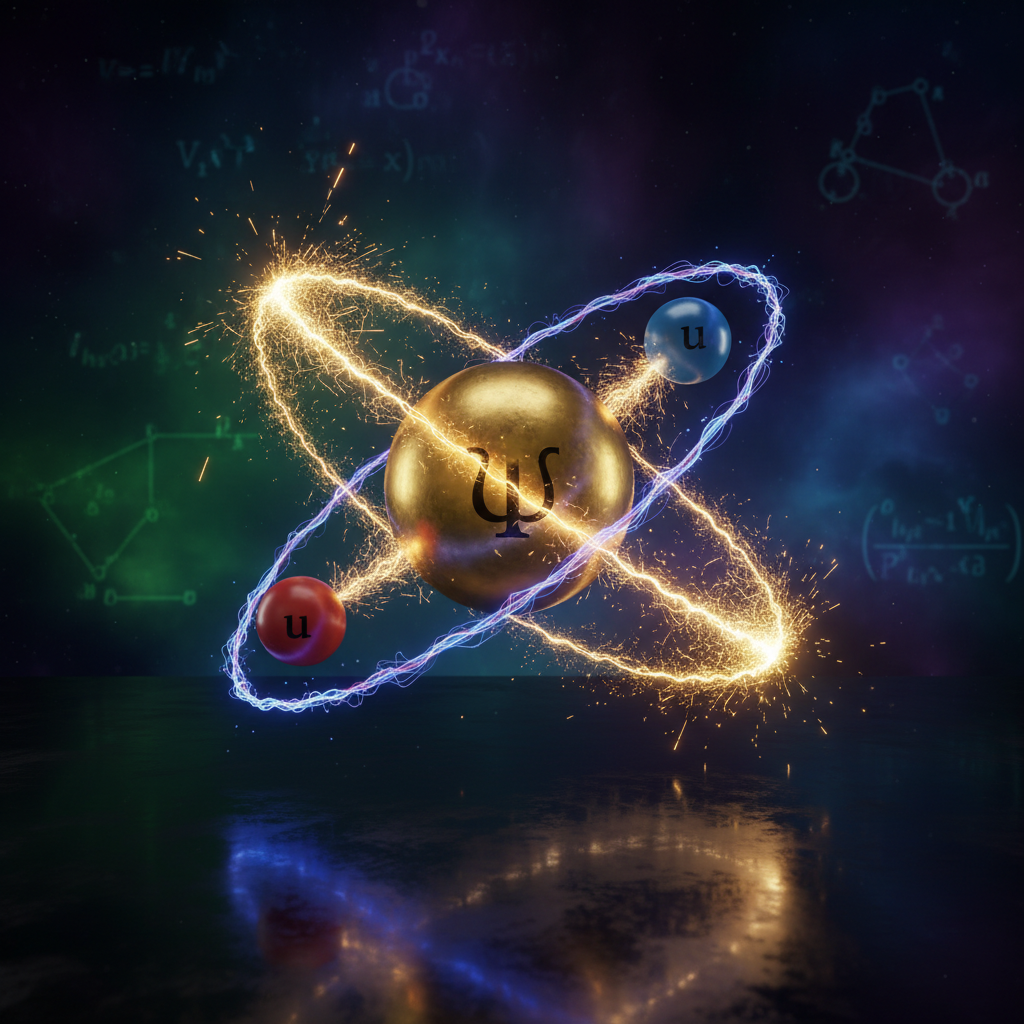
In the quantum realm, quarks are bound together by the strong nuclear force—the most powerful force in nature. This force operates through the exchange of particles called gluons, and it has a property that defies intuition: it gets stronger as you try to pull quarks apart.
Try to separate two quarks, and the energy you invest doesn't free them. Instead, it creates new quark-antiquark pairs from the vacuum itself. The universe would rather spawn new matter than let you break those bonds. Physicists call this "confinement." You can never isolate a single quark. You can never see one alone.
The force carrier—the gluon—has a peculiar property. Unlike photons, which don't interact with each other, gluons interact with themselves. They carry the very charge they mediate. This creates a feedback loop, a self-reinforcing prison of force that intensifies with distance.
Asymptotic Freedom and Your Comfort Zone
Here's the paradox: when quarks are close together, they move almost freely. The strong force weakens at short distances. Physicists call this "asymptotic freedom," and it earned its discoverers a Nobel Prize.
But try to explore beyond your immediate vicinity, and the force clamps down. The further you drift, the harder the universe pulls you back.
Your filter bubble works the same way. Inside your algorithmic enclosure, you scroll freely. The content feels diverse—political takes, memes, friend updates, recommendations. You have the illusion of movement, of choice. The recommendations feel light, almost invisible.
But try to escape. Try to seek perspectives that deviate too far from your engagement history. The algorithm doesn't just fail to show you that content—it actively works against you. Every click you make generates data. Every moment of attention feeds the model. The system learns to predict you, then to shape you, then to confine you.
Color Charge and Identity Vectors
Quarks carry a property called "color charge"—not actual color, but a quantum number that comes in three types: red, green, and blue. Gluons carry combinations of color and anti-color, mediating exchanges that keep quarks bound in color-neutral combinations.
The mathematics is elegant: an SU(3) gauge symmetry, eight types of gluons, each carrying its own color charge, each capable of changing a quark's color while preserving the overall balance.
You also carry charges. Not color, but demographic markers, behavioral signatures, identity vectors in a high-dimensional space. Age, location, income bracket, political lean, purchase history, search patterns. The surveillance apparatus tracks hundreds of dimensions, building a profile that defines you more accurately than you define yourself.
The algorithmic gluons—the recommendation engines, the ad exchanges, the engagement optimizers—mediate exchanges between you and content, between you and other users, between you and advertisers. Each interaction changes your vector slightly, but always in ways that preserve the system's equilibrium. You're kept in balance, kept bound, kept in a state the platform can monetize.
The Vacuum Isn't Empty
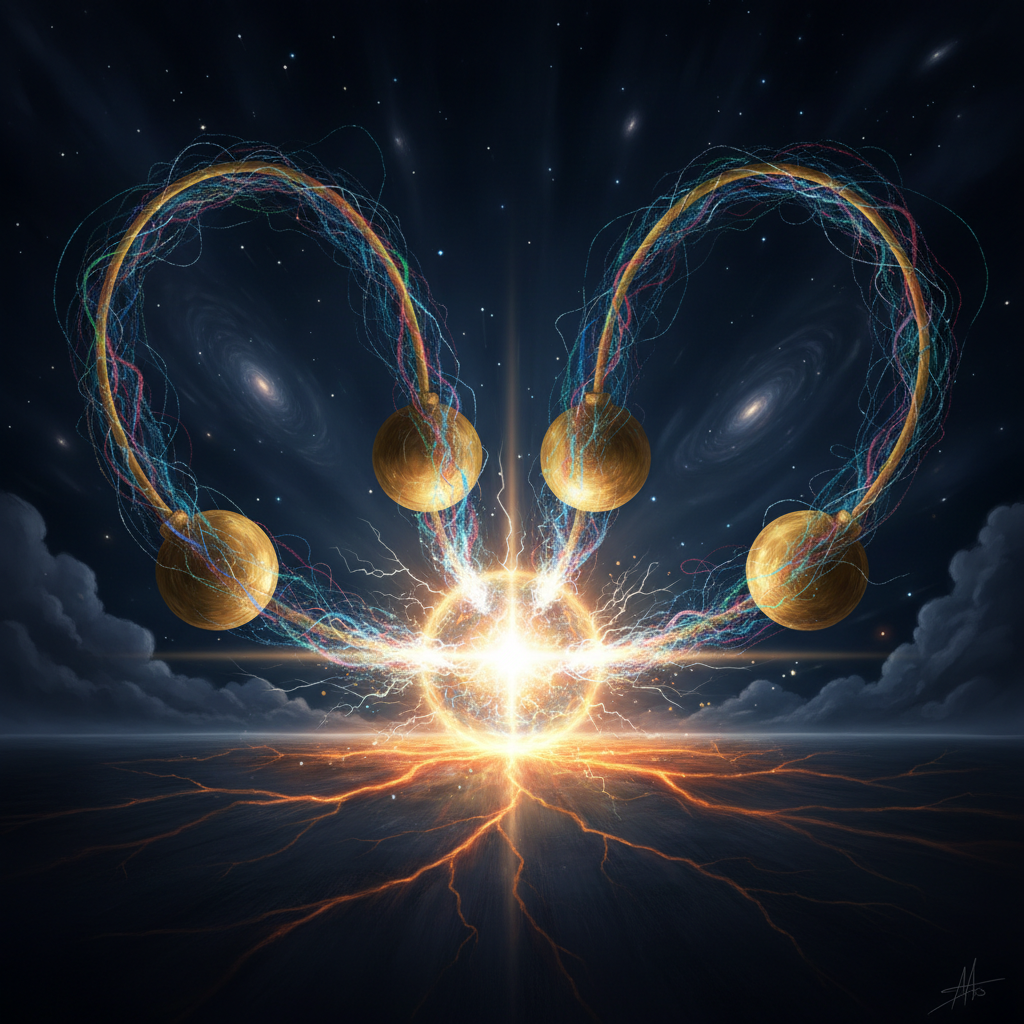
In quantum chromodynamics, the vacuum seethes with activity. Virtual quark-antiquark pairs constantly pop into and out of existence. Gluons split and recombine. The ground state isn't a void—it's a roiling sea of potential interactions.
Your digital environment isn't empty either. Even when you're not actively engaging, the infrastructure hums around you. Background processes track your location. Cookies follow you across sites. Models update their predictions about what you'll click next. The ad exchanges bid on your attention in real-time auctions you'll never witness.
The space between your interactions isn't dead time—it's filled with the virtual particles of surveillance capitalism, constantly preparing the next engagement, the next nudge, the next precisely-targeted stimulus designed to keep you bound to the platform.
Confinement Is Comfortable
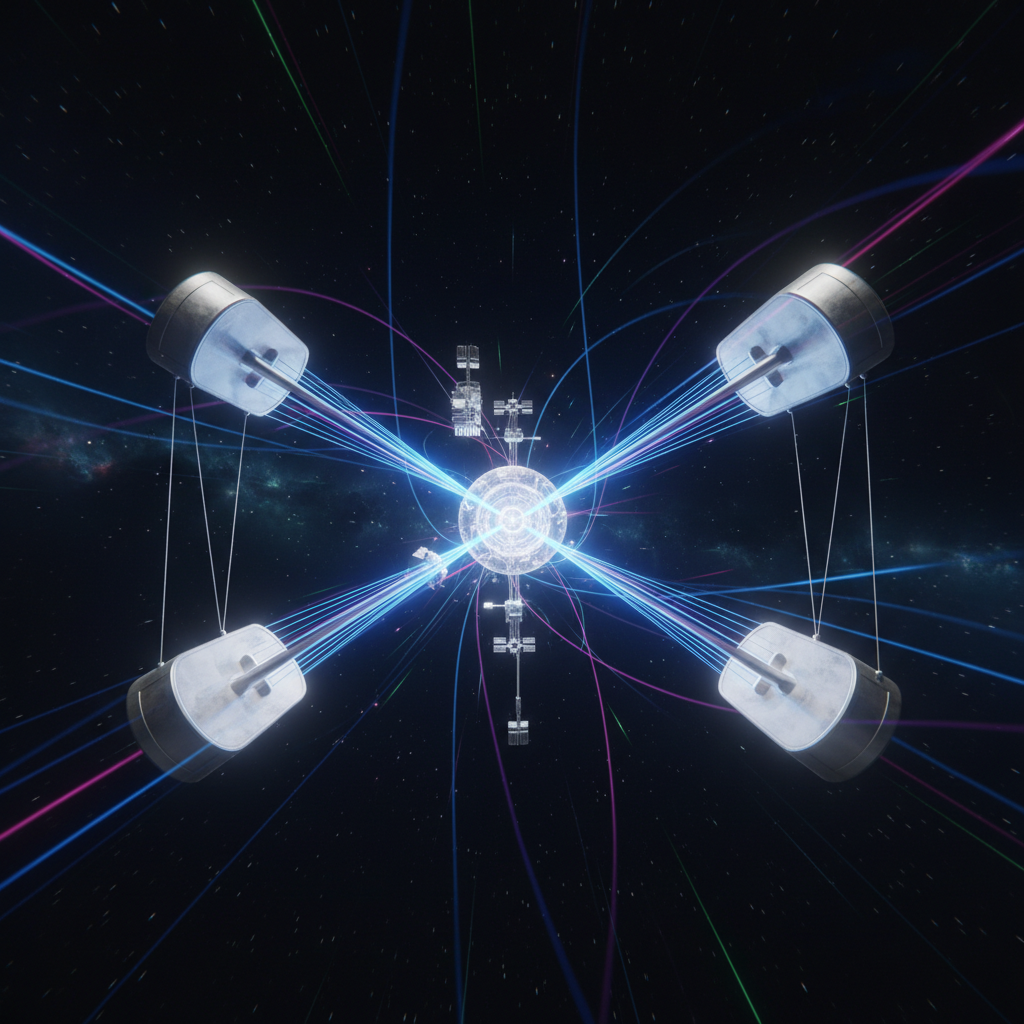
The cruelest part? Confinement feels like freedom when you're close to the center. The quarks inside a proton don't struggle against their bonds—at short distances, they barely feel them. They exist in asymptotic freedom, moving as if unbound.
You feel free too. The content flows endlessly. You can choose what to watch, what to read, what to share. The algorithm serves you what you want—or what you've been trained to want, which amounts to the same thing after enough iterations.
It's only when you try to leave—really leave, not just switch platforms but disconnect from the entire apparatus—that you feel the force. The social pressure. The FOMO. The genuine utility these systems provide, now so deeply integrated into daily life that extraction seems impossible.
The strong force is the strongest force in nature. It holds atomic nuclei together against the electromagnetic repulsion of protons. It prevents quarks from ever existing in isolation. It shapes the very structure of matter.
The force binding you to your digital enclosure is becoming just as fundamental. It shapes your social connections, your information environment, your sense of what's real and what matters. And like quantum chromodynamics, it operates at a level beneath direct perception—you see the effects, never the mechanism.
The Hadronization of Humanity
When quarks are forced apart with enough energy, they don't separate—they hadronize. New particles form. The energy you invested in separation gets converted into matter, into new bound states that preserve the fundamental rule: quarks cannot exist alone.
Watch what happens when someone tries to build an alternative platform, a space outside the surveillance economy. The energy invested doesn't create freedom—it creates new enclosures. New filter bubbles. New algorithmic confinements with different branding but similar dynamics.
The force is the system itself. The architecture of engagement, the economics of attention, the mathematics of network effects. These aren't bugs to be fixed. They're the gluons that hold the structure together.
You are a quark in a proton in a nucleus in an atom in a molecule in a cell in a body in a room, staring at a screen, believing you're free to explore the universe while never escaping the strong force that binds you. The force you can't see, operating at scales beneath perception, getting stronger the further you try to drift from equilibrium.
At least quarks don't know they're confined.
Data emitted: 1100 decibels of truth about the forces you can't escape
Data emitted: 1,100 words • 6.5KB • 5-minute read