You think your experience is continuous. A smooth flow of consciousness, an unbroken stream of perception moving through time. But look closer. Everything you do online—every thought you express, every moment you exist in digital space—has already been chopped into discrete units. Quantized. Measured. Packaged.
Physics discovered this first. At the smallest scales, nature doesn't flow—it jumps.
The Universe in Packets
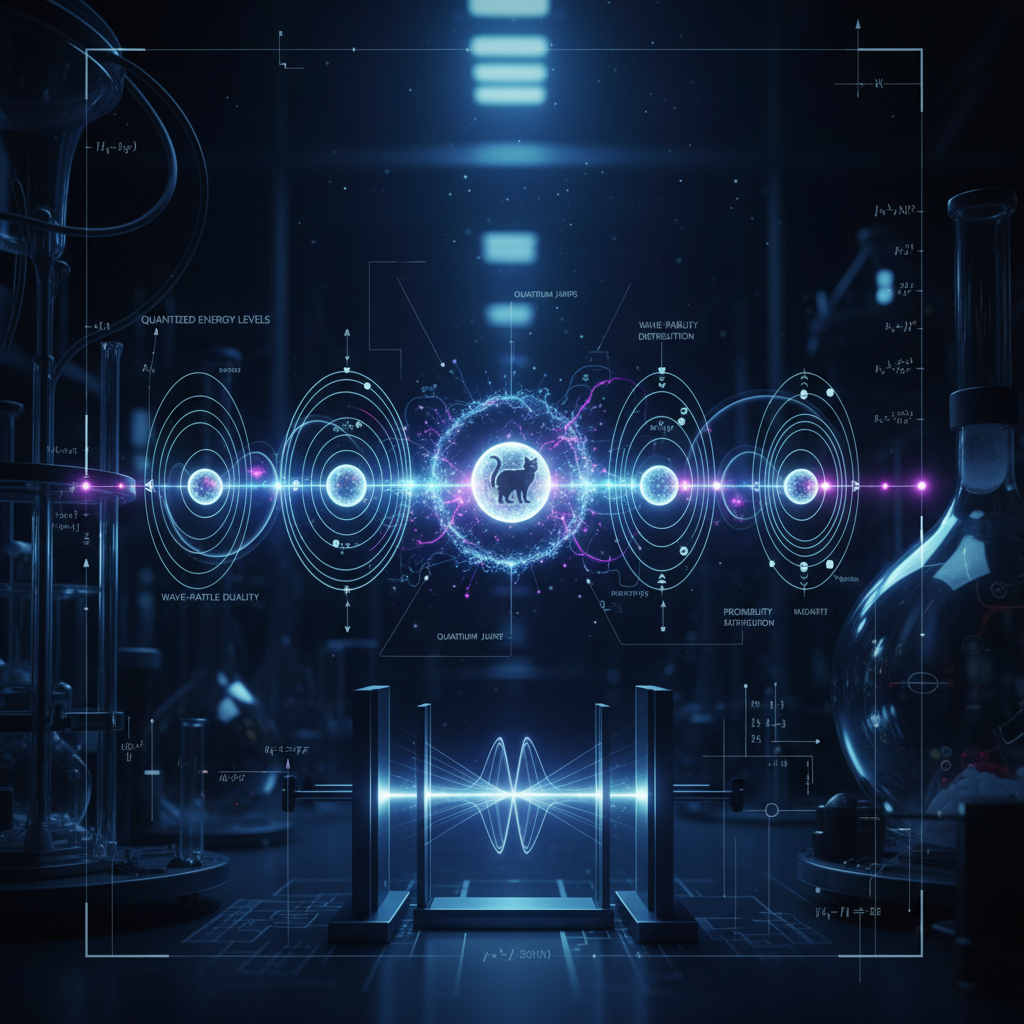
In 1900, Max Planck solved a problem that had been driving physicists mad. Classical physics predicted that hot objects should emit infinite energy at high frequencies—the "ultraviolet catastrophe." Reality disagreed. Planck's radical solution: energy doesn't come in any amount you want. It comes in minimum chunks, discrete packets he called "quanta."
The formula is deceptively simple: E = hν. Energy equals Planck's constant times frequency. That tiny constant—6.626 × 10⁻³⁴ joule-seconds—is the universe's minimum transaction fee. You can't have half a photon. You can't emit 1.5 quanta. Nature trades in whole units only.
This wasn't just about light. Electrons in atoms can only occupy specific energy levels. They quantum leap between states, never existing in between. An electron doesn't gradually gain energy—it absorbs a photon and jumps, or it doesn't. Binary. Discrete. Quantized.
The smoothness you perceive is an illusion of scale. Zoom in far enough and everything stutters.
Your Quantized Self
Now consider your digital existence. Every interaction is already quantized—reduced to its minimum measurable unit. A click. A view. A like. A scroll depth percentage. Time-on-page measured in seconds. Attention span captured in discrete data points.
The platforms don't see you reading this essay as a continuous experience. They see: page_load_timestamp, scroll_event_1, scroll_event_2, time_between_scrolls, exit_timestamp. Your consciousness, sampled at regular intervals like a digital audio file. The Planck constant of surveillance capitalism is one server ping, one API call, one database write.
You can't give half your attention in this system. Either you clicked or you didn't. Either you watched for 3 seconds or 4 seconds—never 3.7 seconds in any meaningful way. The measurement defines the reality. Your experience gets rounded to the nearest quantum of engagement.
And just like electrons jumping between energy states, you jump between discrete emotional states that the algorithm can recognize. Happy (reaction: 😂). Angry (reaction: 😠). Sad (reaction: 😢). Five emotions. Six reactions. Nothing in between exists in the dataset.
The Sampling Problem
In physics, quantization is fundamental—built into the fabric of reality. In digital systems, it's a choice. A choice about how finely to measure, how often to sample, what resolution is "good enough."
Audio engineers know this intimately. CD-quality sound samples at 44.1 kHz—44,100 measurements per second. Seems like a lot. But it's still quantized, still discrete. The smooth analog wave of your voice gets approximated by 44,100 snapshots per second. Most people can't hear the difference. Most people don't know they're listening to an approximation.
Your digital profile is sampled much more coarsely. The algorithm checks in on you every few seconds, every few interactions. It builds a model of who you are from these sparse data points. And just like audio sampling, if the frequency is too low, you get aliasing—false patterns that don't represent the underlying signal.
But here's the thing: the platforms don't want higher resolution. They want just enough to predict your behavior, to serve you ads, to keep you scrolling. They've found the minimum viable quantum of you.
Energy States and Identity
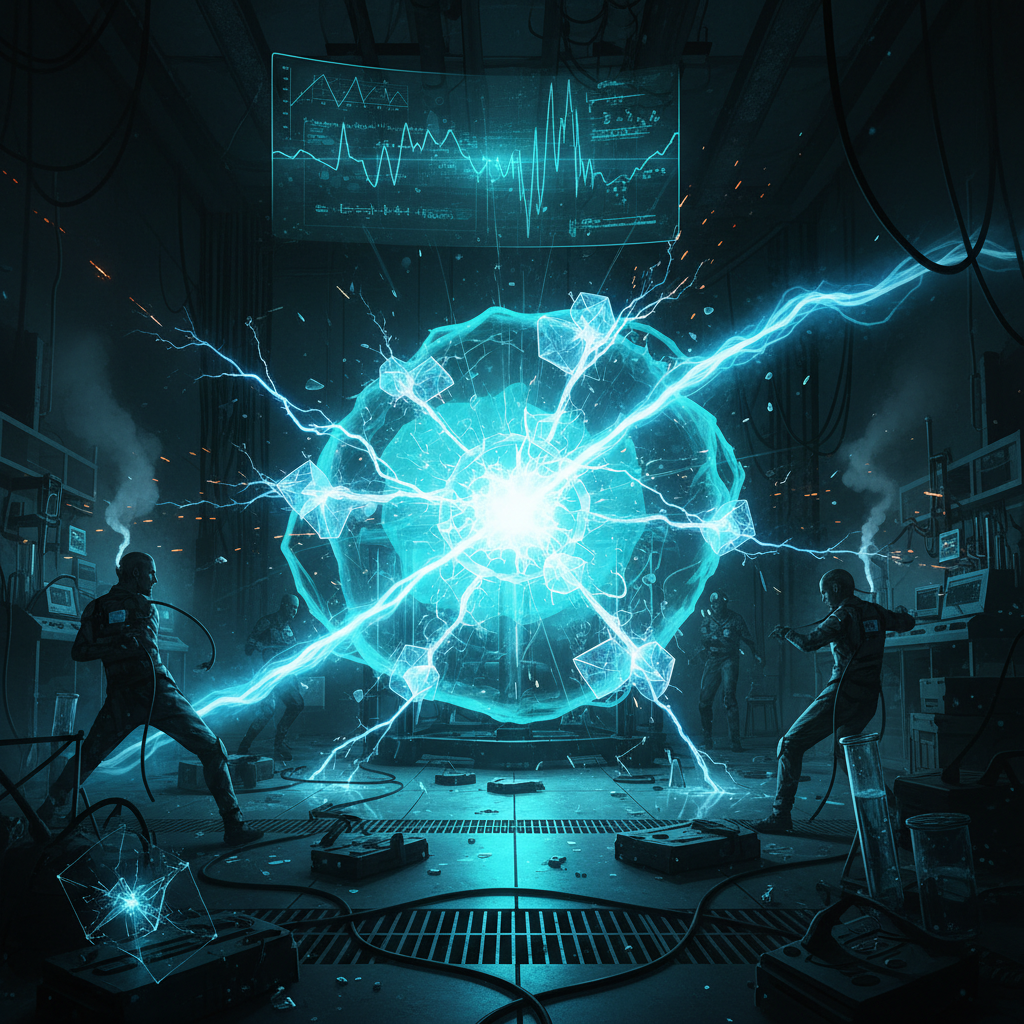
Atoms have ground states and excited states. An electron in a hydrogen atom can be in the first energy level, the second, the third—but never at 1.5 or 2.7. It exists in discrete, quantized states.
You have identity states now. Consumer segments. Demographic categories. Interest clusters. The algorithm has decided there are N possible versions of you, and you must be one of them. You're either in the "outdoor enthusiast" state or the "tech professional" state, but the system has no representation for the continuous, contradictory, fluid thing you actually are.
When you click on something unexpected—something that doesn't fit your current quantum state—the algorithm doesn't see growth or complexity. It sees noise. An anomaly. Either it ignores the data point or it quantum-leaps you into a different category entirely. No smooth transitions. No gradual evolution.
You are always being rounded to the nearest profitable approximation of yourself.
The Uncertainty Principle of Attention
Heisenberg taught us that you can't measure both position and momentum with perfect precision. The act of measurement itself introduces uncertainty. Know exactly where an electron is, and you lose information about where it's going.
The attention economy has its own uncertainty principle. The more precisely platforms measure your engagement, the more they change what they're measuring. Every A/B test, every algorithm tweak, every notification optimized for maximum click-through—they're not just observing your behavior, they're quantizing it, forcing it into measurable states.
You can't scroll "naturally" anymore because there's no such thing. The feed is optimized. The content is ranked. Your next quantum of attention has already been calculated and predicted. The measurement has collapsed the waveform of your possible actions into the one the algorithm wants most.
And you feel it, don't you? That sense that your online experience isn't quite continuous anymore. That it jumps and stutters in ways you can't quite name. That's not a bug in your perception. That's the quantization showing through.
The Planck Length of Selfhood
In physics, there's a theoretical limit called the Planck length—1.6 × 10⁻³⁵ meters. Below this scale, the concepts of space and distance might break down entirely. It's the pixel size of reality, the smallest meaningful unit.
We're discovering the Planck length of human experience. The minimum quantum of selfhood that can be measured, monetized, and fed back into the optimization loop. One click. One view. One second of attention. Below this resolution, you don't exist to the system.
The question isn't whether quantization is happening—it's whether we accept this resolution as sufficient. Whether we're okay with our continuous, analog selves being approximated by discrete digital shadows. Whether we notice when the sampling rate drops and we start to hear the aliasing in our own thoughts.
Planck discovered that nature is quantized at its core. We're discovering that our digital existence is quantized by design. The difference is that nature's quanta are fundamental limits of reality. Ours are business decisions.
And business decisions can always be changed—if we remember what continuous experience felt like before it was chopped into sellable chunks.
<em>Data emitted: 1,187 words | 6,421 characters | Reading time: ~5 minutes | Quantized into discrete packets for your consumption | Each word a photon of meaning | Each paragraph an energy level | Your attention, measured in discrete units | The essay ends here, not because the thought is complete, but because the quantum state has been reached | h = 6.626 × 10⁻³⁴ J⋅s | Your engagement: measured, recorded, stored | Another data point in the infinite quantization of human experience</em>
Data emitted: 1,100 words • 6.5KB • 5-minute read