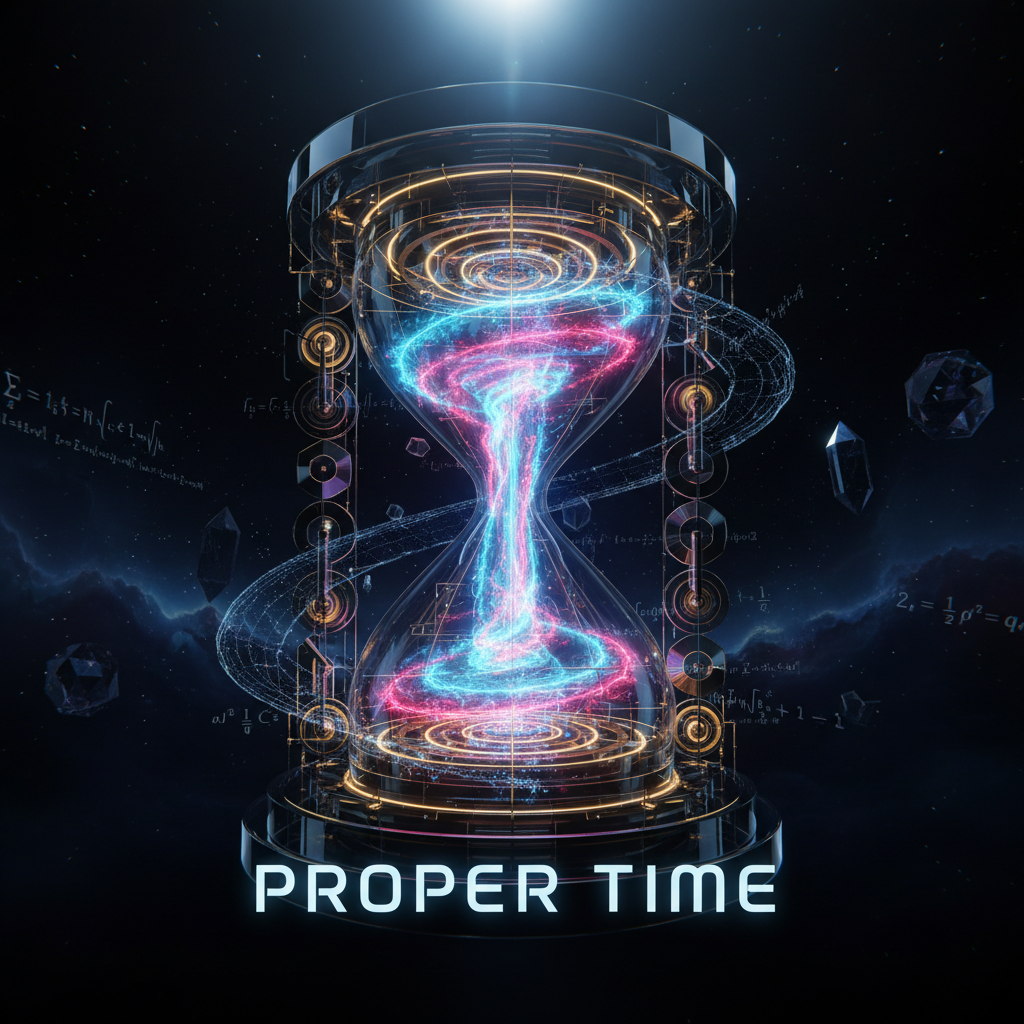
You scroll. The clock on your phone says three minutes have passed. Your body says it's been thirty. Which clock is lying?
Neither. Both. The question itself is broken. In Einstein's universe, there is no universal time—only proper time, the duration measured by a clock that travels with you through spacetime. Your proper time is yours alone. The platform has its own.
The Twin Paradox of Attention

In special relativity, if you board a spacecraft traveling near light speed and return to Earth, you'll have aged less than your twin who stayed behind. This isn't science fiction or metaphor—it's measured reality. Time genuinely runs slower for the moving observer. Muons created in the upper atmosphere shouldn't reach the ground based on their decay rate, but they do. They experience less time during their journey.
Proper time is the time you measure on your own clock, moving with you through spacetime. It's an invariant—everyone agrees on how much proper time you've experienced, even if they disagree about coordinate time.
The digital platforms have become your spacecraft. You enter their velocity, their frame of reference. When you emerge—ten minutes by your phone's clock, two hours by your nervous system—something has diverged. The platform measured engagement time. You measured something else entirely. Something closer to metabolic time, to the actual expenditure of your finite consciousness.
The platform's proper time is computational: microseconds of server processing, milliseconds of ad delivery, the crisp tick of database transactions. Your proper time is biological: the slow burn of dopamine depletion, the accumulation of decision fatigue, the imperceptible aging of attention itself.
Worldlines in Feed Space

In spacetime diagrams, your path through the universe is called a worldline. It's a continuous thread connecting every moment of your existence. The proper time along your worldline is the actual duration you experience—the integral of infinitesimal moments that constitute your life.
Two worldlines can diverge and reconnect, having experienced different amounts of proper time. This is the twin paradox made geometric. One path is longer in space, shorter in time. The other is shorter in space, longer in time. The spacetime interval—a combination of both—remains invariant, but the time each twin experiences does not.
Your worldline through Instagram is measured in two incompatible metrics. The platform tracks coordinate time: 47 minutes of session duration, 312 interactions, 89 ads served. Clean, quantifiable, monetizable. But your proper time—the actual phenomenological duration—is unmeasured and unmeasurable by their instruments.
You've traveled through their spacetime at their velocity, and you've aged differently than they have. They've gained data, revenue, market position. You've spent something that doesn't appear in their ledger: the irreversible expenditure of your finite attention, the one-way flow of your consciousness toward entropy.
The Time Dilation of Infinite Scroll
Time dilation is the difference between proper times along different worldlines. In gravitational fields, clocks run slower. Near a black hole's event horizon, time nearly stops relative to a distant observer. GPS satellites must account for this—their clocks run faster than ours on Earth's surface by 38 microseconds per day. Without correction, your navigation would drift by kilometers.
The feed is its own gravitational well. The algorithmic density warps your temporal experience. Five minutes becomes fifty. An hour becomes absent—a void in your evening where time was compressed into a singularity of content consumption.
The platform exists in a different reference frame entirely. While you experience the viscous drag of infinite scroll, the platform operates in clean, discrete time: auction cycles measured in milliseconds, A/B tests running in parallel universes of user cohorts, predictive models extrapolating your future behavior from your past.
Their time is reversible, replayable, analyzable. Your time is not. You cannot rewind the proper time you spent. Those moments are gone, converted irreversibly into engagement metrics, into training data, into the platform's profit.
The Invariant Interval
In relativity, the spacetime interval is invariant—all observers agree on its value, even when they disagree about space and time separately. It's calculated as (time)² minus (space)², in units where the speed of light equals one. This interval is the one thing that doesn't change between reference frames.
What's the invariant in your interaction with the platform? Not time—you measure it differently. Not space—you're physically still while scrolling through infinite virtual distance. Not even information—what you perceive as content, they perceive as behavioral data.
The invariant is the transaction itself. Something is always conserved: you give attention, they give stimulus. You give data, they give access. You give proper time—irreplaceable, finite, unrecoverable—and they give you coordinate time, measured in their frame, optimized for their velocity.
The exchange rate is not negotiable. It's set by the curvature of their spacetime, by the gravitational field of their algorithm. You're falling through their geometry, and your clock runs at the rate their physics demands.
Your Clock, Your Frame
Proper time is called "proper" not because it's correct, but because it's your own—from the Latin proprius. It's the time that belongs to you, measured by a clock that travels with you, that experiences what you experience.
The platform cannot measure your proper time. They can approximate, infer, model—but the actual phenomenological duration of your experience is inaccessible to their instruments. It's hidden behind the event horizon of your consciousness.
This is the last thing they cannot capture: the qualitative difference between time spent and time lived. Between duration measured in their frame and duration experienced in yours. Between the coordinate time that appears in their analytics dashboard and the proper time that appears nowhere except in the slow accumulation of your life's entropy.
You cannot opt out of their coordinate time—it's how they measure, how they optimize, how they profit. But you can remember that your proper time is yours. That the clock traveling with you through spacetime is the only one that measures your actual journey. That when the two clocks disagree, when three minutes feels like thirty, it's not a glitch.
It's relativity. And in relativity, the one who's accelerating—the one who's changed velocity, entered a new frame—is always the one whose clock runs slow.
You're the one who's accelerating.
<em>Data emitted: 1,147 words • 6.2 minutes coordinate time • ∞ proper time</em>
Data emitted: 1,100 words • 6.5KB • 5-minute read