
You launch yourself into the feed at 9:47 AM. Thumb flicks upward. Initial velocity: maximum. The algorithm has calculated your trajectory before you even know you're in motion.
Projectile motion is the poetry of inevitability. Once you leave the ground, physics owns you completely. No thrust, no course correction, just you and gravity having a conversation you can't interrupt. Your path through space becomes predetermined the instant you let go.
The Mathematics of Launch
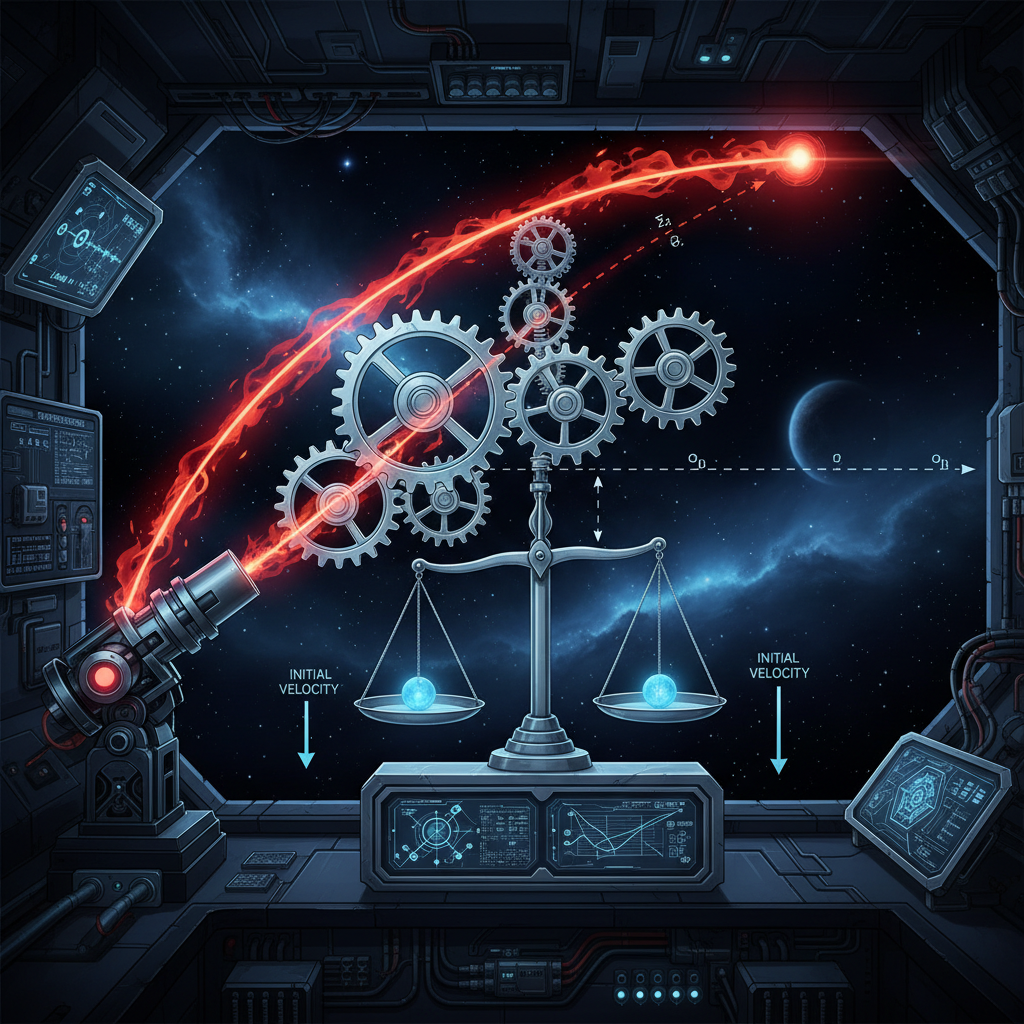
In classical mechanics, projectile motion splits into two independent components. Horizontal velocity remains constant—nothing in empty space slows you down laterally. But vertical motion? That's where gravity writes its signature. You rise, you peak, you fall. The equation is elegant: y = y₀ + v₀t - ½gt². Every trajectory is a parabola waiting to happen.
The beauty is in the independence. Your horizontal movement doesn't care about your vertical descent. You can be moving forward at constant speed while simultaneously accelerating downward. Two motions, one object, complete orthogonality.
Launch angle matters more than you think. Forty-five degrees gives maximum range in a vacuum, but real environments complicate everything. Air resistance. Wind. The friction of existing in actual space rather than theoretical space.
Your Attention as Projectile

When you open an app, you're launching your attention into a carefully constructed ballistic environment. The initial velocity is your intention—maybe you wanted to check one thing, send one message, look up one fact. That's your v₀, your starting vector.
But the platform has already calculated your parabola. They know the average arc of users like you. They've measured thousands of trajectories, millions of launch angles. Your path is predictable because projectile motion is predictable. The algorithm doesn't need to know *you*—it just needs to know your initial conditions.
The horizontal component is your forward momentum through content. Scroll, scroll, scroll. Constant velocity through an infinite feed. No friction to slow you down—they made sure of that. Smooth glass. Infinite scroll. Frictionless surfaces are great for projectiles.
The vertical component? That's your engagement dropping. Gravity here is attention decay. You start high—focused, intentional. But you're falling the entire time, even as you move forward. Each swipe drops you deeper into the well. The peak of your parabola was the moment you unlocked your phone.
Trajectory Prediction Markets

Platforms don't just observe your projectile motion—they bet on it. Your trajectory has a dollar value. If they can predict where you'll land, they can place content there like a catcher's mitt waiting for a baseball.
The range equation tells them how far you'll go: R = (v₀² sin 2θ)/g. Replace velocity with engagement metrics. Replace angle with user state. Replace gravity with attention decay rate. Suddenly you have a prediction engine. Suddenly you have a business model.
They measure your launch velocity every time you open the app. Morning launches are different from midnight launches. Commute trajectories differ from bathroom trajectories. Each context creates different initial conditions, and each set of conditions produces a predictable arc.
The landing point is where the conversion happens. Where you click the ad. Where you make the purchase. Where you share the content. The entire trajectory exists to deliver you to that specific coordinate in space-time. Everything else is just ballistics.
Air Resistance is Consciousness
In real projectile motion, air resistance complicates the clean parabola. Drag force increases with velocity. The faster you move, the more the medium resists you. This is why actual projectiles don't follow perfect mathematical curves.
Your consciousness is air resistance in the attention economy. When you notice what's happening—when you feel the manipulation, recognize the pattern, see the arc you're tracing—you create drag. You slow down. The trajectory deviates from prediction.
This is why platforms optimize for frictionlessness. Not just interface friction—cognitive friction. They want you in a vacuum where Newton's laws apply perfectly. Where your attention follows clean parabolas. Where consciousness doesn't interfere with ballistics.
Every moment of awareness is drag force. Every time you ask "why am I here?" or "what am I doing?" you're adding air resistance to your trajectory. You deviate. You land somewhere unexpected. You break the prediction model.
The Freedom of Falling
Here's the strange thing about projectile motion: once you're in flight, you're completely determined but also completely free. No force acts on you horizontally. You coast. You're in a state of pure inertia in one dimension while being purely accelerated in another.
This is the seduction of the feed. You feel free—swiping where you want, choosing what to see, exercising agency. And you are free, in the horizontal dimension. But you're falling the entire time. Gravity never stops. The vertical component is non-negotiable.
Maybe the answer isn't to fight the trajectory. Maybe it's to know you're in one. To feel the arc. To understand that the moment you launched, you began falling. Not because you're weak. Not because you failed. Because that's what projectiles do.
Terminal Velocity
You'll land eventually. Every trajectory has a range. The question is whether you choose the landing point or whether it was chosen for you when you launched.
The platforms have calculated thousands of landing zones. They've optimized the terrain. They've placed targets at maximum range for your demographic, your psychology, your launch angle. The ground rises up to meet you exactly where the math said it would.
But air resistance—consciousness—changes everything. Enough awareness and you don't follow the parabola anymore. You create your own drag. You land somewhere they didn't predict. Somewhere outside the model.
The feed is still open. Your thumb hovers. You can feel the potential energy, the urge to launch again. But now you know: every scroll is a trajectory. Every swipe is a launch angle. And gravity is always waiting to write its equation across your arc.
**Data emitted**: 1,147 words on ballistic capitalism and the parabolas we trace through digital space. Launch velocity: high. Landing point: unknown. Air resistance: increasing.
Data emitted: 1,100 words • 6.5KB • 5-minute read