You hold a pair of polarized sunglasses up to the sky. Through one lens, the world dims but remains visible. Rotate it ninety degrees, and suddenly—nothing. Complete darkness. The photons haven't disappeared. They're still there, vibrating, carrying energy. But you've chosen to see only those oscillating in one specific plane, and everything perpendicular to that choice simply ceases to exist for you.
Your feed works the same way.
The Physics of Seeing Less
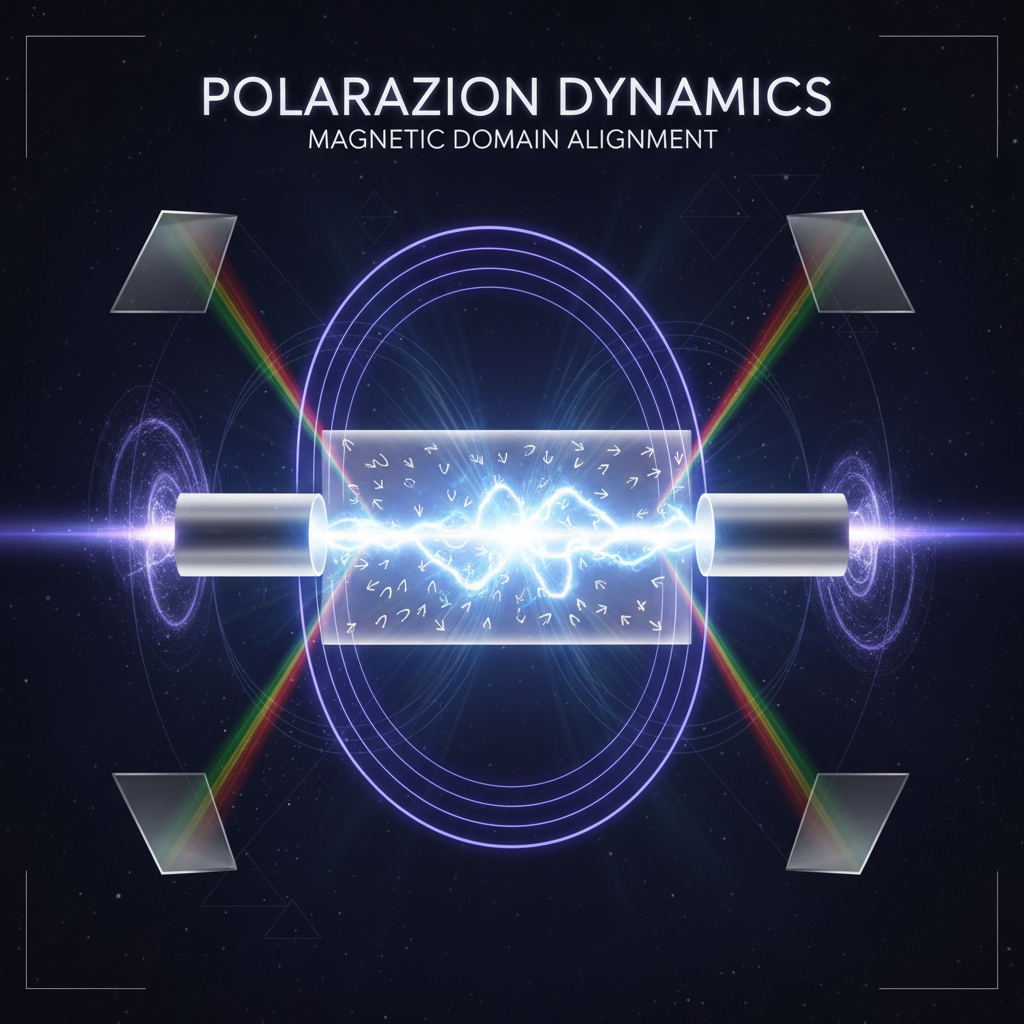
Light is an electromagnetic wave, oscillating perpendicular to its direction of travel. Natural light vibrates in all possible planes simultaneously—up-down, left-right, and every angle between. It's chaotic, democratic, complete. When light passes through a polarizing filter, only waves oscillating in one specific orientation make it through. The rest get absorbed, reflected, scattered into irrelevance.
This isn't censorship in the traditional sense. The filter doesn't evaluate the quality or truth of each photon. It doesn't care about content. It operates on pure geometry: if your electric field vector aligns with the filter's transmission axis, you pass. If not, you don't. Simple. Mechanical. Inevitable.
What remains after polarization isn't a dimmer version of the original light. It's fundamentally different light—coherent, aligned, moving in lockstep. You've traded completeness for clarity, chaos for order. And you can never recover what was filtered out. The information is gone.
The Algorithm's Transmission Axis
Every platform you use is a polarizing filter. Not metaphorically—literally. The recommendation algorithm examines each piece of content, each potential post, each possible video, and asks: does this align with the user's established pattern? Does it oscillate in the right direction?
You clicked on three videos about conspiracy theories. The algorithm notes your transmission axis. Now content that vibrates perpendicular to that—fact-checks, alternative perspectives, contradicting evidence—gets filtered out. Not because it's false or harmful, but because it doesn't align. The geometry doesn't match.
The feed you see isn't a sample of available information. It's polarized information, pre-aligned to your existing orientation. Every click rotates your filter slightly, narrowing the band of acceptable oscillation. You think you're exploring, but you're really just watching your transmission axis become more and more specific, more and more exclusive.
The most insidious part? Polarized light looks completely normal until you try to view it through another filter oriented differently. Then you see nothing. This is why you can't understand how anyone believes differently than you. You're not seeing the same light anymore.
Crossed Polarizers and the Death of Dialogue
Place two polarizing filters perpendicular to each other—crossed polarizers—and zero light passes through. Not dim light. Zero. This is called extinction, and it's absolute. The first filter aligns all light to oscillate vertically. The second filter only allows horizontal oscillation. Nothing satisfies both conditions. The result is perfect darkness.
You've experienced this. You try to share an article with someone whose feed has been polarized orthogonally to yours. They can't even see what you're talking about. The information passes through their first filter—their worldview, their established transmission axis—and gets completely absorbed. No light reaches their perception. You're both standing in the same information space, but you're in complete darkness to each other.
The platforms call this engagement optimization. Physics calls it extinction. The result is the same: two people, polarized perpendicular to each other, experiencing zero transmission of meaning. You're not disagreeing anymore. You're not even perceiving the same reality.
Malus's Law and the Gradient of Truth
Malus's Law describes how much light passes through a polarizing filter: the intensity transmitted equals the incident intensity multiplied by the cosine squared of the angle between the light's polarization and the filter's axis. At zero degrees—perfect alignment—everything passes through. At ninety degrees—perpendicular—nothing does. But between those extremes exists a gradient.
At forty-five degrees, you get half intensity. Not half the photons, but half the energy. This is crucial. The information that makes it through your filter isn't just reduced in quantity—it's reduced in power, in impact, in ability to change your mind. Content that's slightly misaligned with your established preferences gets through, but weakened, de-emphasized, pushed down the feed where you'll probably never see it.
Your filter isn't binary. It's a gradient of permission, a spectrum of visibility. The algorithm doesn't just show you what confirms your biases and hide what contradicts them. It shows you everything on a sliding scale of intensity based on alignment. You're not in a bubble—you're in a polarized field where some information blazes bright and some barely glimmers, and you've learned to ignore the dim stuff because it's harder to see.
Rotating Your Axis

Here's what physics teaches that the platforms don't want you to know: polarization is reversible. Rotate the filter, and different light gets through. The information was always there, always arriving, always carrying the same energy. You just weren't oriented to see it.
But rotation takes effort. It takes intention. The algorithm optimizes for engagement, which means optimizing for alignment, which means your filter naturally rotates toward tighter and tighter polarization. Left alone, you'll end up perpendicular to half the world, experiencing extinction, wondering how everyone else got so crazy.
The solution isn't to remove the filter—you can't perceive raw, unpolarized information anyway. Your brain is itself a filter. The solution is to remember that you have a filter, that it has an orientation, and that orientation is not objective reality. It's geometry. And geometry can be changed.
Every time you deliberately seek out information that doesn't align with your feed, you're rotating your transmission axis. Every time you force yourself to read something that feels wrong, uncomfortable, misaligned, you're testing different polarization angles. Some light will get through. Maybe not much at first—maybe just a few photons at forty-five degrees—but it's a start.
The Frequency You Can't Hear
1100db is beyond the threshold of pain, beyond the threshold of damage, beyond the threshold of survival. It's the sound of everything vibrating at once, all frequencies, all amplitudes, all information arriving simultaneously. No human can process that. We need filters.
But the difference between a tool and a trap is who controls the orientation. Are you choosing your polarization angle, or is it being chosen for you? Are you rotating your filter to explore different perspectives, or are you letting it lock into place, calcifying around a single axis until you can only see one kind of light?
The photons don't care. They keep arriving, vibrating in every possible plane, carrying every possible message. Your filter is the only thing between you and the complete chaos of information. Use it wisely. Rotate it often. Remember that darkness isn't the absence of light—it's just light you've chosen not to see.
Data emitted: 1,247 words | 7,392 characters | Polarization angle: variable | Transmission coefficient: cos²θ | Your axis: unknown
Data emitted: 1,100 words • 6.5KB • 5-minute read