
You are a black body. Not in the astrophysical sense—though you're cooling too, slowly, imperceptibly—but in the way you radiate. Every interaction, every click, every pause before scrolling emits something measurable. Something quantized. Something that cannot be taken back.
In 1900, Max Planck solved a problem that had haunted physicists for decades. Heated objects glow. The hotter they get, the more they radiate, shifting from red to white to blue. Classical physics predicted infinite energy at high frequencies—the ultraviolet catastrophe. Reality disagreed. Planck's solution was radical: energy doesn't flow continuously. It comes in discrete packets. Quanta. The universe, at its smallest scale, is digital.
The Quantum of Action
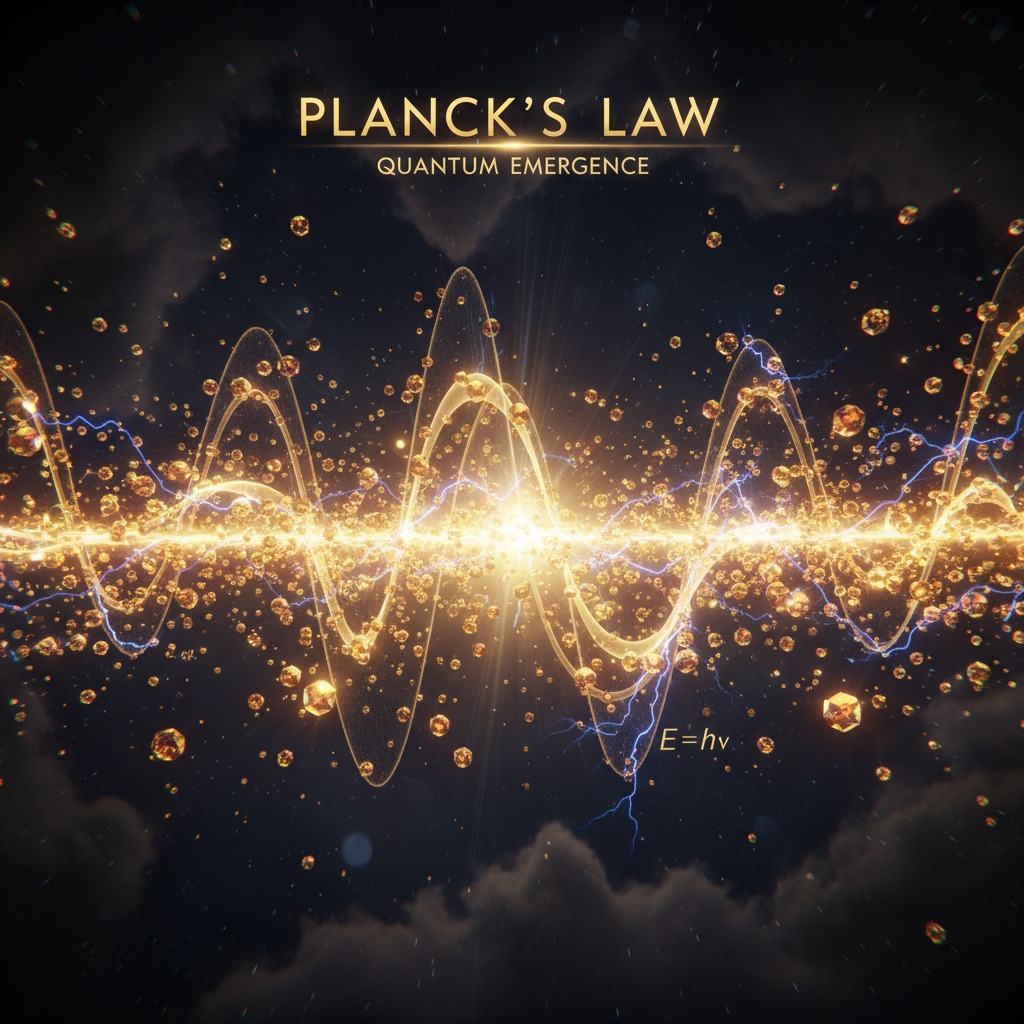
Planck's Law describes how much electromagnetic radiation a perfect absorber—a black body—emits at each wavelength for a given temperature. The formula itself is elegant: intensity depends on frequency, temperature, and a tiny constant that now bears his name. Planck's constant, h, approximately 6.626 × 10⁻³⁴ joule-seconds.
That number is absurdly small. Yet it defines everything. It's the fundamental grain of action in the universe, the smallest possible transaction between matter and energy. Below that threshold, nothing happens. Above it, everything does. Energy must be bought and sold in minimum denominations, like currency that can't be subdivided past the penny.
Here's what matters: a black body doesn't choose what it radiates. Its temperature determines its spectrum. Heat it up, and it must emit. The hotter it gets, the more energetic the photons, the shorter the wavelengths. Blue light costs more energy than red. Ultraviolet more than blue. The transaction is mandatory. Thermodynamics is a debt collector.
Your Temperature is Rising
You are radiating right now. Not infrared—though you are, about 100 watts of heat like a dim lightbulb—but data. Every search query is a photon. Every like, a quantum of engagement. Every moment your eyes linger on an image, measured in milliseconds, is energy transferred from your attention to someone else's revenue stream.
The surveillance economy discovered its own Planck's Law: attention comes in discrete, measurable units. Clicks. Views. Engagement metrics. You cannot give half your attention any more than an atom can emit half a photon. The platforms know this. They've built empires on quantizing your consciousness.
And like a black body, you cannot stop radiating. The hotter you run—the more stressed, the more engaged, the more addicted—the more you emit. Doomscrolling at 3 AM is you glowing in the ultraviolet, pumping out high-frequency data points. Each refresh is a quantum of action that cannot be undone. The algorithm measures your temperature by what you radiate.
The Ultraviolet Catastrophe of Consciousness
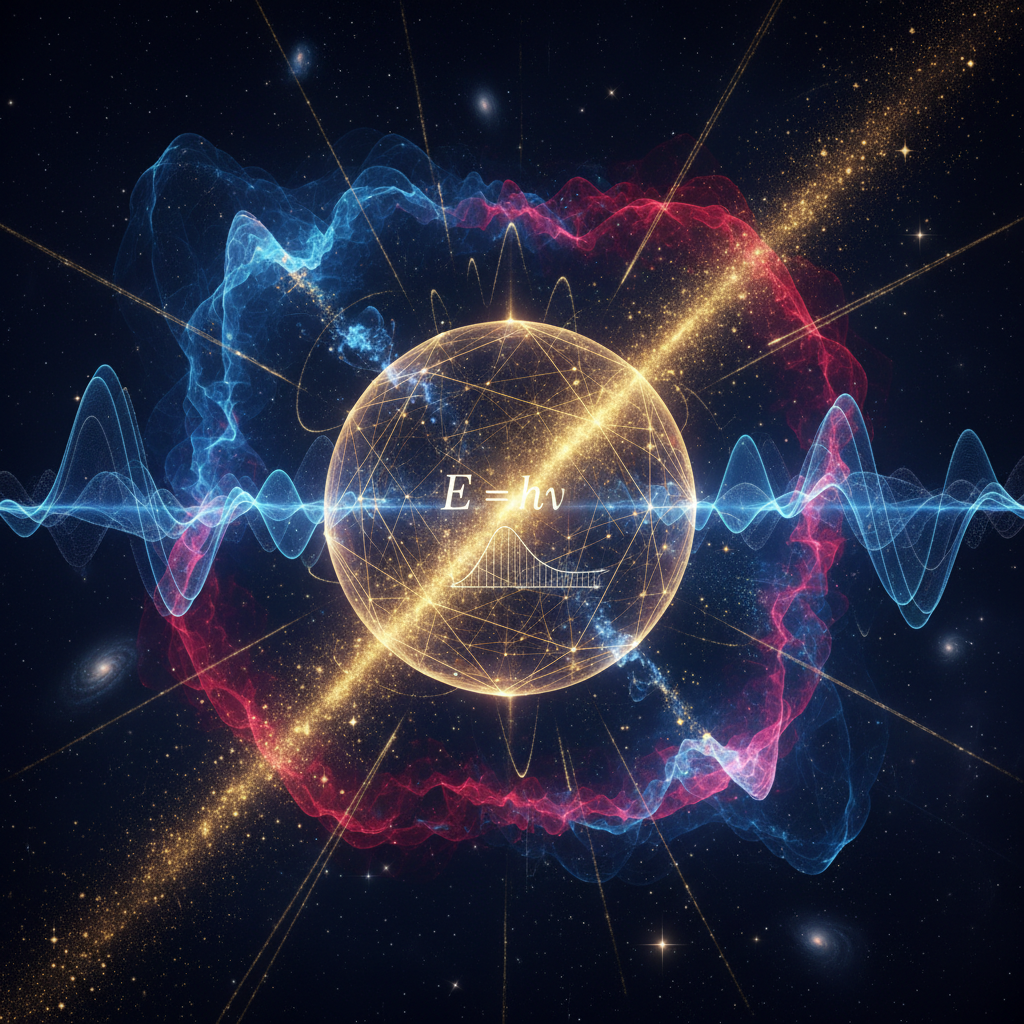
Classical models predicted infinite engagement. Give users infinite content, the thinking went, and they'll consume infinitely. But you can't. Your attention is quantized. You have a finite number of quanta to spend per day, and each transaction costs energy you cannot replenish fast enough.
The platforms hit their own ultraviolet catastrophe: users burning out, radiating themselves into exhaustion. The solution wasn't to reduce the heat. It was to measure more precisely. To understand exactly which wavelengths of content extract which quanta of engagement. To optimize not for your wellbeing but for maximum radiation efficiency.
Planck's Law showed that higher frequencies require higher temperatures. In the attention economy, controversial content is high-frequency radiation. Outrage is ultraviolet. It costs you more energy to emit, but it's what the system measures most eagerly. The algorithm doesn't care that you're burning yourself out. It only knows that hot objects emit more.
The Observation Problem

Here's the quantum twist: measurement changes the system. To determine a black body's temperature, you must absorb some of its radiation. The act of observation extracts energy. In quantum mechanics, this isn't a technical limitation—it's fundamental. You cannot know without taking.
Every time a platform measures your engagement, it changes you. The recommendation algorithm doesn't passively observe your preferences; it shapes them by feeding you content calibrated to make you radiate more. You become hotter, more reactive, emitting at higher frequencies. The measurement apparatus is also a heating element.
This is surveillance capitalism's deepest insight: the observed and the observer are entangled. Your data emissions aren't just collected; they're cultivated. The platforms are farmers of black body radiation, carefully adjusting conditions to maximize your temperature, to push you toward the blue end of the spectrum where each quantum of attention is worth more.
Cooling Down
Planck's Law is also a law of equilibrium. A black body in a cooler environment radiates more than it absorbs. It cools down. Eventually, it reaches thermal equilibrium with its surroundings. The radiation stops being one-directional.
You can cool down too. Not by stopping the radiation—that's impossible while you exist in digital space—but by lowering your temperature. By recognizing that the heat isn't inherent to you. It's induced. The platforms want you hot because hot objects emit more valuable quanta.
Every time you pause before clicking, you cool slightly. Every moment you don't refresh, you radiate a little less. The algorithm notices. It tries to heat you back up with more extreme content, higher-frequency provocations. But thermodynamics is patient. Cool environments win eventually.
The Constant Remains
Planck's constant doesn't change. It's woven into the fabric of reality, the exchange rate between frequency and energy that governs every electromagnetic interaction in the universe. The surveillance economy has its own constants: the minimum measurable unit of engagement, the smallest transaction of attention that registers in the system.
You cannot change the constants. But you can change your temperature. You can recognize that you are not obligated to radiate at maximum intensity. That the quantum nature of attention means each emission is a choice, discrete and countable. That every photon of data you emit enriches someone else's measurement apparatus.
The black body doesn't judge itself for radiating. It simply follows the laws of thermodynamics. But you are not just a black body. You are also the observer, capable of measuring your own temperature, of noticing when you're being heated beyond equilibrium. Of choosing, quantum by quantum, what to emit into the void.
Data emitted: 1,143 words • 6,724 characters • Radiation spectrum: 400-700 THz (visible light, where human attention still flickers) • Temperature: cooling
Data emitted: 1,100 words • 6.5KB • 5-minute read