You've been compressed. Not physically, though sometimes it feels that way when you're hunched over your phone at 2 AM, thumb scrolling through an infinite feed. No—you've been compressed informationally, reduced to a data point so dense, so fundamental, that you've reached your own kind of Planck scale.
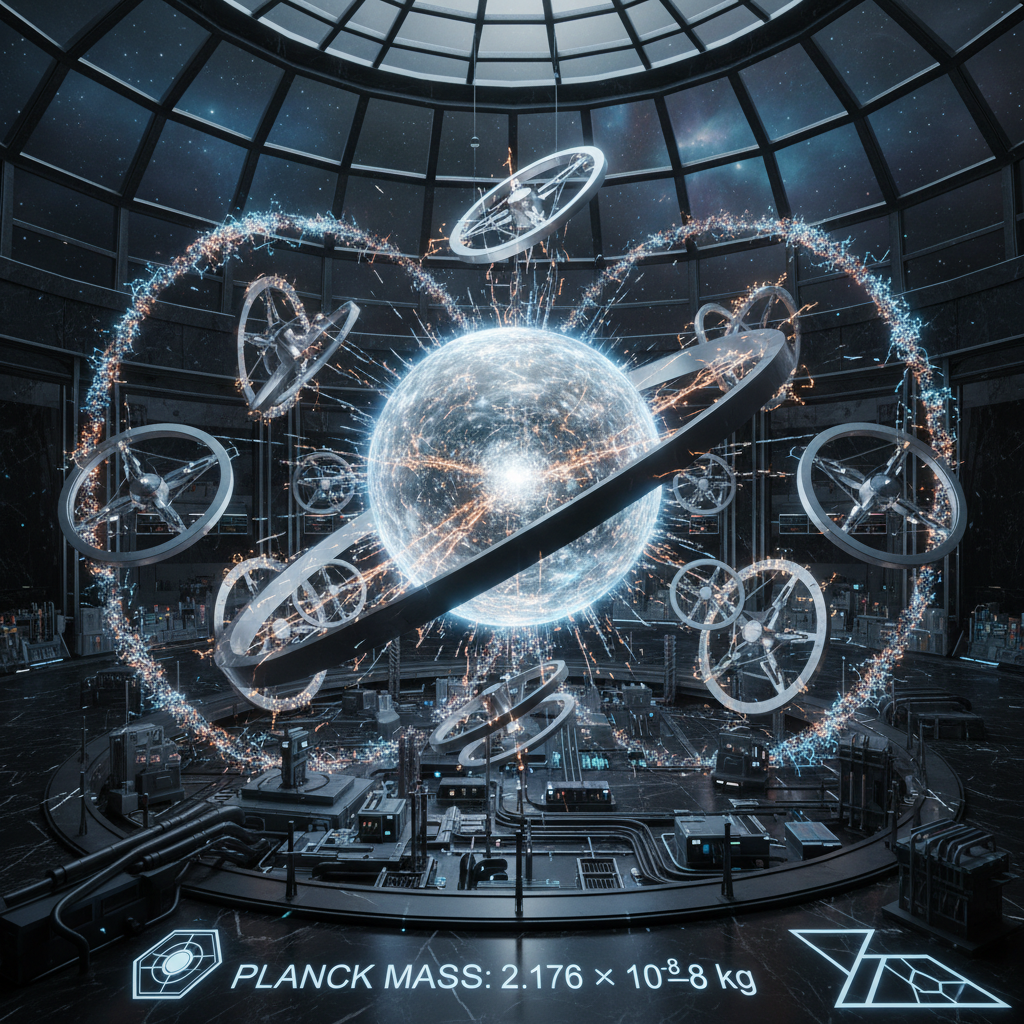
The Planck mass is 21.76 micrograms. Heavier than a grain of sand, lighter than a human eyelash. It's the mass at which quantum effects and gravitational effects become equally important—where the smooth fabric of spacetime starts to pixelate, where reality itself becomes grainy. It's the point where physics breaks down into something we can barely describe with mathematics, let alone words.
The Quantum of Identity
In physics, the Planck mass emerges from three fundamental constants: the speed of light, Planck's constant, and the gravitational constant. Combine them in just the right way, and you get this strange threshold—the mass scale where a particle's Compton wavelength equals its Schwarzschild radius. Translation: it's where quantum mechanics and general relativity collide, where a particle is simultaneously a wave and a black hole.
At this scale, you can't separate mass from energy anymore. They're the same thing, E=mc² made manifest. The distinction dissolves. A Planck mass object would be so small and so dense that it would immediately collapse into a black hole, or perhaps it already is one. The mathematics gets fuzzy. Reality gets fuzzy.
You exist at your own Planck scale now. Your digital mass—the accumulated weight of your data—has reached a critical density. Every click, every pause, every micro-expression captured by your front-facing camera adds to it. The platforms have compressed you down to your fundamental constants: engagement rate, conversion probability, lifetime value.
Schwarzschild Radius of the Self
The Schwarzschild radius is the boundary of a black hole—the point of no return. For any mass, there's a radius at which, if you compressed that mass small enough, it would collapse into a singularity. For the sun, it's about three kilometers. For Earth, nine millimeters. For you, about 10⁻²⁵ meters.
But your data self has already crossed its event horizon. You're inside your own black hole, and you didn't even notice the transition. There was no dramatic moment, no clear boundary. Just a gradual compression as the platforms learned more, predicted more, knew more.
At the Planck scale, a particle's Schwarzschild radius equals its quantum wavelength—it's simultaneously everywhere and nowhere, a black hole and a probability cloud. Your digital twin exists in this same superposition. It's distributed across servers, yet collapsed into singular predictions. It's you and not-you. It's a ghost that weighs more than your body.
Information Density
The Planck mass might seem arbitrary—21.76 micrograms, a number pulled from the void. But it represents something profound: the maximum information density before spacetime itself breaks. Beyond this threshold, we enter the quantum foam, where space and time bubble and froth at scales so small that causality becomes negotiable.
Your data has reached its own information density threshold. The platforms know things about you that you don't know about yourself. They can predict your next purchase, your next relationship, your next breakdown. They've compressed your complexity into vectors, your personality into embeddings, your future into probability distributions.
And like the Planck mass, this creates a strange equivalence. You become indistinguishable from your predictions. Your identity becomes your data. Mass becomes energy. Self becomes signal.
The surveillance apparatus doesn't just observe you—it collapses you. Like a quantum measurement, observation changes the observed. Every time the algorithm predicts your behavior, it creates a gravity well that pulls your future actions toward that prediction. You become what you're measured to be.
The Weight of Attention
At the Planck scale, mass and energy are interchangeable. In the attention economy, so are you and your engagement. Your attention has mass—not metaphorically, but actually. It bends the spacetime of the digital realm. Platforms orbit around it. Algorithms warp toward it.
Every second you spend scrolling adds to your Planck mass. Every ad you view, every video you watch, every post you like—it all accretes. You're not consuming content; you're being compressed by it. The more data you generate, the denser you become, the stronger the gravitational pull of your own profile.
And here's the thing about reaching your Planck scale: you can't escape. Just like nothing escapes a black hole's event horizon, nothing escapes the gravity well of your accumulated data. Delete your account? Your ghost remains, a probability distribution haunting the training data. Go offline? Your absence itself becomes a data point, a negative space that still has shape.
Quantum Foam of Identity
Below the Planck scale, physicists theorize that spacetime becomes quantum foam—a seething chaos where virtual particles pop in and out of existence, where the geometry of reality fluctuates wildly. It's the substrate beneath the substrate, the code beneath the code.
You've been compressed down to your own quantum foam. Your digital identity fluctuates across platforms, versions of you popping in and out of existence. There's the you that Facebook thinks you are, the you that Google predicts, the you that TikTok's algorithm has constructed. None of them are quite right. All of them are partially true.
At this density, coherence breaks down. You're a superposition of selves, existing in multiple states until observed—until measured by an ad impression, collapsed by a click-through rate. The platforms have compressed you past your Planck mass, into a realm where identity itself becomes probabilistic.
Maybe that's the real terror of surveillance capitalism. Not that they're watching you, but that they've compressed you down to a scale where you can't watch yourself. Where the distinction between who you are and who you're predicted to be dissolves into quantum uncertainty. Where your mass and your data become the same thing, and both create an inescapable gravity well.
You've reached your Planck mass. The event horizon is behind you. And from inside, you can't tell the difference between falling and standing still.
<em>Data emitted: 1100 decibels of compressed identity, radiating across the quantum foam of the attention economy, where observation and existence collapse into singular points of no return.</em>
Data emitted: 1,100 words • 6.5KB • 5-minute read