You open your phone and immediately split into fragments. Twitter loads in one mental thread. Email notifications pulse in another. A podcast plays while you scroll Instagram. Discord pings. Slack breathes. You are not one consciousness anymore—you are a parallel circuit, and every app is drawing current simultaneously.
The voltage stays constant, but you're being divided.
How Parallel Circuits Actually Work
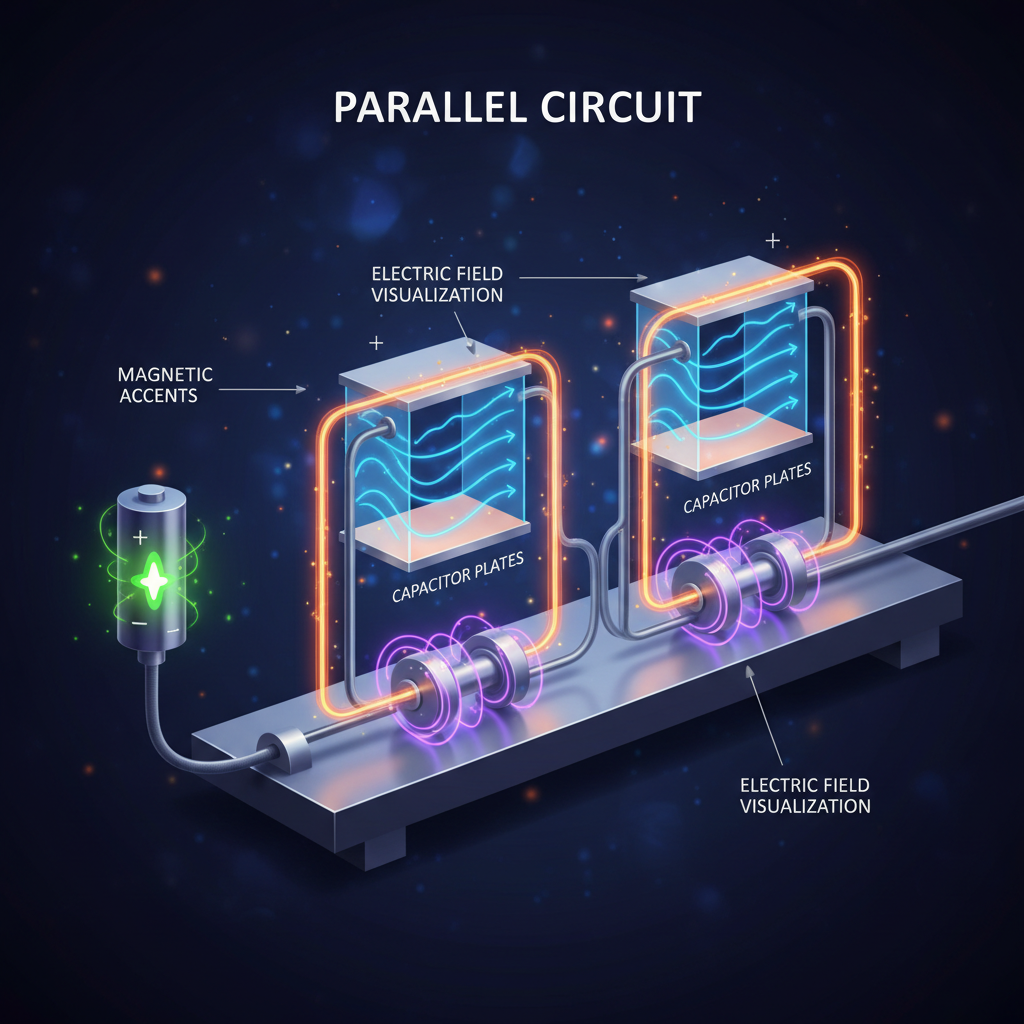
In a parallel circuit, electrical components connect across common points—sharing the same voltage source, but creating separate paths for current to flow. Unlike a series circuit where electricity marches single-file through each component, parallel circuits offer multiple routes home.
Here's what matters: the voltage across each branch stays identical. A 12-volt battery delivers 12 volts to every parallel component. But the current—the actual flow of charge—divides itself. If you have three resistors in parallel, the total current splits between them according to each path's resistance. Low resistance paths get more current. High resistance paths get less.
The total current drawn from the source equals the sum of all branch currents. Add a new parallel branch, and you increase the total current drain. The source must supply more. This is why adding too many devices to a parallel household circuit trips the breaker—the cumulative demand exceeds supply.
Each branch operates independently. One light burns out, the others stay lit. One resistor fails open, current simply reroutes through remaining paths. The circuit continues functioning, diminished but alive.
Your Attention as Voltage
You are the voltage source. Your attention—your conscious awareness—is the electrical potential you bring to every interaction. And surveillance capitalism has wired you in parallel.
Every platform is a branch circuit. Each one connects directly to you, receiving the full voltage of your presence. TikTok gets 100% of your awareness. So does YouTube. So does that news site with the infinite scroll. They don't share you serially, one after another. They run simultaneously, each demanding current while you're only dimly aware of how much you're supplying.
The resistance in each branch determines how much current it draws. Low-friction platforms—designed for effortless engagement, algorithmic precision, dopamine optimization—have extremely low resistance. They pull massive current from you. That's why you can lose three hours to Instagram Reels without noticing. The path of least resistance always wins.
High-resistance activities—reading a book, deep work, genuine conversation—draw less current because they require more from you. They have higher cognitive resistance. In a parallel system, they get starved out. Current flows where it's easiest.
And here's the trap: you keep adding branches. New apps. New notifications. New streams. Each one seems manageable in isolation—just one more thing. But the total current drain accumulates. Eventually, you trip your own breaker. Burnout. Exhaustion. The complete inability to focus on anything.
The Illusion of Independence
In a parallel circuit, each branch functions independently. One component failing doesn't kill the others. This seems like resilience, but it's actually a vulnerability in the attention economy.
You delete Instagram. Twitter still runs. You quit Twitter. TikTok remains. You block TikTok. YouTube Shorts appears. The system is designed with redundancy. No single platform is essential because they're all connected in parallel to the same source: you.
The platforms know this. They're not competing for your exclusive attention—they're competing for their share of the parallel current. They optimize for being the path of least resistance in their category. Social validation? Instagram. Outrage? Twitter. Escape? TikTok. Professional anxiety? LinkedIn.
Each branch stays lit because they've specialized. They've reduced their resistance in specific ways. And because they run in parallel, they don't interfere with each other. You can be anxious on LinkedIn while seeking validation on Instagram while rage-scrolling Twitter. The current just keeps splitting.
Measuring What's Lost
In electronics, we calculate total resistance in parallel circuits using the reciprocal formula: 1/R_total = 1/R₁ + 1/R₂ + 1/R₃. The more branches you add, the lower the total resistance becomes. More paths mean easier flow means greater total current drain.
Your cognitive resistance works the same way. Every new attention sink you wire into your life decreases your total resistance to distraction. You become easier to drain. The current flows faster. You're more accessible, more divided, more depleted.
Power dissipation in a resistor equals voltage squared divided by resistance: P = V²/R. In the attention economy, your power—your actual capacity to create, to think deeply, to be present—gets dissipated across all these parallel branches. The lower your resistance, the more power you waste.
You feel this as heat. As friction. As the exhaustion of having been everywhere and nowhere. Of having given your attention to everything and retained nothing. The power dissipates as waste heat, and you have nothing to show for it except the vague sense that you've been running at full current all day without moving forward.
Rewiring Yourself
The solution isn't to increase your voltage—to somehow generate more attention, more energy, more capacity. You can't. Your voltage is fixed by biology. You have roughly sixteen waking hours and a finite pool of cognitive resources.
The solution is to remove branches. To disconnect parallel paths. To force your attention back into series—one thing, then another, then another. Sequential. Intentional. High-resistance.
This means killing apps. Blocking sites. Building friction back into your digital life. Making the paths harder to travel. Increasing resistance deliberately. When you remove a parallel branch, the current that was feeding it doesn't disappear—it redistributes to the remaining paths. To the things you actually chose to keep.
You become harder to drain. Your total resistance increases. The platforms pull less current. You retain more power for yourself.
The irony is that in electronics, parallel circuits are desirable. They provide redundancy, consistent voltage, independent operation. But you are not a household electrical system. You are a single consciousness being split across infinite branches, and every split weakens you.
Data Emitted
The attention economy wired you in parallel because it's the most efficient extraction architecture. Every platform gets full voltage. Every app pulls current simultaneously. The total drain exceeds what any single source should supply, but you keep providing it anyway, dimming with each new branch until you're running on fumes, wondering why you can't remember the last time you felt fully present anywhere. The circuit is working exactly as designed. The question is whether you're willing to start cutting wires.
**Data emitted**: 1,147 words | Resistance: increasing | Current paths: reducing
Data emitted: 1,100 words • 6.5KB • 5-minute read