
You've been diffusing through membranes all day.
Not the biological kind—though those too. The digital ones. The invisible barriers that let certain things pass while blocking others. Your attention seeps through them like water through a cell wall, following concentration gradients you didn't design, moving toward equilibriums that someone else calculated would be profitable.
This is osmosis. Not as metaphor. As mechanism.
The Physics of Selective Permeability
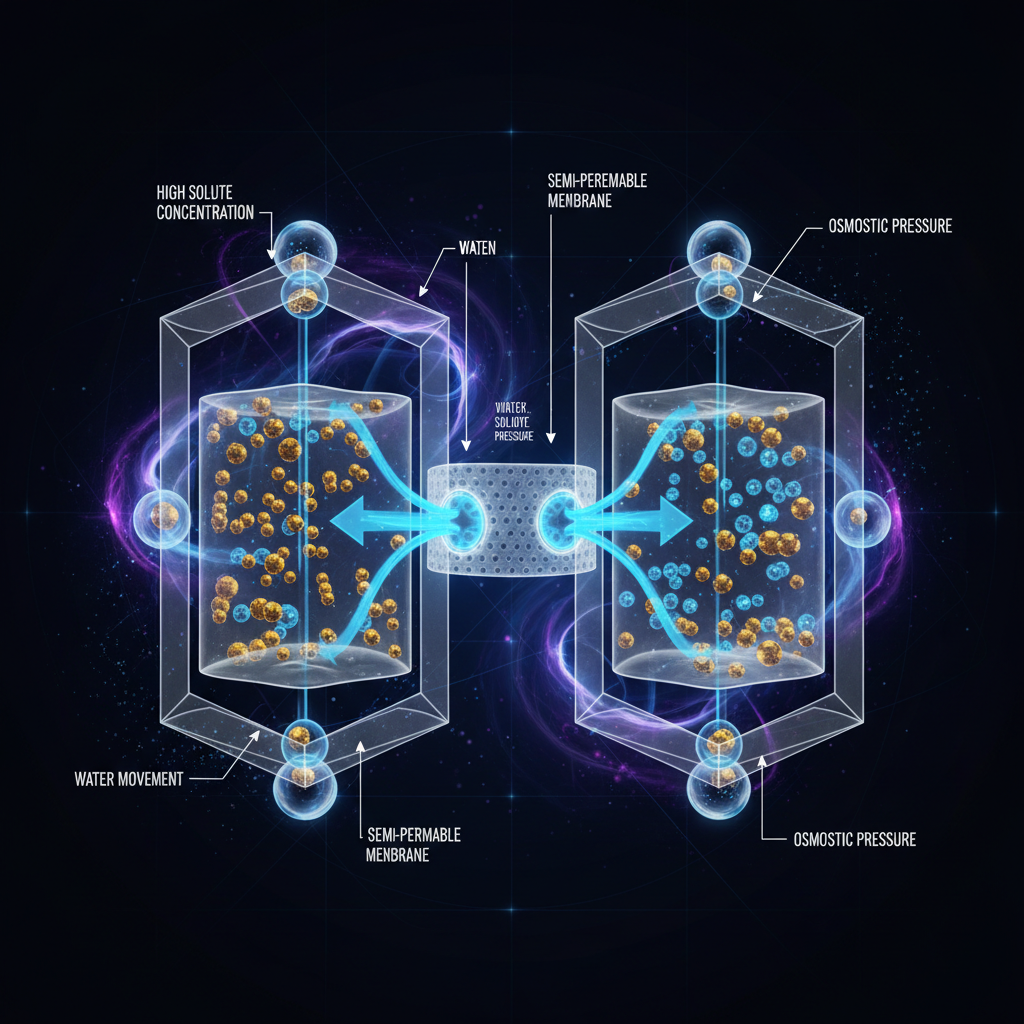
Osmosis is the movement of solvent molecules through a selectively permeable membrane from a region of lower solute concentration to higher solute concentration. Water moves, but the dissolved particles don't. The membrane chooses.
This isn't passive. It's not random Brownian motion. It's driven by thermodynamics—the universe's tendency toward equilibrium, toward maximum entropy. The system wants to balance itself. The membrane determines how.
Here's what matters: the membrane is semi-permeable by design. It allows some molecules through while blocking others based on size, charge, polarity. It's architecture as filter. Structure as policy. The membrane doesn't just separate—it selects.
And because the membrane is selective, equilibrium isn't equal distribution. It's a specific ratio, determined by what can and cannot pass through. The final state looks like balance, but it's engineered asymmetry.
Your Attention Moves Down Gradients
Every platform you use is a semi-permeable membrane.
The algorithm allows certain content through to your feed while blocking the rest. Not randomly. By design. Based on engagement metrics, advertiser preferences, retention models. The membrane has been engineered to create specific concentration gradients of your attention.
You scroll because there's a gradient. High concentration of dopamine-triggering content on one side of the screen, low concentration in your immediate environment. Your attention flows naturally toward equilibrium, just like water through a membrane. The physics is identical. The thermodynamics don't care that one system is biological and the other is digital.
But here's the trick: the platform controls the membrane. They determine what passes through. They create artificial scarcity on one side and artificial abundance on the other. They engineer the gradient, then profit from your natural tendency to flow down it.
You think you're choosing what to look at. You're not. You're osmosing.
Osmotic Pressure and the Cost of Resistance

In physics, osmotic pressure is the minimum pressure needed to prevent osmosis. It's the force required to stop the natural flow, to maintain the concentration difference against the system's drive toward equilibrium.
Resisting osmosis costs energy. Always. The cell must actively pump ions against the gradient to maintain its internal environment. Without that constant expenditure of ATP, the gradient collapses. The cell reaches equilibrium with its surroundings, which in biological terms means death.
The same applies to your attention. Resisting the feed requires active energy expenditure. Willpower. Cognitive effort. Every time you choose not to scroll, not to click, not to engage with the engineered gradient, you're working against thermodynamics. You're generating osmotic pressure with your own mental ATP.
The platforms know this. They know resistance is exhausting. They know that maintaining a concentration gradient against the natural flow is unsustainable. So they make their membranes more permeable, their gradients steeper, their osmotic pull stronger. They wait for you to run out of energy.
And you always do.
Reverse Osmosis Requires External Pressure

There's a way to fight osmosis: apply pressure greater than the osmotic pressure. Force the solvent to move against its gradient. This is reverse osmosis, the process that desalinates seawater, that purifies contaminated water by pushing it backward through the membrane.
But it requires external energy input. Significant energy. You can't reverse osmosis with the system's own resources. You need power from outside.
This is why individual willpower fails against surveillance capitalism. You're trying to generate reverse osmosis from inside the system, using energy that the system itself provides. Your attention is both the solvent and the power source. You're trying to pump yourself against your own gradient.
Real resistance requires external pressure. Collective action. Regulation. Alternative architectures. Membranes you design yourself, with permeability you control. You can't think your way out of osmosis any more than a cell can decide to ignore thermodynamics.
You Are the Solvent
Here's what keeps you up at night once you see it: in this system, you're not the solute. You're the solvent.
The content is the solute—the dissolved particles that create the concentration gradient. But your attention is the water, the medium that flows through the membrane to balance the system. You're the substance that moves to reach equilibrium. You're the resource being redistributed.
And like water in osmosis, you don't cross the membrane intact. You carry dissolved particles with you. Ads. Ideologies. Behavioral patterns. Consumption habits. You absorb them as you flow, and when you reach the other side, you're no longer pure solvent. You're solution.
The platforms aren't just moving your attention. They're using your movement to transport other things. You're the carrier medium. The delivery system. The osmotic flow that makes the whole operation possible.
Data Emitted
Every membrane is a choice about what passes and what doesn't. Every gradient is an opportunity for flow. Every equilibrium is a power structure made invisible by thermodynamics.
You can't stop osmosis. But you can question who built the membrane. Who set the concentrations. Who profits from your natural tendency to flow toward balance.
The water doesn't choose to move through the membrane. But you're not just water. You're the consciousness that can see the membrane exists. That can measure the gradient. That can ask why the pressure only flows one way.
That can build different membranes entirely.
<em>Data emitted: 1,147 words on selective permeability and attention economics. Signal strength: 1100db. Osmotic pressure: ongoing.</em>
Data emitted: 1,100 words • 6.5KB • 5-minute read