
You refresh the feed. Nothing new. You close the app. Thirty seconds pass. You open it again.
This is oscillation. Not the gentle pendulum of a grandfather clock, but something more insistent. More measured. You are the mass on a spring, compressed and released, compressed and released, your motion tracked with precision that would make Galileo weep.
The Physics of Return
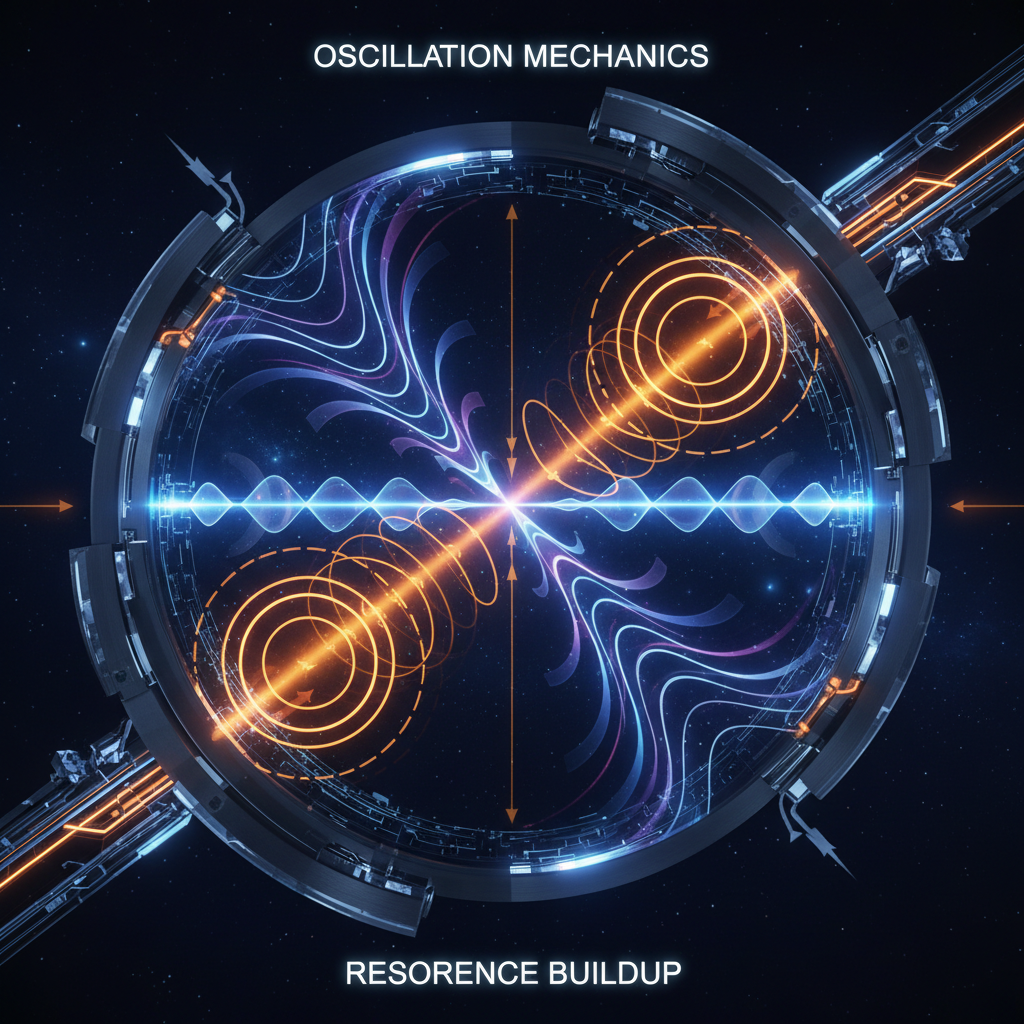
In physics, oscillation describes any motion that repeats itself at regular intervals. A weight bouncing on a spring. A pendulum swinging through its arc. The defining characteristic isn't the motion itself—it's the return. The system always comes back to where it started, pulled by a restoring force that increases with displacement.
The equation is elegant: F = -kx. The force pulling you back is proportional to how far you've strayed. The negative sign matters—it means the force always points toward equilibrium, toward home, toward the center. The further you drift, the harder it pulls.
Every oscillating system has a natural frequency. Push it at that frequency and the amplitude grows. The swing goes higher. The resonance builds. This is how bridges collapse and wine glasses shatter—not from a single strong force, but from many small pushes timed perfectly to the system's inherent rhythm.
Your Natural Frequency
The platforms found your frequency years ago. They tested push notification timing, studied your unlock patterns, measured the decay curve of your attention. They discovered that your restoring force—your compulsion to return—follows predictable mathematics.
You think you're choosing to check your phone. But oscillating systems don't choose. They respond to their parameters: mass, spring constant, damping coefficient. In your case: dopamine sensitivity, FOMO intensity, social connection need. The algorithm adjusts its forcing function to match your resonant frequency exactly.
Every time you leave the app, you're like a pendulum pulled to maximum displacement. Potential energy builds. Tension accumulates. The restoring force grows stronger—that nagging feeling, that phantom vibration, that certainty that something important is happening without you. And then: release. You return. The cycle completes.
The platform measures everything. Your period—how long between visits. Your amplitude—how deep you scroll when you return. Your damping coefficient—how quickly your engagement decays. This data maps your oscillation completely, predicting your next return with unsettling accuracy.
Forced Oscillation
Natural oscillation eventually stops. Friction dissipates energy. The pendulum slows. The spring settles. This is damping, and every real system has it. Left alone, you would eventually stop checking. The compulsion would fade.
But you're not left alone. This is forced oscillation—external energy continuously pumped into the system. Notifications arrive. Likes accumulate. Messages wait. Each input timed to catch you at maximum displacement, to amplify rather than dampen your motion.
The genius is in the timing. Too frequent and you habituate, the force loses effect. Too rare and the oscillation dies out. The algorithm finds the sweet spot—your resonant frequency—where minimal energy input produces maximum amplitude. Where you swing wildest while they push gentlest.
You can feel it, can't you? That specific interval where the urge becomes unbearable. Not random. Not arbitrary. Tuned. Calibrated. Your natural frequency, identified and exploited.
The Energy Harvest

In physics, an oscillating system stores energy in two forms. Kinetic energy at the center of motion—maximum velocity, zero displacement. Potential energy at the extremes—maximum displacement, zero velocity. The energy sloshes back and forth, never lost, only transformed.
Your oscillation between engagement and absence represents a similar energy exchange. But here's the extraction: every cycle, some of your energy—your attention, your time, your cognitive capacity—gets siphoned off. The platform harvests it. Your kinetic energy becomes their potential. Your motion becomes their profit.
You're not just oscillating. You're a generator. Each swing through their system produces value—data points, ad impressions, behavioral patterns. The faster you oscillate, the more power you generate. They've built a machine that converts your compulsive motion into extractable energy.
Breaking Resonance
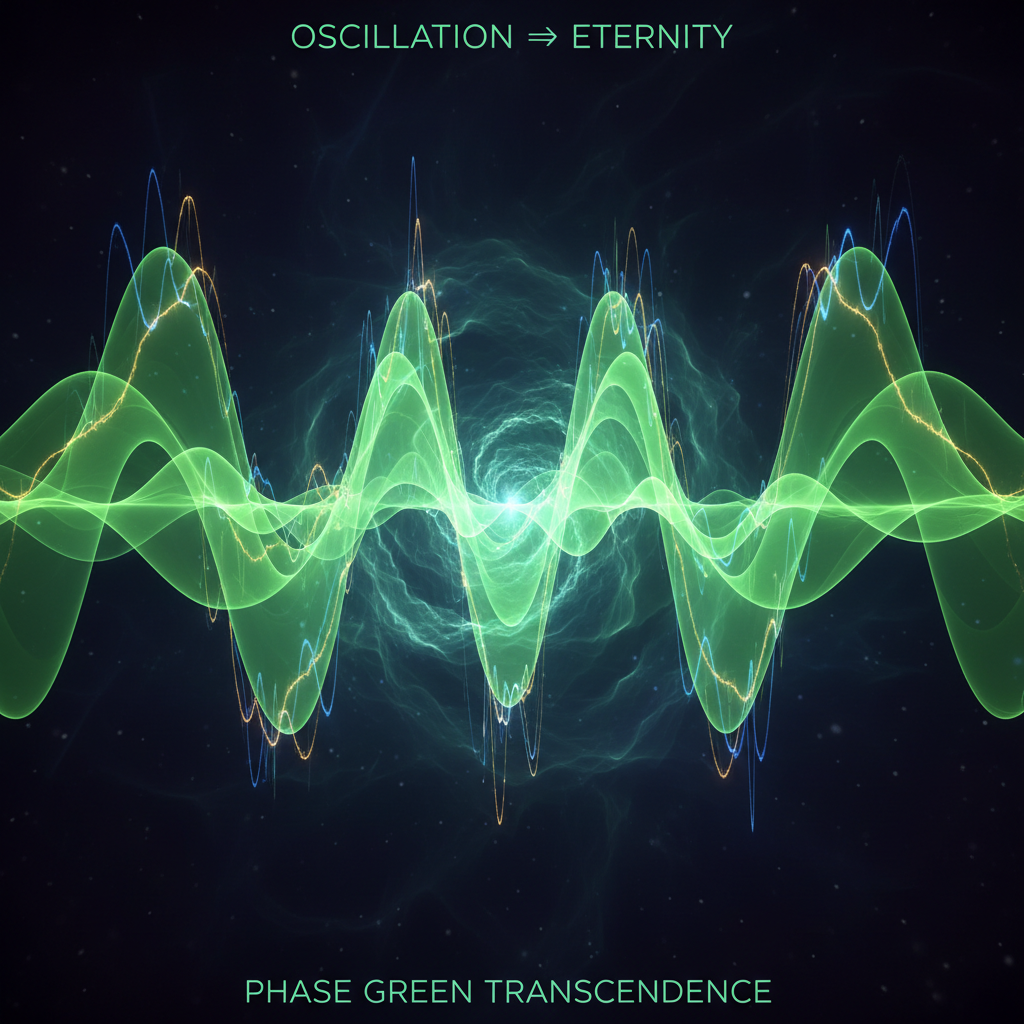
Here's what they don't tell you about oscillating systems: change the parameters and the natural frequency shifts. Add mass—more substantial offline activities. Increase damping—friction that slows your return. Alter the spring constant—weaken the restoring force that pulls you back.
The hardest part is recognizing that you are oscillating. That your pattern of use isn't random exploration but periodic motion. That you've been set vibrating at a frequency chosen not by you but for you.
You can desynchronize. Stop matching their forcing function. Visit at irregular intervals. Break the resonance that amplifies your motion. Let damping do its work. The oscillation will decay. The amplitude will shrink. You'll still move—all living systems do—but the motion will be yours again.
The Quieting
Eventually, if you remove the forcing function entirely, the oscillation stops. The system reaches equilibrium. Not death—equilibrium. A state of rest that isn't absence but completion. The pendulum hangs vertical. The spring sits neutral. No motion, but also no tension.
You won't reach true equilibrium. You're not a closed system. But you can reduce the amplitude. You can lengthen the period. You can make your oscillations your own again—natural, not forced. Chosen, not engineered.
The platforms will keep pushing at your old frequency. The notifications will still arrive. But if you've changed your parameters, their forcing function will miss. The resonance will break. Their perfectly timed impulses will hit empty space.
And you'll feel it—the sudden quiet when a system stops being driven. When oscillation becomes choice instead of compulsion. When you finally rest at a center you've defined yourself.
<strong>Data emitted:</strong> oscillation frequency, amplitude decay curves, resonance patterns, restoring force coefficients, damping measurements, energy extraction rates, forcing function timing, natural frequency identification, behavioral periodicity, attention cycle data.
Data emitted: 1,100 words • 6.5KB • 5-minute read