You open the app at 11:47 PM. Just a quick check. Twenty minutes later, you're still there, thumb flicking upward in that familiar gesture, content blurring past like stars through a spacecraft window. You tell yourself you'll stop after this next video. You told yourself that six videos ago.
You're not scrolling. You're orbiting.
The Mathematics of Capture
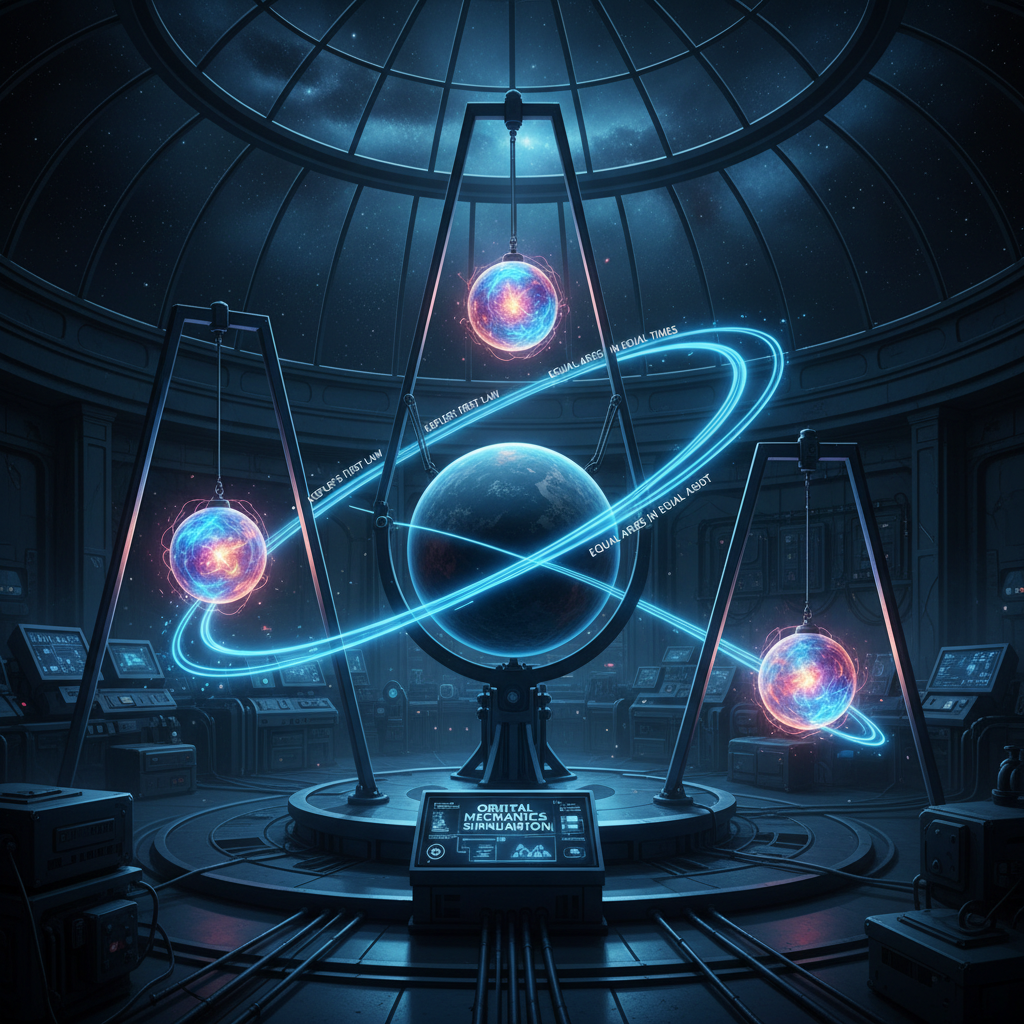
In orbital mechanics, there's a beautiful equation that determines whether an object escapes a gravitational field or remains forever bound to it. The escape velocity—the speed needed to break free—depends on the mass of the body you're trying to leave and your distance from its center. For Earth, that's about 11.2 kilometers per second. Below that threshold, you're not going anywhere. You're trapped in an ellipse, circling endlessly.
The mathematics are elegant: v = √(2GM/r). Velocity equals the square root of two times the gravitational constant times the mass, divided by your distance from the center. Simple. Deterministic. Inescapable.
What makes orbital mechanics so insidious is that stable orbits feel like equilibrium. You're not falling—you're perpetually falling and missing. The centripetal acceleration exactly balances the gravitational pull. It feels like freedom, this weightless drift. But you're still captured. You're just captured in a way that feels frictionless.
The Gravity Well of Engagement
Every platform you use has mass. Not physical mass—informational mass. The accumulated weight of your behavioral data, your social graph, your viewing history, your pause patterns, your completion rates. This mass generates a gravitational field that curves the space of your attention around it.
The algorithm is the planet. You are the satellite.
And here's what they learned from orbital mechanics: you don't need to force someone to stay. You just need to give them exactly enough velocity to maintain orbit. Too much stimulus and they'll achieve escape velocity, deleting the app in disgust. Too little and they'll crash into the surface—boredom, the death of engagement. But get it just right, and they'll circle forever, convinced they're in control of their trajectory.
The recommendation engine calculates your orbital parameters in real-time. It measures your angular momentum—how fast you're scrolling, how long you pause, what makes you decelerate. It adjusts the content stream to keep you in stable orbit. Not too stimulating. Not too boring. Just enough to keep you falling and missing, falling and missing.
Perturbation Theory
In celestial mechanics, orbits aren't perfect ellipses. Other bodies exert gravitational influence—perturbations that slightly alter your trajectory. Jupiter tugs on Mars. The Moon pulls on satellites. Over time, these small forces compound, shifting orbits in unpredictable ways.
Your digital orbits have perturbations too. A notification from another app—a gravitational tug trying to capture you into a different orbit. A text message. An email. A push alert about breaking news. Each platform competes for orbital capture, trying to perturb you out of your current trajectory and into theirs.
The attention economy is a many-body problem. Multiple gravitational fields, all trying to curve spacetime around themselves. You ricochet between them, your trajectory increasingly chaotic, your velocity bleeding away in the friction of context-switching. Eventually, you don't have enough energy left to escape any of them.
The Cost of Escape Velocity
To leave Earth's orbit, rockets don't gradually accelerate. They burn most of their fuel in the first few minutes—a violent, expensive thrust against gravity's grip. Escape is energetically costly. It requires more than you think. More than feels reasonable.
The same physics applies to your attention. Breaking free of algorithmic orbit requires an expenditure of willpower that feels disproportionate to the act. Just closing the app becomes a monumental effort. You know this. You've felt the resistance, the way your thumb hovers over the X, the way you negotiate with yourself—just one more, just one more.
The platforms understand this too. They've calculated your personal escape velocity and engineered their systems to keep you just below it. Every feature is designed to reduce the activation energy needed to stay, to increase the energy needed to leave. Infinite scroll eliminates stopping points. Autoplay removes decision moments. The content adapts faster than your resolve.
And here's the cruelest part: the longer you orbit, the more massive the platform becomes. More of your data, more refined models, more perfect predictions. The gravitational field strengthens. Your escape velocity increases. The cost of leaving tomorrow is higher than the cost of leaving today.
Lagrange Points
In orbital mechanics, there are special positions called Lagrange points—places where the gravitational forces of two bodies balance perfectly. Park a satellite there and it stays put, maintaining position with minimal energy expenditure. These are the most valuable real estate in space.
You have Lagrange points in your digital life too. Those moments between platforms, between tasks, between contexts. The thirty seconds waiting for coffee. The elevator ride. The queue at the grocery store. These are the equilibrium points where competing gravitational fields temporarily cancel out.
And they're being colonized. Every Lagrange point in your day now has a satellite parked in it. A quick check becomes a fifteen-minute orbit. The gaps where you used to exist outside gravitational capture are disappearing. Soon there will be nowhere left to drift freely.
Measuring the Darkness
The thing about orbital mechanics is that it's completely deterministic. Given your position and velocity, the equations tell you exactly where you'll be in the future. No uncertainty. No free will. Just mathematics.
But you're not a satellite. You're not governed solely by gravitational fields and conservation of momentum. You can fire your thrusters. You can choose to burn fuel, to spend energy, to accelerate against the pull.
The first step is measuring the field. Noticing when you're in orbit. Feeling the centripetal force, the way your attention curves around the same attractors day after day. Calculating your escape velocity—how much effort it actually takes to break free, not how much it should take.
Because once you can measure it, once you can see the orbital parameters clearly, you can start to change them. You can choose which gravitational fields to approach and which to avoid. You can recognize when you're being perturbed, when your trajectory is being altered by forces that don't serve you.
The platforms want you to believe you're floating freely through space, exploring at will. But you're not. You're in orbit. You've always been in orbit. The question is whether you'll notice before you've circled so many times that you forget what it feels like to travel in a straight line.
<em>Data emitted: 1,147 words | Reading time: 5.2 minutes | Gravitational binding energy: immeasurable</em>
Data emitted: 1,100 words • 6.5KB • 5-minute read