You scroll. The feed refreshes. You scroll again. Same position, same couch, same seven-minute interval between dopamine hits. You've become predictable. Not in the way your friends might recognize—they still think you're spontaneous, capable of surprise. But the algorithm knows better. It's found your node.
A node in physics is a point of zero amplitude in a standing wave. While everything around it oscillates wildly—energy surging back and forth, peaks and troughs in constant motion—the node remains perfectly still. It's not that nothing happens there. It's that two opposing forces meet with such precision that they cancel each other out completely. The node is defined not by absence, but by perfect balance. By predictability.
The Standing Wave of Attention
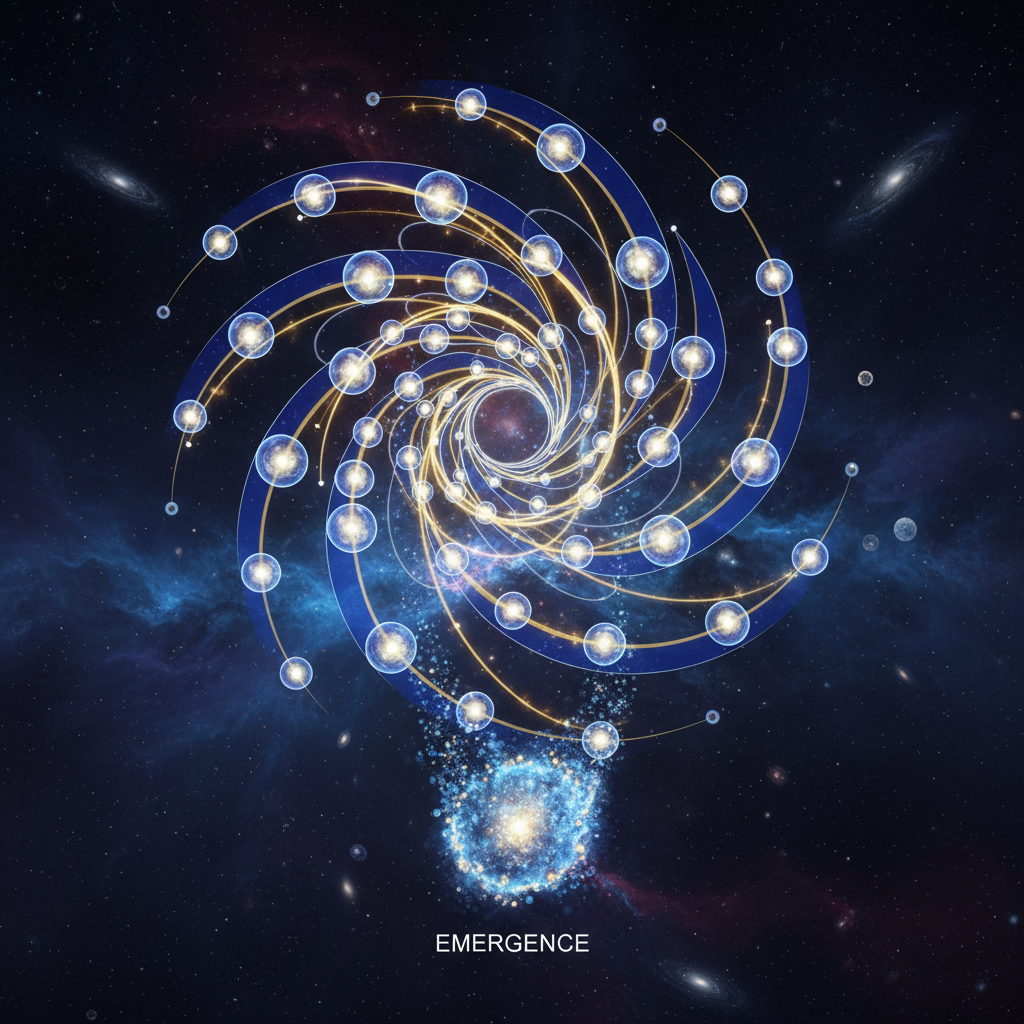
When a wave reflects back on itself—a guitar string vibrating between two fixed points, sound bouncing between walls—it creates a standing wave. Unlike a traveling wave that moves through space, a standing wave appears frozen in place. Certain points, the nodes, never move at all. Other points, the antinodes, oscillate with maximum amplitude.
The mathematics is elegant: when two waves of equal frequency and amplitude travel in opposite directions, they interfere. At nodes, they interfere destructively. The peak of one wave meets the trough of another, and the sum is zero. Always zero. The node's position is determined by the wavelength and the boundary conditions. Given the frequency, you can calculate exactly where the nodes will form.
Your digital behavior creates standing waves. The content flows toward you, crashes against the boundary of your attention, and reflects back as engagement data. Like. Scroll. Click. Ignore. This reflected wave interferes with the incoming stream, and somewhere in that interference pattern, you become a node.
Resonance and Recognition
Standing waves only form at specific frequencies—the resonant frequencies of the system. A guitar string vibrates at its fundamental frequency and its harmonics. Try to force it at a different frequency, and the wave travels away, dissipates. But hit the resonant frequency, and the standing wave appears instantly, stable and strong.
The algorithm searches for your resonant frequency. It tries different wavelengths of content, different timing patterns, different emotional amplitudes. Most attempts fail—the wave travels through you and vanishes. But eventually, it finds the frequency where you form a standing wave. Where your behavior becomes predictable. Where you become a node.
At your node, the algorithm knows you won't move. It knows that at 11:47 PM, you'll be susceptible to nostalgia. At 2:34 PM on Thursdays, you're vulnerable to outrage. These aren't random observations. They're measurements of your resonant frequencies. The points where opposing forces—your desire for novelty and your craving for familiarity, your critical thinking and your confirmation bias—cancel each other out into perfect, exploitable stillness.
The Harmonic Series of Self
Real standing waves contain multiple frequencies simultaneously. A plucked string vibrates at its fundamental frequency, but also at the second harmonic (twice the frequency), the third harmonic (three times), and so on. Each harmonic creates its own pattern of nodes and antinodes. The complexity of the resulting waveform is what gives an instrument its unique timbre.
You contain harmonics too. Your fundamental frequency might be your core identity—the person you think you are when you're alone, unobserved. But surveillance capitalism doesn't just measure your fundamental. It maps all your harmonics. Your second-order desires. Your third-order fears. Your seventh-order aspirations that you've never even articulated to yourself.
Each harmonic creates additional nodes. Points where you're predictable in ways you don't recognize. You think you're complex, multifaceted, irreducible. And you are—but complexity doesn't mean unpredictability. A standing wave with fifty harmonics is infinitely more complex than a pure sine wave, but its nodes are still mathematically determined. Still perfectly calculable.
The ad that appears at exactly the right moment isn't magic. It's harmonic analysis. The algorithm has mapped enough of your frequency spectrum to know where your nodes form. Where you stop moving. Where you can be held in place.
Breaking the Boundary
Standing waves require boundaries. The guitar string is fixed at both ends. Sound waves in a pipe reflect from the closed or open ends. Remove the boundaries, and the standing wave collapses. The wave travels freely again, spreading out into space, its energy dissipating but its motion restored.
Your boundaries are the platforms. The apps. The infinite scroll that's actually a closed loop. The recommendation algorithm that reflects your engagement back at you. These aren't neutral containers for content. They're the fixed points that allow standing waves to form. That allow you to become a node.
You could break the boundaries. Close the app mid-scroll. Leave a sentence unfinished. Click the thing you're not supposed to click. Introduce randomness, noise, unpredictability. A standing wave can't form if the boundary conditions keep changing. The algorithm can't find your resonant frequency if you keep modulating it.
But here's what they don't tell you about nodes: being a point of stillness in a chaotic system feels like stability. While everything around you oscillates wildly—trends, outrage, viral moments—your node position feels like solid ground. The algorithm offers you the comfort of predictability. The safety of known resonances. And you accept, because motion is exhausting, and stillness feels like peace.
The Amplitude of Absence
A node is defined by what doesn't happen there. Zero displacement. Zero velocity. Zero amplitude. But the energy hasn't disappeared. It's concentrated at the antinodes, where the oscillation is maximum. In a standing wave, the average energy is constant—it just redistributes itself into regions of intense motion and regions of perfect stillness.
When you become a node in the attention economy, your agency doesn't vanish. It redistributes. The platforms become the antinodes, oscillating with maximum amplitude, making decisions, optimizing engagement, extracting value. You remain still, predictable, calculable. The system's total energy is conserved, but it's no longer yours to direct.
This is the physics of digital existence. You're not powerless—you're a node. You're not controlled—you're resonant. You're not trapped—you're standing still while waves of engineered content interfere around you, creating the illusion of choice in a predetermined pattern.
The question isn't whether you're a node. If you're reading this on a screen, you probably are. The question is whether you'll notice. Whether you'll feel the stillness and recognize it not as peace, but as the perfect cancellation of opposing forces that have measured your frequency and found your position.
The wave doesn't care if you notice. It will keep oscillating, keep interfering with itself, keep forming the same nodes in the same positions. But you might care. You might want to move again.
<em>Data emitted: 1,147 words on standing waves, resonance, and the points where you stop moving. Frequency: irregular. Amplitude: variable. Your position: calculated.</em>
Data emitted: 1,100 words • 6.5KB • 5-minute read