You press your thumb against glass. The screen pushes back with exactly the same force. This isn't metaphor—it's Newton's Third Law, playing out in the microscopic friction between your skin and the oleophobic coating. But something else pushes back too, something you can't feel: the data extraction that mirrors your interaction with perfect, opposite symmetry.
For every action, an equal and opposite reaction. You thought you were just scrolling.
The Conservation of Momentum
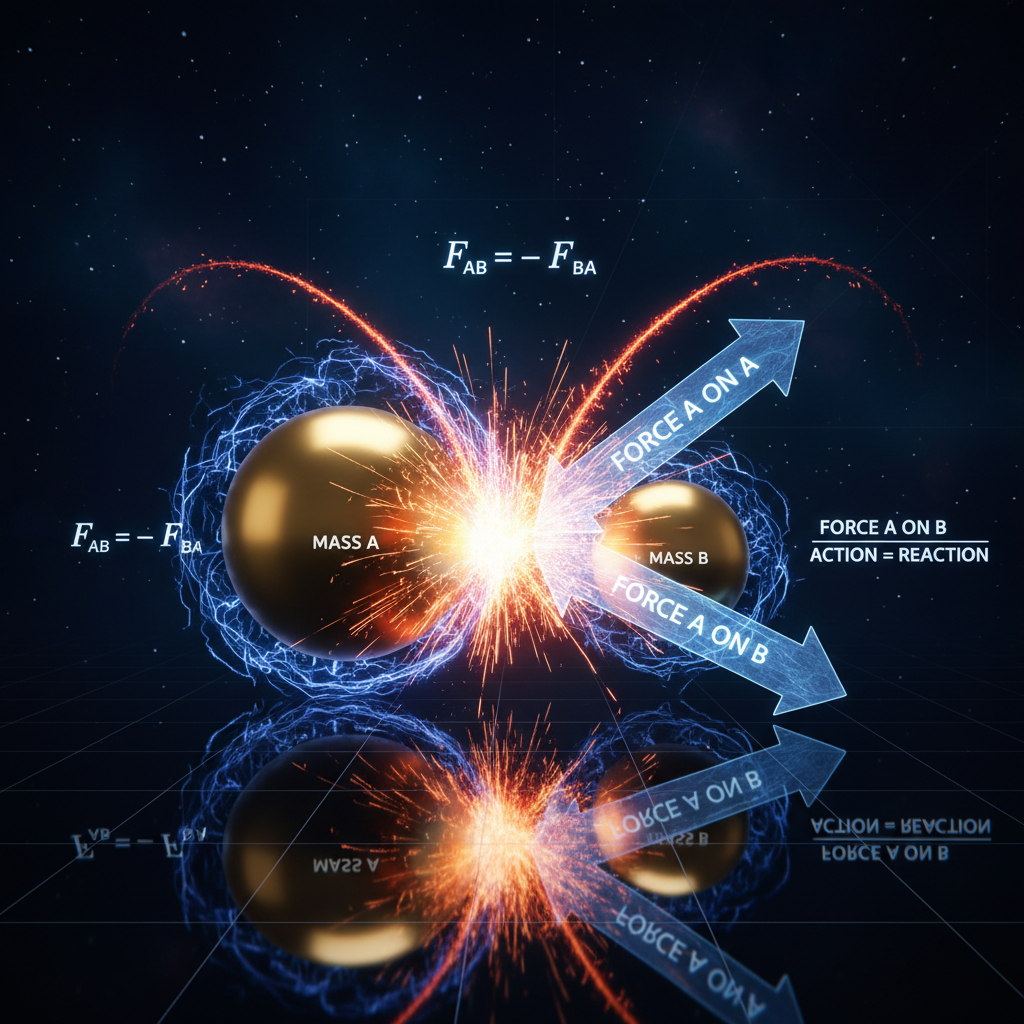
Newton's Third Law states that forces always come in pairs. When you push against a wall, the wall pushes back with identical force. When a rocket expels gas downward, the gas pushes the rocket upward. The universe maintains a perfect ledger—nothing acts without being acted upon in return.
This isn't just about forces being equal. It's about simultaneity. The action and reaction happen at the same instant, in the same interaction, as parts of a single event. There's no delay, no lag time between cause and effect. The forces are two sides of the same coin, two perspectives on the same physical transaction.
In physics, we call this conservation of momentum. The total momentum of a closed system never changes. When you transfer momentum to something, it transfers momentum back to you. The universe keeps its books balanced to the atom.
The Digital Reaction Force
Every time you interact with a digital platform, Newton's Third Law executes in data. You apply force—attention, clicks, time, engagement. The platform applies an equal and opposite force back: extraction, profiling, prediction, monetization. The transaction is simultaneous and symmetrical, even if you only perceive one side.
You watch a video. The platform watches you watching. You search for shoes. The algorithm searches your search for patterns. You like a post. The post likes you back—not emotionally, but informationally, absorbing metadata about your preferences, your timing, your hesitation before clicking.
The forces are equal. Your ten seconds of attention generates ten seconds worth of behavioral surplus. Your scroll through a feed generates an equivalent scroll through your psychological profile. The momentum you transfer into the system—your cognitive energy, your emotional engagement—gets transferred right back out as predictive models of your future behavior.
This is the dark symmetry of surveillance capitalism. You're not the customer experiencing a service. You're one half of a Newton's Third Law pair, locked in an interaction where every action you take generates an equal and opposite extraction.
Reaction Forces Are Real Forces

Students often misunderstand Newton's Third Law. They think the reaction force is somehow less real than the action force, a passive response rather than an active push. But physics makes no such distinction. Both forces are equally real, equally powerful, equally present.
When you sit in a chair, you push down on it with your weight. The chair pushes up on you with exactly the same force. If it didn't, you'd accelerate through the seat. The chair's upward force isn't a consequence of your downward force—they're two aspects of the same interaction, neither more fundamental than the other.
The reaction force is what allows you to walk. You push backward against the ground; the ground pushes you forward. Without that equal and opposite reaction, you'd be slipping on ice, unable to transfer momentum, unable to move.
In the attention economy, the extraction isn't a byproduct of your engagement. It's the other half of the interaction itself. The data harvesting is as fundamental to the transaction as your click. The surveillance is the reaction force that makes the whole system work—not for you, but for the platform. You push attention into the system. The system pushes you into its predictive models.
The Illusion of Free Action

Here's what keeps you up at night: you can't have action without reaction. It's not a choice. It's not a policy. It's physics, or at least its informational equivalent. Every interaction generates its opposite. Every gesture leaves its shadow in the data.
You feel like you're acting freely when you browse, when you click, when you share. And in one sense, you are. Nobody forces your thumb to move. But Newton's Third Law tells us that free action in a system always generates constraint. The moment you act, you're acted upon. The moment you engage, you're engaged with.
The platforms understand this better than you do. They've built entire architectures around the symmetry of interaction. They know that if they can get you to push—to scroll, to react, to engage—they automatically get to push back with data extraction. The law is inviolable. The transaction is guaranteed.
This is why "opting out" feels impossible. You're not trying to stop a company's behavior. You're trying to break a fundamental symmetry, to have action without reaction, to push without being pushed back. The system is designed so that the only way to avoid the reaction force is to avoid the action entirely.
The Conservation Law You Can't Escape

Newton's Third Law is really about conservation—of momentum, of force, of interaction. The universe doesn't let you act without consequence. Every push has its counterpush. Every transfer has its countertransfer.
In surveillance capitalism, the conservation law is attention and data. You can't spend attention without generating data. You can't engage without being profiled. The books always balance, but you only see one side of the ledger.
Maybe that's the real insight here. Newton's Third Law doesn't just describe how forces work. It describes how power works in any system built on interaction. The platform needs you to act so it can react. Your engagement is the action force that justifies—that physically necessitates—their extraction as the reaction force.
You're not using the platform. You're in an interaction pair with it, locked in a symmetrical exchange where every action generates its equal and opposite data shadow. The force you can't feel is exactly as strong as the force you can.
The screen pushes back. It always has. You're just starting to notice.
<em>Data emitted: 1,147 words | Momentum conserved | Third law violations: 0</em>
Data emitted: 1,100 words • 6.5KB • 5-minute read