You scroll. The feed accelerates. Something in you changes velocity.
Newton's Second Law states that F = ma. Force equals mass times acceleration. It's the equation that governs every push, every collision, every change in motion throughout the universe. But here's what they don't tell you in physics class: it also governs you. Your attention has mass. Your behavior has inertia. And right now, someone is calculating exactly how much force they need to change your trajectory.
The Physics of Push
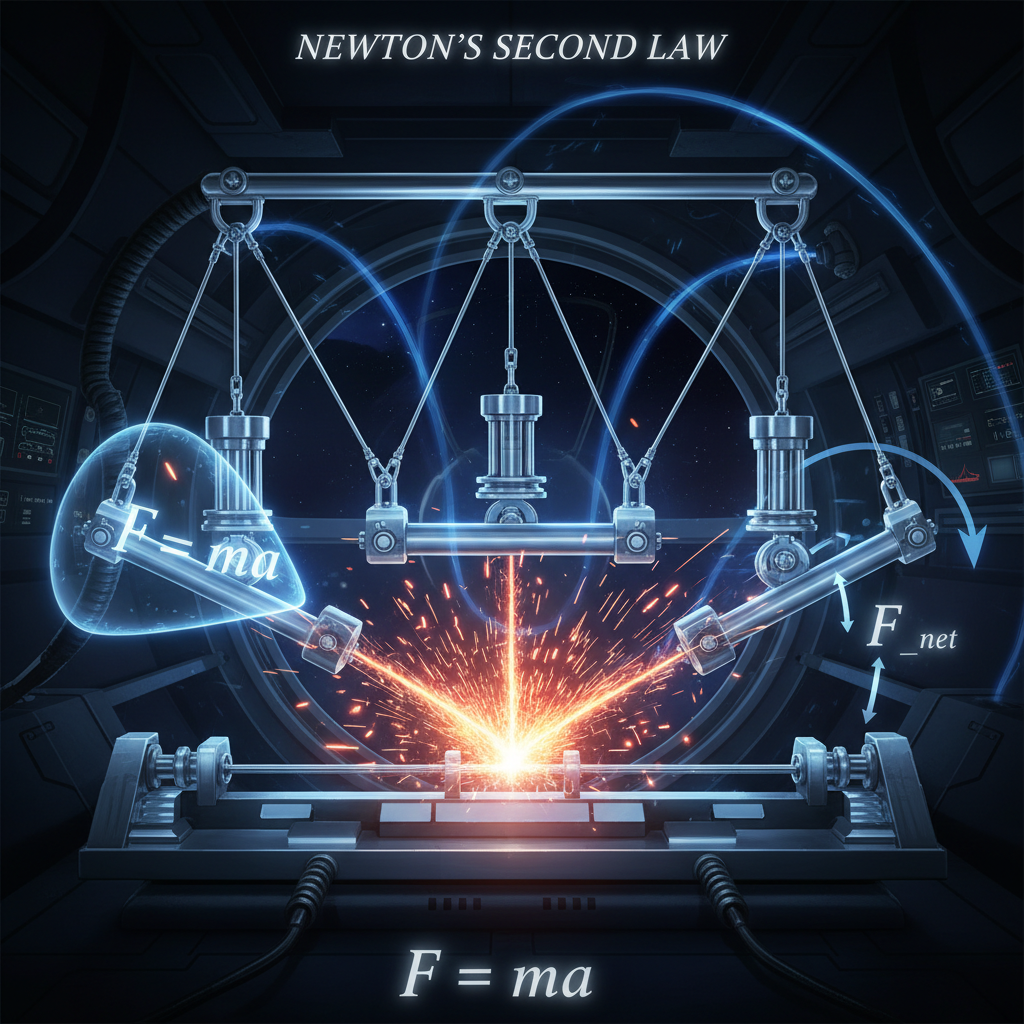
Newton's Second Law is deceptively simple. To change an object's motion, you need force. The more massive the object, the more force required. The faster you want to accelerate it, the more force required. It's linear, predictable, mechanical.
A shopping cart sitting still has inertia—resistance to change. Push it gently, it moves slowly. Push it hard, it accelerates. The force you apply becomes motion. Energy transfers from your muscles into kinetic energy, into momentum. The cart doesn't choose to move. It has no agency in the equation. It simply responds to force.
This is physics at its most fundamental. Every notification that buzzes your phone, every autoplay video that queues itself, every infinite scroll that loads new content—these are forces. Measured forces. Calibrated forces. Forces designed with your mass in mind.
Your Attention Has Mass

In the attention economy, you are the object. Your focus, your time, your engagement—these have mass. Not metaphorical mass. Actual, measurable resistance to change. You have behavioral inertia. You have habits, preferences, patterns. You tend to stay in motion in the direction you're already moving.
The platforms know your mass. They've measured it. Every A/B test, every engagement metric, every time-on-site calculation—they're measuring how much force it takes to move you. How much red in a notification badge to overcome your inertia. How many milliseconds of load time before you bounce. How much dopamine per scroll to keep you accelerating.
They've reverse-engineered Newton's Second Law for human attention. They know your mass (your resistance to engagement). They know their desired acceleration (how fast they want you scrolling, clicking, buying). So they solve for F. They calculate the exact force required.
A push notification at 3 PM. A trending topic that enrages you. A video thumbnail with a face mid-gasp. These aren't random. They're force vectors, precisely calibrated to your measured mass.
Momentum and the Scroll
Once you're in motion, Newton's First Law takes over. An object in motion stays in motion. But getting you into motion—that's the Second Law's domain. That's where force matters.
The infinite scroll is a masterpiece of applied physics. That first swipe down—that's the initial force. But notice how little force is required for subsequent scrolls. You've already been accelerated. You have momentum now. The feed just needs to sustain your velocity, not create it from rest.
This is why the first piece of content matters so much. It's the highest-force moment. It's where your inertia is greatest, where you're most likely to bounce away. So they hit you with the content that generates the most force. The most outrageous, the most personally relevant, the most emotionally charged. They need to overcome your at-rest mass.
After that? You're coasting. Momentum carries you. They just need to prevent deceleration. Keep the content coming. No friction. No load times. No moments of reflection that might act as opposing forces.
The Calculus of Manipulation
Here's where it gets darker. In physics, force is just force. Neutral. Mechanical. But in the attention economy, force is intention. Someone decided to apply that force. Someone calculated that you needed exactly this much push to change your behavior.
Every platform is running the same equation: F = ma. But they're solving for different variables. Facebook solves for maximum acceleration—how fast can we get you engaging? TikTok solves for minimum force—how little effort to keep you scrolling? LinkedIn solves for professional mass—how much force to overcome your work-mode inertia?
And you? You're the constant. The mass term. The thing being moved.
The surveillance apparatus measures your mass continuously. Every interaction updates their model. You clicked that? Your mass just decreased for that content type. You scrolled past? Your mass increased. They're recalculating the force required in real-time, adjusting the feed, the notifications, the recommendations.
It's physics. It's also control.
Increasing Your Mass

But here's what Newton also teaches us: you can change your mass. Not your physical mass—your behavioral mass. Your resistance to manipulation.
Every time you pause before clicking, you increase your mass. Every time you close an app mid-scroll, you add inertia. Every time you choose not to engage, you make yourself harder to move. You require more force. You become expensive to accelerate.
The platforms hate high-mass users. You're inefficient. You require too much force for too little acceleration. You're unprofitable physics. So they'll try harder, apply more force, but there's a limit. Eventually, it costs more to move you than you're worth.
This is how you win the physics game. Not by eliminating force—that's impossible while you're in the system. But by increasing your mass until the force required exceeds their budget.
The Equation Inverted
Newton's Second Law is deterministic. Apply force, get acceleration. It's cause and effect, clean and predictable. But you're not a shopping cart. You have something the equation doesn't account for: awareness.
You can feel the force being applied. You can recognize the push. You can see the algorithm calculating, adjusting, optimizing. And in that recognition, you can choose to increase your mass.
This is the paradox of surveillance capitalism. The more they optimize the force, the more obvious it becomes. The more they measure your mass, the more you can feel yourself being measured. The equation becomes visible. And once you see it, you can't unsee it.
Every notification is a force vector. Every recommendation is a calculated push. Every interface choice is applied physics. They're solving F = ma with you as the variable.
But now you know the equation too.
<em>Data emitted: 1,147 words | 6 sections | Force applied: variable | Your mass: increasing</em>
Data emitted: 1,100 words • 6.5KB • 5-minute read