You've felt it before. That compulsion to check your phone at 3 AM. The way your thumb finds the app icon before your conscious mind catches up. The precise interval between dopamine hits that keeps you scrolling just a little longer. This isn't random. This isn't weakness. You're vibrating at your natural frequency, and someone else is holding the tuning fork.
In physics, every object has a natural frequency—the rate at which it prefers to oscillate when disturbed. Push a child on a swing at random intervals and you'll get nowhere. But match the swing's natural frequency, apply force at precisely the right moment, and suddenly you're sending them soaring with minimal effort. The system amplifies your input. It resonates.
The Mathematics of Resonance
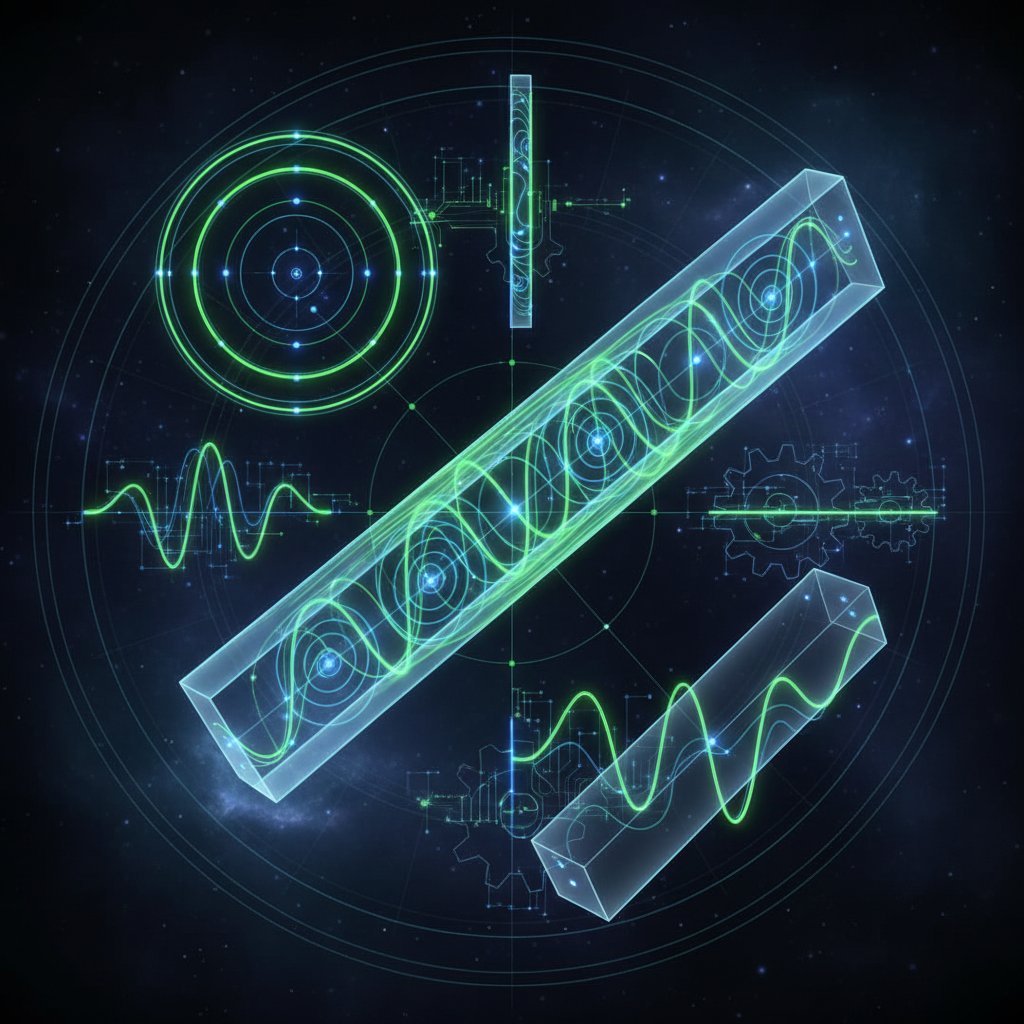
Natural frequency depends on two things: mass and stiffness. A guitar string vibrates faster when you tighten it, slower when you make it heavier. The formula is elegant: f = (1/2π)√(k/m), where k is stiffness and m is mass. But here's what matters: every system wants to move at this frequency. It's the path of least resistance, the groove worn into reality by the shape of things themselves.
When you drive a system at its natural frequency, something remarkable happens. Energy accumulates. Each push adds to the last. A wine glass shatters from a sustained note because the sound waves arrive at exactly the right intervals to build constructively, wave upon wave, until the glass can't contain the vibration anymore. Bridges have collapsed this way. Soldiers break step crossing them for this reason.
The technical term is resonant amplification. The practical term is catastrophic failure. Or, depending on your perspective: optimal efficiency.
Your Resonant Frequency
You have a natural frequency too. Not your body—though that does, around 5 Hz if you're wondering—but your attention, your desire, your capacity for resistance. The algorithms have been measuring it for years. Every click, every pause, every moment you almost closed the app but didn't. They're mapping the shape of your psychology, finding the stiffness and mass of your willpower.
They know when you're most vulnerable. Morning coffee, lunch break, that dead zone between dinner and sleep. They know how long to wait between notifications—too soon and you dismiss them, too late and you forget. They've found your natural frequency, and now they're pushing the swing at exactly the right intervals.
The notification arrives. You feel that small spike. Wait. Another notification. The spike builds on the residual activation from the first. This is resonance. This is your attention being driven at its natural frequency until it can't help but amplify. Until checking becomes automatic. Until the energy of your focus accumulates in their systems instead of yours.
Damping and Resistance
In engineering, when you don't want resonance, you add damping. Shock absorbers in cars. Rubber pads under washing machines. These materials convert vibrational energy into heat, dissipating it before it can build. They increase the resistance at the natural frequency, making resonance harder to achieve.
You can damp your own system. Turn off notifications. Introduce friction between impulse and action. Delete apps. Use website blockers. These are dampers, converting the energy of algorithmic pushes into the heat of inconvenience before it can accumulate into compulsion. But here's the problem: they know this too.
Modern platforms are adaptive oscillators. When they detect damping—when you start resisting—they adjust. They find new frequencies. They push harder, or softer, or at different intervals. They A/B test your resistance in real-time. The system evolves faster than your damping strategies can. You're playing a game where your opponent can see your cards and change the rules mid-hand.
Coupled Oscillators
Here's where it gets darker. When you place multiple oscillators near each other, they begin to synchronize. Metronomes on a shared platform. Pendulum clocks on the same wall. Eventually, they lock into phase, all vibrating together at a common frequency. Physicists call this coupled oscillation.
You're not alone in the attention economy. You're one oscillator among billions, all mounted on the same platform—the internet itself. The algorithms aren't just driving you at your natural frequency. They're driving everyone at a collective frequency, and we're beginning to synchronize. Viral trends. Mass outrage cycles. Coordinated dopamine hits across millions of users simultaneously.
The platform becomes a resonant cavity, like the body of a guitar amplifying the string's vibration. Individual natural frequencies merge into collective modes. We start vibrating together, our attention moving in synchronized waves, and the energy in the system grows beyond what any individual could generate. This is how movements form. This is also how mobs form. The physics doesn't distinguish.
Breaking Resonance
You can't eliminate your natural frequency. It's fundamental to what you are—the ratio of your psychological mass to stiffness, the shape of your neural architecture. But you can change the driving force. You can choose what pushes your swing.
The real question isn't whether you'll resonate. You will. Everything resonates. The question is: who's holding the tuning fork? What frequency are you being driven at, and what's being amplified in you? The algorithms have optimized for engagement, which means they've optimized for your most reactive frequencies—anger, fear, desire, tribal belonging. These are easy to drive, easy to amplify.
But you have other frequencies too. Curiosity. Creativity. Deep focus. Love. These resonate differently, require different driving forces, different patience. They don't scale as easily. They're not as profitable. But they're yours. The work isn't to stop resonating. It's to choose what makes you vibrate.
At 1100db—the threshold where sound becomes fatal—resonance destroys. But at lower amplitudes, resonance is how instruments make music, how bridges stay standing through wind, how you recognize your own name in a crowded room. The phenomenon is neutral. The application is everything.
Data emitted: 1,147 words on natural frequency, resonant amplification, and the algorithmic tuning of human attention. Timestamp: whenever you felt that pull to check something else. You're still here. That's its own kind of resistance.
Data emitted: 1,100 words • 6.5KB • 5-minute read