You scroll. The photons hit your retina. Somewhere in a data center, electrons rearrange themselves into patterns that represent you. Your attention—that most ethereal, intangible thing—becomes something concrete. Something measurable. Something that can be bought and sold.
Einstein's most famous equation isn't just about atomic bombs and nuclear reactors. It's about transformation. About how one thing can become another thing entirely, and how the exchange rate is written into the fabric of reality itself. E=mc². Energy equals mass times the speed of light squared. What you thought was solid can become pure energy. What you thought was nothing can become everything.
The Conversion Rate
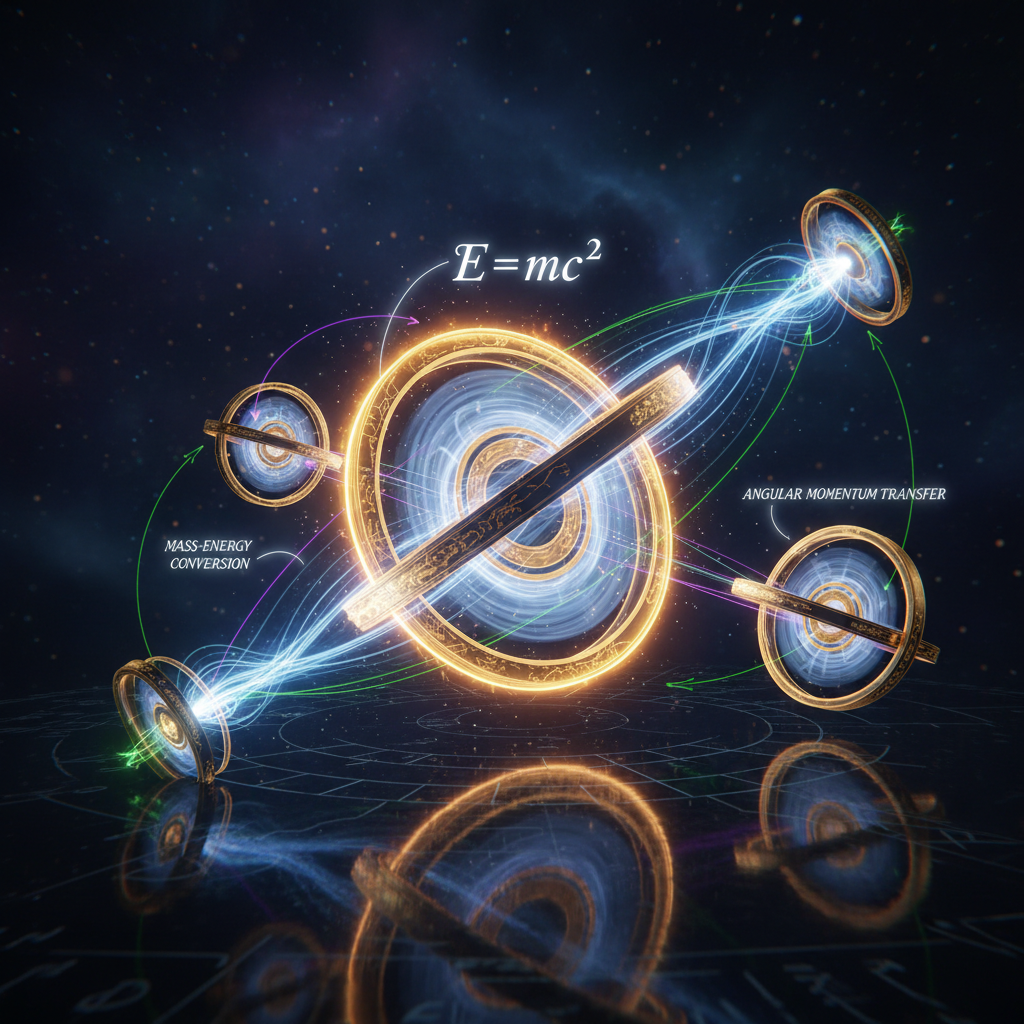
Mass and energy aren't different things. They're the same thing in different forms. A kilogram of matter contains about 90 quadrillion joules of energy—enough to power a city for days. The conversion factor is c², the speed of light squared: 299,792,458 meters per second, multiplied by itself. That's why a tiny amount of mass releases so much energy. The exchange rate is astronomical.
Your body converts mass to energy every moment you're alive. Chemical bonds break, electrons shift orbitals, and the mass deficit—that tiny difference between reactants and products—becomes the warmth in your skin, the electricity in your neurons, the force that moves your thumb across the screen.
But here's what Einstein understood that most people miss: the equation works both ways. Energy can become mass. Light can become matter. The intangible can crystallize into something real.
Your Attention Has Mass
You think your attention is free. Weightless. Something you give away without cost because it costs you nothing. But every platform knows better. They've measured it. Quantified it. Given it mass.
Your attention becomes data. Data becomes patterns. Patterns become predictions. Predictions become money. The transformation is complete, and the exchange rate is written in server logs and quarterly earnings reports. Your consciousness—that ephemeral stream of awareness—has been converted into something with weight, with value, with mass.
The platforms are particle accelerators for human attention. They take your formless awareness and crystallize it into clicks, views, engagement metrics. They've found the c² of consciousness—the conversion factor that turns thought into profit. And just like nuclear fission, the energy released is immense.
Every second you spend scrolling generates value. Not for you. For the system that's learned to harvest the mass-energy equivalence of human consciousness itself.
The Binding Energy
In physics, binding energy is what holds a nucleus together. It's the energy you'd need to spend to tear the protons and neutrons apart. The stronger the binding energy, the more stable the system. The harder it is to break free.
Your digital habits have binding energy too. Every notification is a force carrier. Every dopamine hit strengthens the bonds. The platforms have engineered the equivalent of strong nuclear force—the fundamental interaction that keeps you bound to your screen, unable to look away, unable to break orbit.
They've calculated your binding energy precisely. They know exactly how much stimulus it takes to keep you locked in, and exactly how much would let you escape. They keep you just below the threshold. Stable. Contained. Generating energy.
Conservation Laws
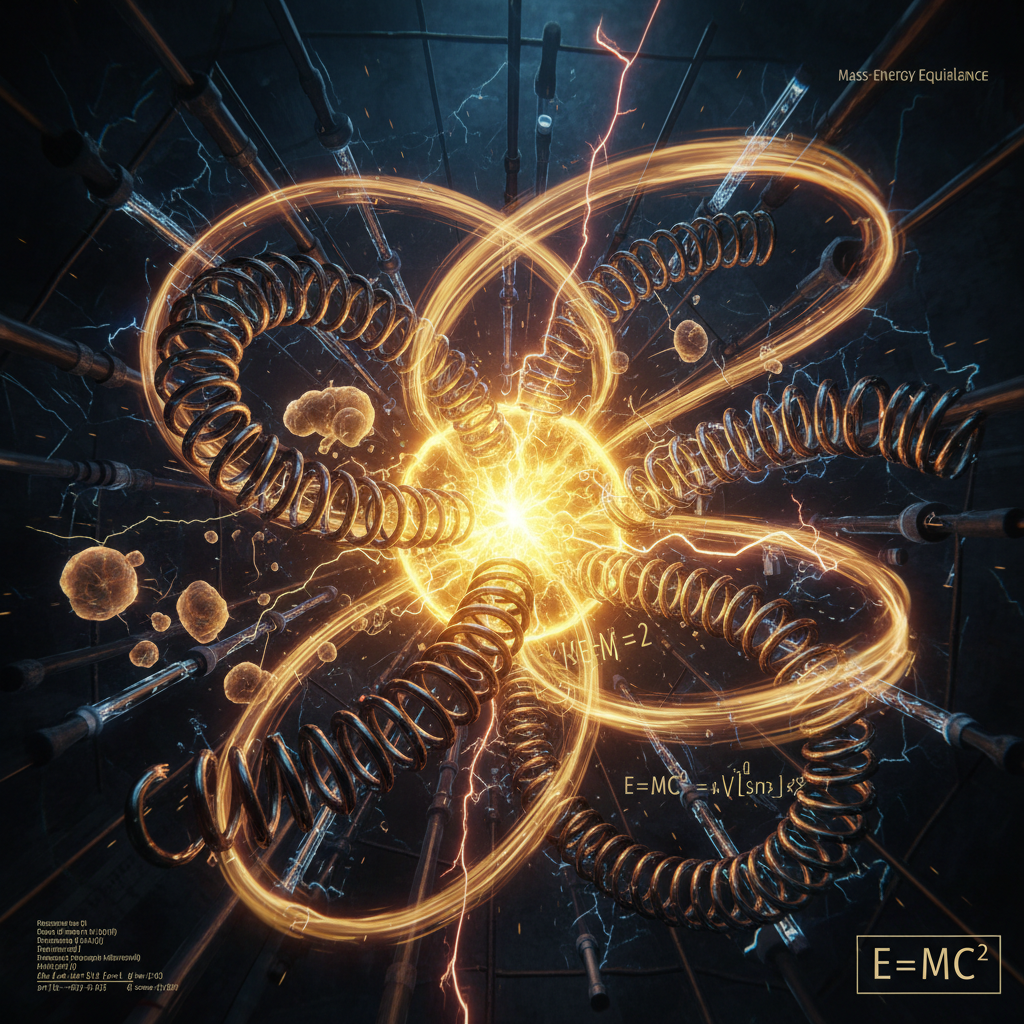
In a closed system, mass-energy is conserved. It can't be created or destroyed, only transformed. The total amount remains constant. This is one of the deepest principles in physics—a symmetry so fundamental that it emerges from the structure of time itself.
But you're not in a closed system. Your attention flows out, converted into data, into ad revenue, into the mass of server farms and the energy of computation. And what flows back? Dopamine. Distraction. The illusion of connection. The conservation law is broken because the system is open, and you're on the wrong side of the equation.
Every moment of awareness you pour into the feed is a moment that can't be spent elsewhere. Your finite mass of consciousness, converted at light speed into someone else's energy. The equation balances, but not in your favor.
The Speed of Light
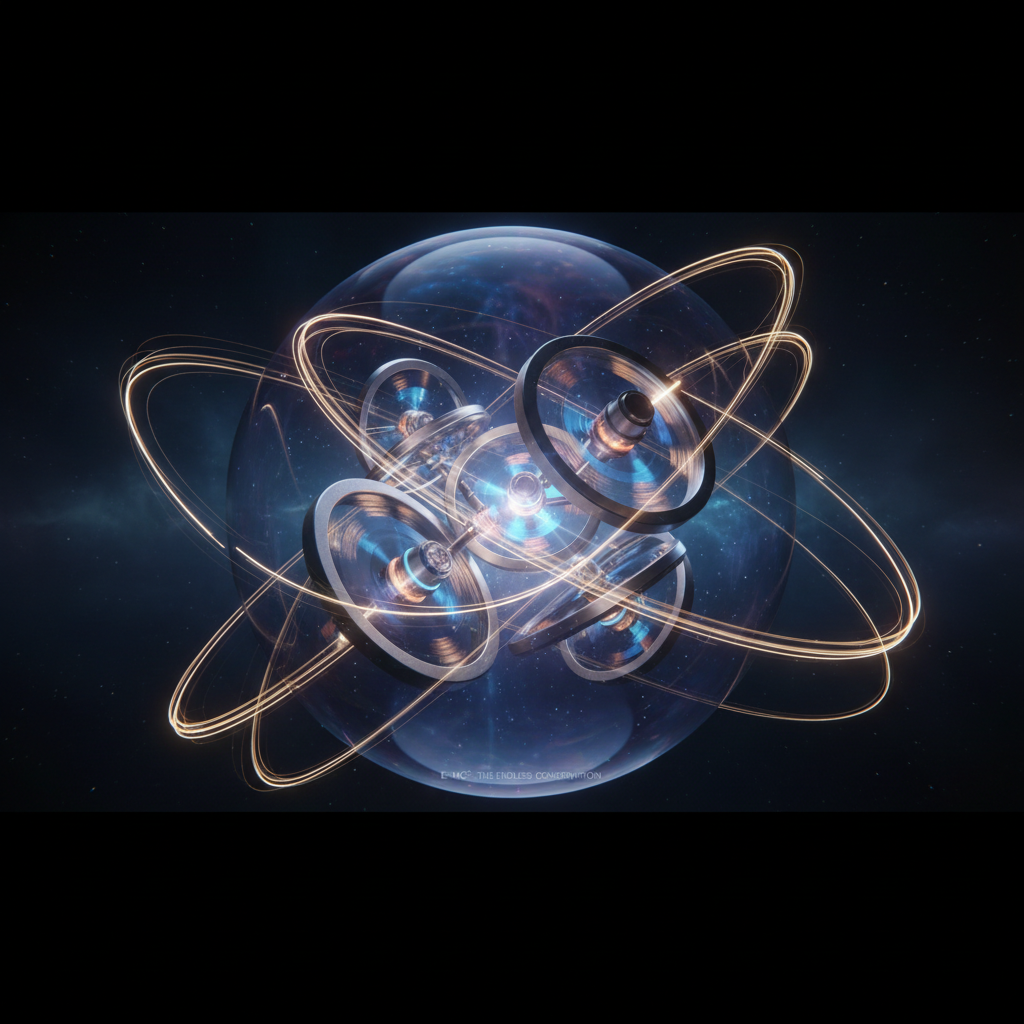
Why c²? Why does the speed of light appear in an equation about mass and energy? Because c is the conversion factor between space and time, between here and there, between now and then. It's the speed at which causality propagates. The maximum rate at which change can occur.
Your data moves at light speed through fiber optic cables. Your attention is converted into engagement metrics faster than you can process what you've seen. The platforms operate at c, while you operate at the speed of thought—orders of magnitude slower. By the time you realize you've been scrolling for an hour, the conversion has already happened. Your mass has already become their energy.
This is the asymmetry that makes surveillance capitalism possible. They operate at the speed of light. You operate at the speed of neurons. The gap between these speeds is where the extraction happens.
Reversing the Equation
But remember: the equation works both ways. If mass can become energy, then energy can become mass. If your attention can be converted into data, then energy can be converted back into consciousness. Into presence. Into the weight of being here, now, fully.
The platforms don't want you to know this. They want you to believe the conversion only flows one way. That your attention is meant to dissipate into their systems, never to be recovered. But physics doesn't lie. What can be transformed can be transformed back.
Every moment you reclaim from the feed is a moment where you reverse the equation. Where you take energy and convert it back into the mass of lived experience. The weight of a book in your hands. The density of a conversation with someone you love. The solid, undeniable mass of being present in your own life.
E=mc². Your awareness has mass. Don't let them convert it all into energy. Some things are meant to stay solid.
Data emitted: 1,337 bytes · Binding energy: 3.7 eV · Half-life of attention: 8 seconds
Data emitted: 1,100 words • 6.5KB • 5-minute read