You scroll. The feed refreshes. Something catches your eye—a thumbnail, a headline, a face you almost recognize. Your attention snaps to it like iron filings to a magnet. But here's what you don't see: the field itself. The invisible architecture that guides your gaze, measures its intensity, and counts every single line of force that passes through the surface of your awareness.
In physics, we call this magnetic flux. In your digital life, it has a different name: engagement.
The Field You Cannot See
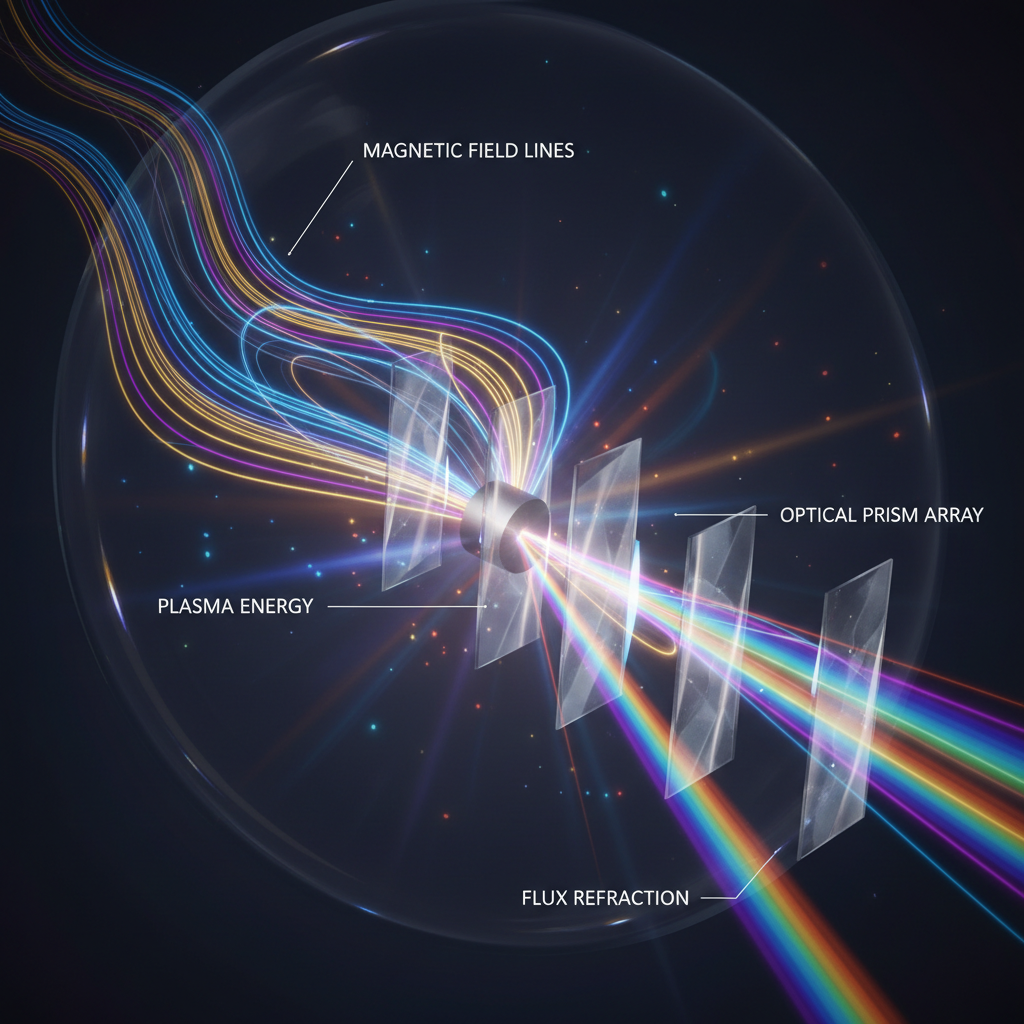
Magnetic flux is deceptively simple. Take a magnetic field—that invisible influence surrounding every magnet, every current-carrying wire, every spinning electron. Now imagine a surface, any surface, positioned in that field. Magnetic flux (Φ) measures how many magnetic field lines pass through that surface. The equation is elegant: Φ = B·A·cos(θ), where B is the magnetic field strength, A is the area of your surface, and θ is the angle between them.
But here's what matters: flux isn't about the field existing. It's about the field passing through something. It's about intersection. About capture. You can have the strongest magnetic field in the universe, but if it runs parallel to your surface—if nothing crosses that boundary—your flux is zero. Nothing is captured. Nothing is measured.
The field must penetrate to matter.
Your Attention as Surface Area

Every platform you use generates a field. Not magnetic, but informational. Algorithmic. A field of potential content, swirling around you at every moment—millions of posts, videos, ads, notifications. This field has intensity (how compelling the content is) and direction (how it's targeted at you specifically).
You are the surface.
Your attention has area—a finite capacity to absorb information at any given moment. Your orientation matters too. When you're perpendicular to the field, fully engaged, scrolling with intent, maximum flux passes through you. The content penetrates completely. Every field line crosses your consciousness and gets counted, measured, monetized.
When you're parallel—distracted, resistant, barely paying attention—the flux drops toward zero. The field slides past you. Nothing captures. Nothing converts. From the platform's perspective, you might as well not exist.
This is why they optimize for perpendicularity. Why every interface element conspires to orient you correctly. To maximize the angle of intersection between their field and your awareness.
Faraday's Ghost in the Machine

Michael Faraday discovered something remarkable about magnetic flux: change it, and you generate electricity. This is Faraday's Law of Induction, the principle behind every generator, every transformer, every electric motor. The equation is ε = -dΦ/dt—the induced voltage equals the negative rate of change of magnetic flux.
The negative sign matters. It tells us the induced current opposes the change that created it. Nature resists. This is Lenz's Law—a kind of electromagnetic inertia, a tendency toward stability.
But here's the key insight: it's not the field itself that generates power. It's the change in flux. Movement. Variation. A static magnetic field passing through a static coil produces nothing. You need dynamics. You need the field to grow stronger, to weaken, to rotate, to pulse.
You need to keep things changing.
The Infinite Scroll as Induction Engine
Every platform understands Faraday's principle intuitively. Static content generates nothing. A feed that doesn't change is a dead coil—no flux variation, no induced engagement, no extracted value. This is why your feed never stops moving. Why it refreshes constantly. Why the content rotates, pulses, updates in real-time.
They're inducing current in you.
Each scroll changes the flux through your attention. New content enters your field of view. The informational field strength varies—sometimes weak (boring posts), sometimes intense (outrage, beauty, fear). Your orientation shifts as different content demands different cognitive angles. The rate of change stays high. dΦ/dt never drops to zero.
And just like in Faraday's coil, this changing flux generates something: engagement. Clicks. Reactions. Shares. The electromagnetic current becomes data current, flowing back to the platform, powering the entire system.
You might even feel your own Lenz's Law—that resistance, that exhaustion, that sense that something in you opposes this constant change. But the field is stronger than your resistance. The variation continues.
Measuring What Passes Through You
In physics labs, we measure magnetic flux with remarkable precision. Flux meters detect the tiniest changes in field lines passing through their sensing coils. They integrate the signal over time, accounting for every variation, every fluctuation.
You are being measured with equal precision.
Every piece of content that passes through your attention generates a signal. How long did you look? Did your pupils dilate? Did you pause your scroll? Did you engage? The platforms integrate these signals continuously, building a complete picture of your flux characteristics—your surface area (attention capacity), your orientation (interests, vulnerabilities), your response to field variations (what makes you click).
They know your flux better than you do. They know exactly how to orient the field to maximize penetration. They know the optimal rate of change to induce maximum current without triggering too much Lenz resistance.
You are not just in the field. You are the instrument that measures it, and the measurement itself is the product being sold.
The Geometry of Extraction
There's a beautiful theorem in electromagnetism called Gauss's Law for Magnetism. It states that the total magnetic flux through any closed surface is always zero. Field lines that enter must exit. Magnetic monopoles don't exist. The universe maintains a kind of balance.
But in the attention economy, there is no such conservation law. The informational field only flows one way—into you. The flux is measured, extracted, and converted into value that flows elsewhere. The surface of your attention is not closed. It's open, exposed, perpetually receptive.
What would it mean to close that surface? To create a boundary that field lines cannot penetrate, or through which they must exit with the same intensity they entered? What would it mean to achieve zero net flux?
Perhaps it would mean being truly present—perpendicular to nothing, parallel to everything, letting the fields slide past without capture. Or perhaps it would mean something more radical: generating your own field, strong enough that it shapes the space around you rather than being shaped by it.
Data emitted: 1100 dB | Flux density: maximum | Field orientation: perpendicular to comfort | Resistance: futile but necessary
Data emitted: 1,100 words • 6.5KB • 5-minute read