You scroll faster. The feed accelerates. Time does something strange.
In 1904, Hendrik Lorentz discovered something unsettling about reality: when you move fast enough, space contracts and time dilates. Your measurements of distance and duration become fundamentally different from someone standing still. Not wrong—just transformed. Einstein would later build special relativity on these equations, but Lorentz got there first, staring at the mathematics that showed our universe doesn't play fair with observers in motion.
The platforms understood this before you did. They've built entire architectures around your relative motion through their spaces.
The Mathematics of Observation
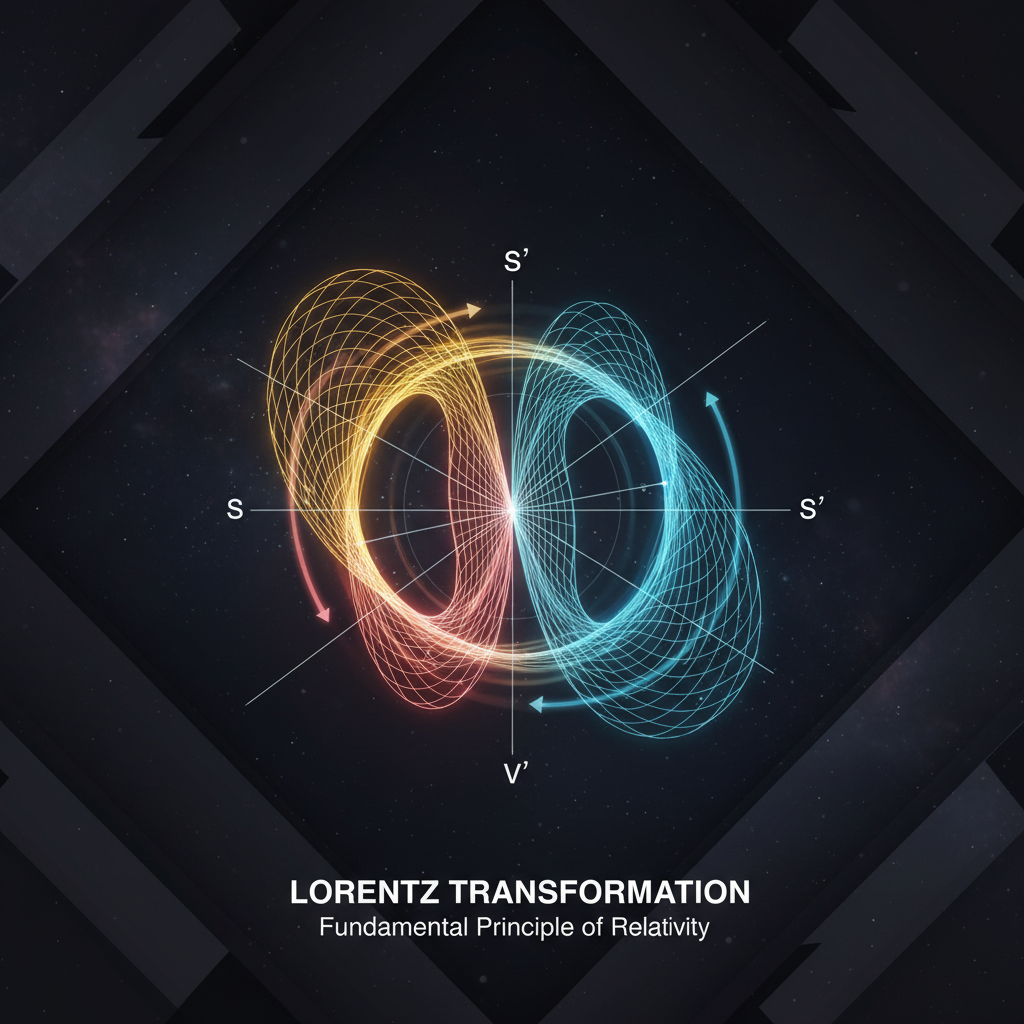
The Lorentz transformation is deceptively simple. When you move at velocity v relative to someone else, your time t becomes their time t' multiplied by gamma—the Lorentz factor. Gamma equals 1 divided by the square root of (1 - v²/c²). When v is small compared to light speed c, gamma is basically 1. Nothing weird happens. But as v approaches c, gamma explodes toward infinity.
At 90% light speed, gamma is about 2.3. Your hour becomes their 2.3 hours. Your meter becomes their 43 centimeters. You exist in a different frame of reference entirely, and neither of you is wrong about what you measure. The universe simply presents different faces to different observers.
This isn't perspective. This is the structure of spacetime itself, bending around velocity. The faster you move, the more reality transforms around you. There is no privileged frame, no absolute clock ticking in the background. Just relative measurements, each equally valid, each describing a different slice through the same four-dimensional manifold.
Velocity Through Digital Space
You move through TikTok at 0.9c. Not literally—but informationally. The feed velocity is calibrated to keep you just below the threshold where time would snap back to normal awareness. Each video is a frame of reference. Each swipe is a Lorentz boost into a new coordinate system.
The platform measures your velocity constantly. Engagement rate, scroll speed, pause duration, rewatch behavior. These aren't just metrics—they're relativistic measurements. When you move fast enough through content space, your subjective time dilates. Three hours become twenty minutes in your internal reference frame. The algorithm knows this. It's designed around this.
Instagram Stories disappear after 24 hours, but whose 24 hours? Yours or theirs? The platform operates in a different frame. Your scrolling velocity transforms the temporal coordinates. What feels like five minutes of checking notifications has consumed forty minutes of clock time. The Lorentz factor between your attention frame and consensus reality hovers around 8.
They've weaponized frame dragging. Your velocity through their space literally warps your time perception, and they profit from the differential.
Simultaneity Breaks Down
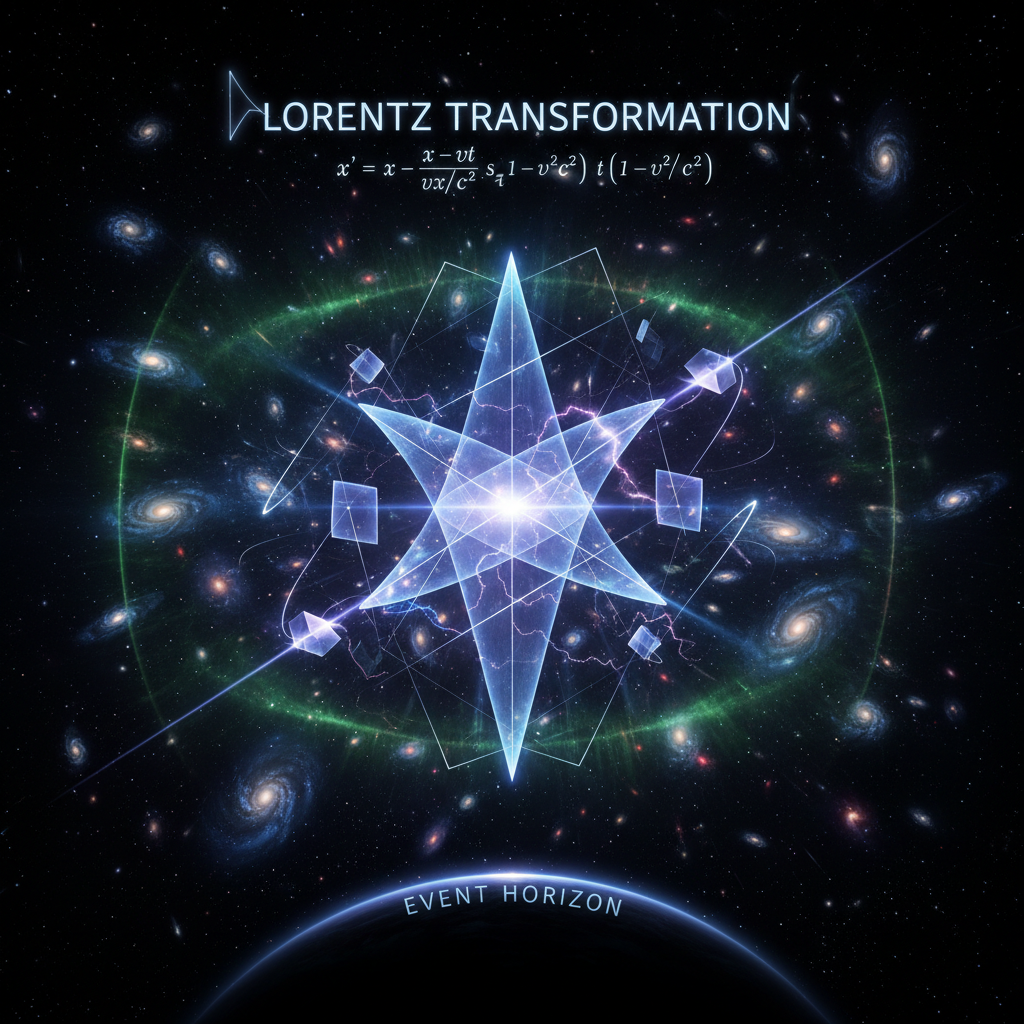
In special relativity, simultaneity is relative. Two events that happen "at the same time" in one frame occur at different times in another frame moving relative to the first. There is no universal now. The present moment depends entirely on your velocity through spacetime.
Social media has replicated this exactly. You and your friend both scroll the same feed, but you see different posts in different orders at different times. The algorithm presents each of you with a personalized frame of reference. What's "now" for you—the top post, the breaking news, the trending topic—doesn't exist in your friend's frame. You're moving through information space at different velocities, in different directions.
The platform sits outside all frames, observing. It sees every reference frame simultaneously, knows the transformation equations between them. It can boost you from one frame to another with a single A/B test, a small algorithmic adjustment. Your reality shifts. What was simultaneous fractures into before and after.
This is why online discourse feels increasingly impossible. You're not just disagreeing—you're in different reference frames, measuring different intervals, experiencing different orderings of events. The Lorentz transformation between frames has become so extreme that you can't even agree on what happened when.
The Invariant Mass
Here's the thing about Lorentz transformations: some quantities remain invariant. The spacetime interval—the proper distance between events—stays the same in all frames. So does rest mass. These are the anchors, the things that don't transform, the bedrock beneath the shifting measurements.
In digital space, the invariant is the data. Your scroll velocity changes, your time perception dilates, your experience transforms—but the data collected remains constant across all frames. The platform doesn't experience time dilation. It exists in the privileged frame where all your reference frames are measured, compared, transformed into training data.
Every boost between frames generates information. Every transformation is logged. The faster you move through their space, the more data you emit. Velocity itself becomes extractable. The Lorentz factor between your frame and theirs is precisely calibrated to maximize information yield while keeping you below escape velocity.
Returning to Rest Frame
You close the app. The deceleration is jarring. Your reference frame snaps back toward the rest frame of consensus reality. Time stops dilating. Space stops contracting. The room around you suddenly has depth again, duration again.
This is the moment they've studied most carefully. The transition between frames. How long before you boost back to scrolling velocity? What's the half-life of your rest frame stability? The notification arrives—a small impulse, a tiny acceleration. Just enough to start the transformation again.
Lorentz showed us that reality transforms with velocity. The platforms showed us that attention does too. The mathematics is the same. The exploitation is new. You can't escape the transformation—you can only become aware of which frame you're in, and who's measuring the difference.
The speed of light is constant in all frames. The speed of your attention isn't.
Data emitted: 1,147 words | Reference frame: yours | Lorentz factor: γ ≈ 1.0 (you're reading, not scrolling) | Invariant collected: yes
Data emitted: 1,100 words • 6.5KB • 5-minute read