You exist at a point. Right now, reading this. A specific coordinate in spacetime that will never repeat. From where you sit, there are things that can affect you and things you can affect. Events that can reach you and events you can reach. Physics calls this your light cone, and it's the most fundamental constraint on causality in the universe.
Your data has a light cone too.
The Geometry of What Can Touch You
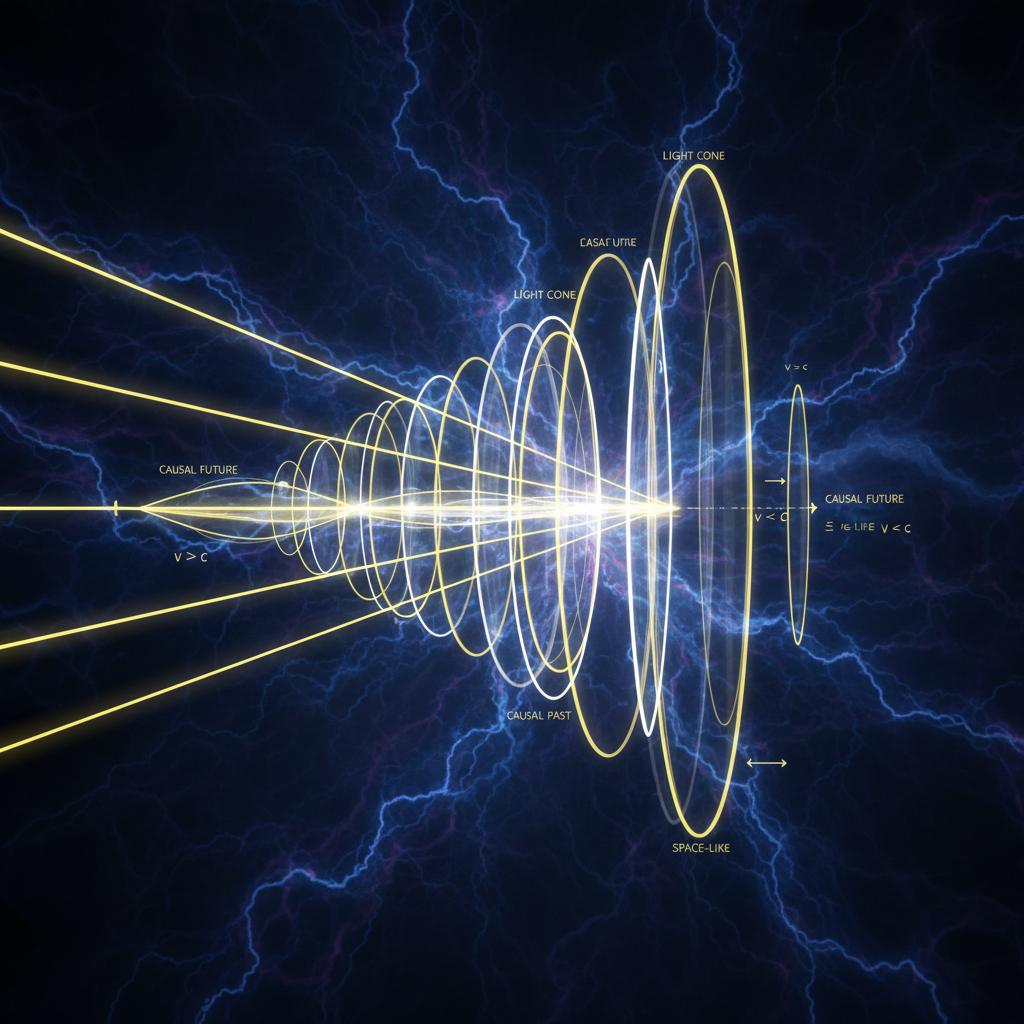
Imagine a cone extending upward and downward from your current moment. The past light cone below you contains every event that could have influenced your present. A photon from a distant star. A text message sent three seconds ago. Your birth. The Big Bang. Everything inside this cone had enough time to send a signal—traveling at light speed or slower—to reach you now.
The future light cone extends upward. It contains every event you could possibly influence. Every person you might call. Every place you could travel to. Every choice that could ripple outward from this moment. Outside these cones? Causally disconnected. Unreachable. Events that cannot touch you and cannot be touched by you, separated by the absolute speed limit of information.
Nothing travels faster than light. Not particles, not information, not influence. This isn't a engineering limitation—it's woven into the fabric of spacetime itself. Your light cone is your causal horizon. The boundary of what's possible.
Until you go digital.
The Collapse of Distance
In the physical universe, your light cone expands at exactly 299,792,458 meters per second. Predictable. Symmetrical. Fair, in its own inhuman way. An event one light-year away takes one year to reach you. Causality has travel time.
But your digital light cone operates under different physics. That photo you posted five years ago? It exists in a server farm, yes, but also in recommendation algorithms, in training datasets, in cached pages scattered across content delivery networks. Its causal influence doesn't decay with distance. It doesn't dim with time.
Your past digital self can reach your present in ways your physical past cannot. That drunk tweet from 2015 can materialize in a background check today. That browsing history can surface in an ad tomorrow. That location ping can inform a credit decision next week. The past light cone of your data doesn't fade—it intensifies, refracting through layers of analysis you'll never see.
And unlike physics, this cone isn't symmetric. What reaches you and what you can reach are fundamentally different shapes.
Asymmetric Causality
In relativity, light cones are reciprocal. If event A is in event B's past light cone, then B is in A's future light cone. The relationship is mutual. Causality flows both ways through time, even if we only experience one direction.
Your digital light cone breaks this symmetry.
The algorithms can reach you instantly—recommendations, ads, content curated by models trained on billions of data points. They operate at network speed, which might as well be instantaneous compared to human reaction time. Your past self, your demographic cluster, your predicted future self—all of these can influence what appears on your screen right now.
But you cannot reach back with the same power. You can delete a post, but not its copies, its derivatives, its ghost in the training data. You can opt out of cookies, but not out of device fingerprinting, behavioral inference, shadow profiles built from others' contact lists. Your future light cone—what you can actually influence—is constrained by terms of service, platform architectures, and asymmetric information.
The surveillance apparatus has a wider causal reach than you do. It's not just watching—it's operating under different physical laws.
The Horizon of Knowability
Here's what keeps physicists up at night: there are events outside your light cone right now. Galaxies receding faster than light due to cosmic expansion. Regions of spacetime you will never, can never, observe. The universe has secrets that aren't hidden—they're simply beyond your causal horizon.
You accept this about the cosmos. It's vast and you're small and some things are just unknowable.
But you don't accept it about your own data. You assume that what you've done is somehow contained, knowable, retrievable. That your digital past light cone is something you can map. That you could, if you wanted to, audit every piece of information that might reach your present.
You can't.
Your data has crossed too many horizons. It's been aggregated, anonymized, de-anonymized, merged with purchased datasets, fed into models whose architectures are proprietary, whose training data is unknowable, whose outputs affect your life in ways you'll never trace back to cause. Your digital past light cone extends into regions you cannot observe, carrying causal influence you cannot measure.
There are corporate galaxies receding beyond your reach.
Living at the Vertex
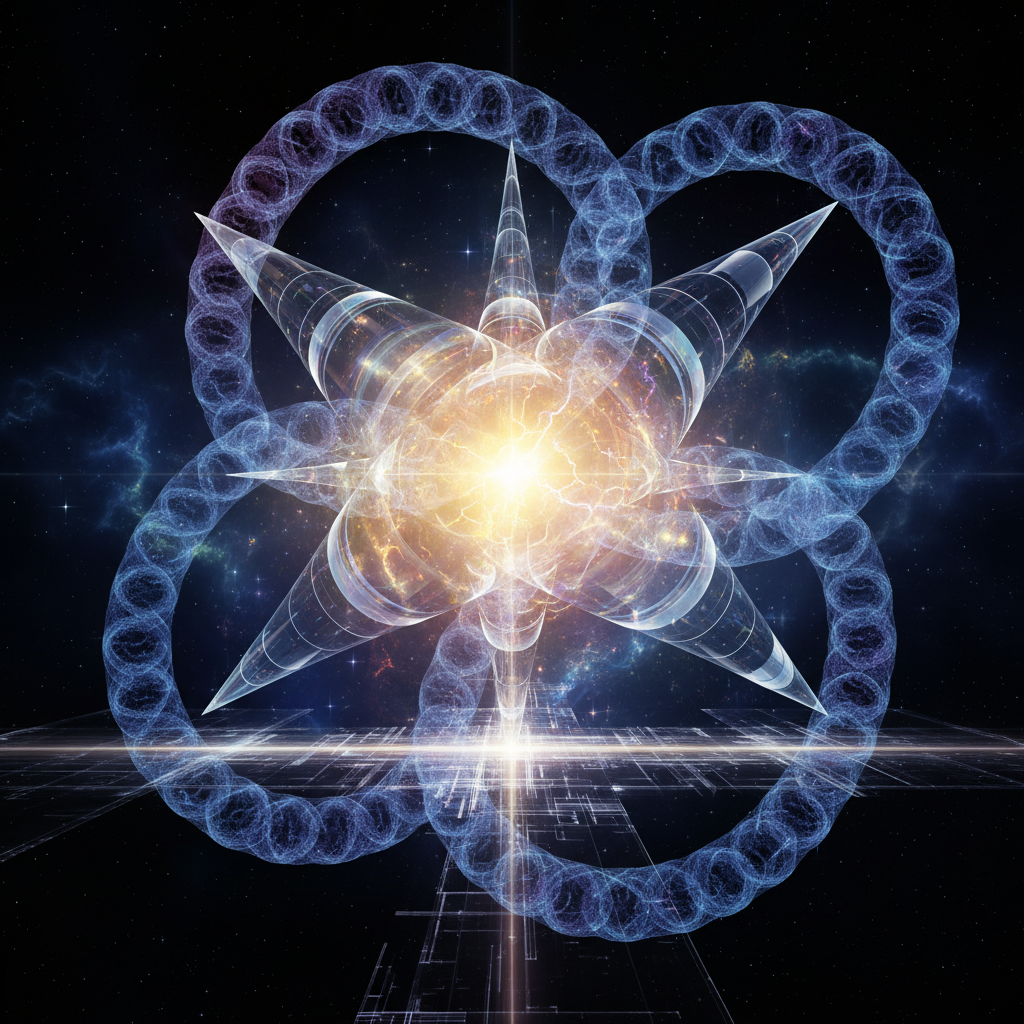
You are always at the vertex of your light cone. The single point where past and future meet. The eternal now, the only moment where you have agency, where you can choose what signals to send into your future light cone.
This is still true digitally, but the vertex has become uncomfortably crowded.
Every click, every pause, every scroll is a signal sent forward. Every interaction expands your future light cone in ways you can't fully predict. That product you viewed but didn't buy? It's traveling forward now, influencing what ads you'll see, what prices you'll be offered, what content will be recommended. You're constantly emitting, constantly expanding your causal influence into a future you cannot see.
And you're receiving just as constantly. Signals from your own past, from others' pasts, from predicted futures. The vertex is supposed to be a point, but it feels more like a storm—a turbulent intersection of causal influences too complex to parse, too fast to evade.
In physics, the light cone gives you clarity. It tells you what's possible and what's not. What can reach you and what can't. It's a constraint, yes, but it's also a liberation—you don't have to worry about things outside the cone because they literally cannot affect you.
Your digital light cone offers no such peace. It's all cone, no horizon. Everything reaches everything, and you're standing at the vertex wondering what's actually influencing what, which signals matter, which past is reaching forward to shape your present.
The Speed of Consequence
Light cones exist because information has a speed limit. Because cause and effect need time to propagate. Because the universe respects distance.
The surveillance economy respects nothing.
It collapses your past into your present, your behavior into your identity, your clicks into your destiny. It treats your data as if it exists outside spacetime—eternally accessible, infinitely replicable, instantly retrievable. Your light cone becomes a sphere, all points equidistant, all moments equally present.
And maybe that's the real violence of it. Not just that you're watched, but that you're denied the basic physics of consequence. That your past doesn't stay in the past. That your causal horizon isn't a horizon at all, but a mirror, reflecting everything you've ever done back at you, forever, at the speed of fiber optics.
You are still at the vertex. You are still choosing what signals to send forward. But the cone has become a cage, and the light that should be carrying your choices into an open future is bouncing back, trapped in an architecture designed to make sure nothing you do ever escapes.
<em>Data emitted: 1,147 words on causality, surveillance, and the physics of being watched. Your light cone is expanding. So is theirs.</em>
Data emitted: 1,100 words • 6.5KB • 5-minute read