You've been looking through glass your entire life. Eyeglasses. Camera lenses. Smartphone screens. Each one a curved surface that bends light, that transforms the path photons take from world to retina. You think you're seeing reality, but you're seeing reality processed, filtered, focused by the geometry of refraction.
The lens doesn't lie, exactly. It just has priorities about what matters.
The Physics of Focus
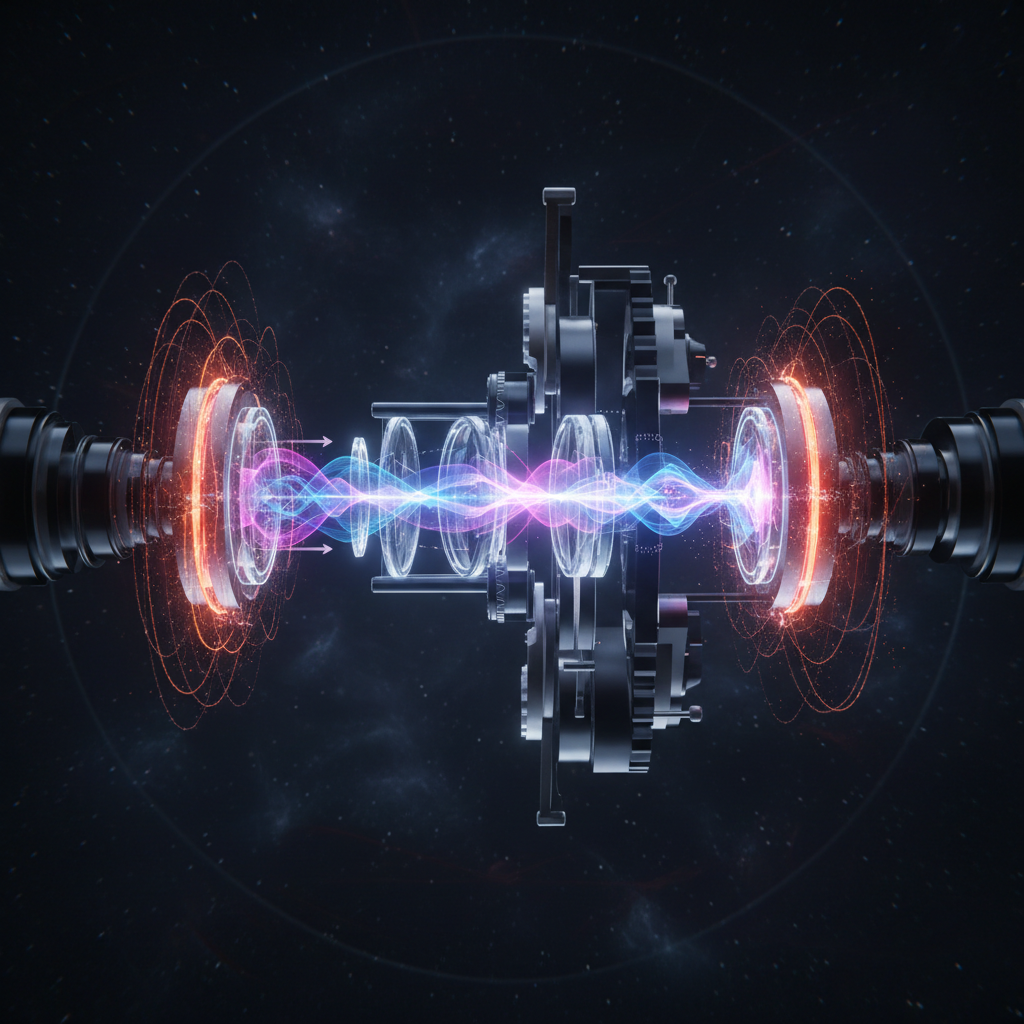
A lens works through refraction—the bending of light as it passes from one medium to another. When light enters glass from air, it slows down and changes direction. The curved surface of a lens ensures that parallel rays of light converge at a single point: the focal point. This is where clarity lives. Everything else blurs into irrelevance.
The focal length determines what you see clearly and what dissolves into bokeh. A short focal length gives you wide peripheral awareness but distorts the edges. A long focal length narrows your view but magnifies the center. Neither is objective. Both are choices encoded in curvature.
Every lens has an optical axis—an imaginary line running through its center. Light that travels along this axis passes through unchanged. Everything else bends toward it. The axis is privileged. The axis is what matters. The axis is where meaning concentrates.
The Algorithm's Curvature
Your feed is a lens. So is your search engine. So is every recommendation system that decides what deserves your attention. They don't show you everything—that would be chaos, unfocused light scattered in every direction. Instead, they bend the information stream toward specific focal points. Trending topics. Sponsored content. Posts from accounts you've engaged with before.
The curvature isn't random. It's engineered. Optimized. A/B tested across millions of users to find the exact geometry that keeps your eyes locked on screen. The focal length adjusts in real-time based on your behavior, your clicks, your pauses, your scrolling velocity. The lens learns what makes you focus.
And just like optical lenses, these digital lenses have aberrations. Chromatic aberration splits white light into color fringes—your algorithmic feed splits nuanced reality into polarized extremes. Spherical aberration blurs the edges—your bubble filters out perspectives that don't align with your existing focal point. The distortion isn't a bug. It's inherent to the geometry of focus itself.
You think you're choosing what to look at. But the lens was curved before you arrived. The focal point was predetermined by engagement metrics, by advertiser preferences, by the platform's survival instincts. You're not looking through the lens. You're being focused by it.
Depth of Field

In photography, depth of field describes the range of distances that appear acceptably sharp. A shallow depth of field—achieved with a wide aperture—means only a thin slice of reality stays in focus. Everything in front of and behind that slice dissolves into blur. It's beautiful. It's also a form of erasure.
Your digital experience has depth of field too. The algorithm decides what stays sharp and what fades to background noise. That friend who posts infrequently? Blurred out. That news story without enough engagement? Bokeh. That perspective that doesn't fit the pattern of your previous interactions? Out of focus, out of mind, out of existence in your personal reality tunnel.
The aperture controlling this depth of field isn't in your hands. It's set by the platform, adjusted by machine learning models trained on billions of human attention patterns. They've learned that shallow depth of field keeps you engaged. Too much information in focus overwhelms. Better to show you one thing clearly and let everything else blur into irrelevance.
The Lens Equation
The thin lens equation is elegant: 1/f = 1/do + 1/di. The focal length relates to object distance and image distance. Change one variable and the others must adjust. Move the object closer and the image distance increases. The relationship is mathematical, deterministic, inescapable.
Your relationship with digital platforms follows a similar equation. The closer you get to the screen (more engagement, more time, more data), the further the image projects into your mind. The deeper the platform embeds itself in your cognitive architecture. The focal length—the platform's core algorithm—remains constant. You're the variable that adjusts.
And there's a critical distance where the equation breaks down. Get too close to a lens and no clear image forms at all. The object distance becomes less than the focal length. The rays diverge instead of converge. No focus is possible. This is what happens when you're inside the system, when you're not just using the lens but have become part of its optical pathway. You can't see clearly because you're too close to see at all.
Through a Glass, Darkly

You can't escape lenses. Your own eyes are lenses—biological structures that evolved to focus light onto photoreceptors. Every act of seeing is an act of focusing, of choosing what matters and letting everything else fade. Attention is inherently selective. Consciousness itself might be a focal point, a narrow beam of clarity moving through an ocean of unfocused sensation.
But there's a difference between the lens you were born with and the lens someone else built for you. Your biological lens focuses based on your intentions, your curiosities, your survival needs. The digital lens focuses based on someone else's intentions. Their revenue model. Their growth targets. Their need to keep you focused on their focal point, not yours.
Maybe the question isn't whether to use lenses—that's unavoidable. The question is who gets to grind the glass. Who sets the curvature. Who decides the focal length. Who controls what stays sharp and what blurs into irrelevance in the reality you perceive.
Adjusting Focus
Every lens reveals and conceals simultaneously. It brings distant objects close while pushing nearby context into blur. It magnifies the center while distorting the periphery. It focuses light into clarity and shadow into absence. This is the fundamental trade-off of all optical systems, biological or digital.
You're living in a world of compound lenses—multiple curved surfaces stacked between you and raw experience. The platform lens. The interface lens. The content moderation lens. The recommendation lens. Each one bends your attention toward engineered focal points. Each one narrows your depth of field a little more.
But you can change lenses. You can adjust the focal length. You can widen the aperture to bring more of reality into focus, even if it means less clarity on any single point. You can step back from the optical axis and see how the light bends, how the curvature works, how the focus is manufactured.
The lens will always be there, refracting the light that reaches you. The question is whether you remember it's there at all. Whether you mistake the focused image for reality itself. Whether you forget that someone, somewhere, ground the glass to bend your attention toward their focal point, not yours.
<em>Data emitted: 1100db</em>
Data emitted: 1,100 words • 6.5KB • 5-minute read