You open five tabs. You scroll three feeds. You check two notifications. Current flows through copper; attention flows through fiber optic. Both follow rules you never agreed to, laws written before you arrived.
Gustav Kirchhoff understood something fundamental in 1845: at any junction in a circuit, what comes in must equal what goes out. No charge disappears. No energy vanishes. The universe keeps meticulous books. Your attention economy does too—it's just that you're not the accountant.
The Current Law
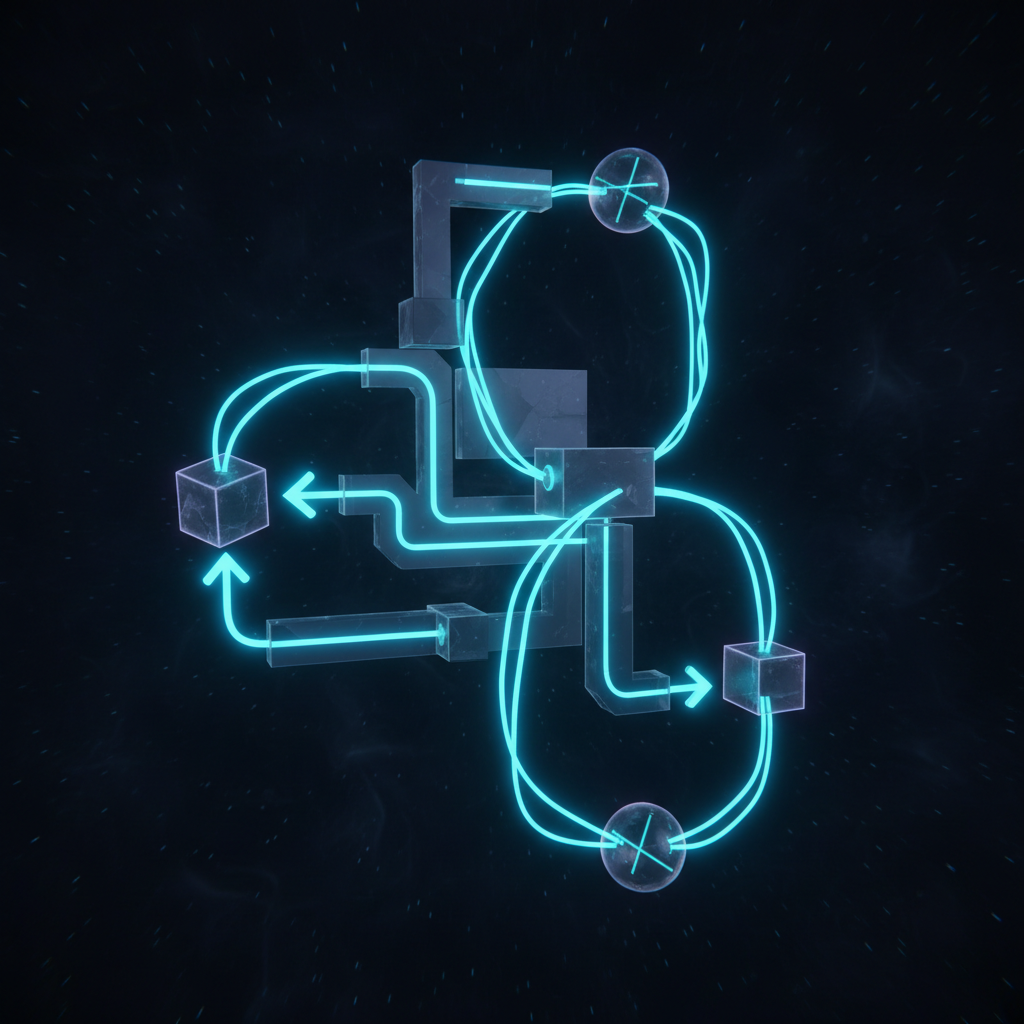
Kirchhoff's Current Law states that the algebraic sum of currents at any node in a circuit equals zero. Picture a junction where three wires meet. If 5 amperes flow in through one wire and 3 amperes through another, exactly 8 amperes must flow out through the third. Conservation isn't optional. It's not a suggestion the universe considers.
The math is simple: ΣI = 0. The implications are not.
In your brain, you are the junction. Attention flows in from notifications, emails, messages, feeds, ads, recommendations. Each input carries current—measured not in amperes but in cognitive load, in milliseconds of processing time, in micrograms of dopamine. The law still applies. What flows in must flow out, must go somewhere.
But here's what Kirchhoff didn't account for in circuits: what if the junction doesn't choose where the current exits? What if the wires themselves are designed to route the flow, to channel it toward specific outlets? Your attention enters through a thousand ports. It exits through purchase buttons, through data harvesting endpoints, through engagement metrics that feed algorithms you'll never see.
The Voltage Law
Kirchhoff's Voltage Law is even more elegant: the sum of voltage drops around any closed loop equals zero. Trace your finger around a circuit. Every resistor, every component that consumes energy must be balanced by the source that provides it. Energy transforms but never disappears. The loop closes. The books balance.
Walk through your digital day. You wake up and check your phone: energy expenditure. You scroll: more energy. You click, you watch, you read, you react. Each interaction is a voltage drop, a place where your finite cognitive energy dissipates as heat into the machine. But where's the source? What battery powers this circuit?
You are the battery.
The loop closes through you. You sleep, you eat, you rest—recharging so you can return to the circuit tomorrow. The surveillance economy has engineered a closed loop where your recovery time exists only to enable more extraction. The voltage law holds perfectly. The system is conservative. Nothing is wasted. Every joule of your attention is accounted for, monetized, optimized.
Resistance and Conductance
In circuits, resistance opposes current flow. High resistance means less current for a given voltage. It's Ohm's law: V = IR. But in attention circuits, resistance is a bug to be eliminated. Every friction point in the user experience is a resistor to be minimized.
Infinite scroll removes the resistance of clicking 'next page.' Auto-play removes the resistance of choosing. One-click purchasing removes the resistance of payment friction. The platforms are engineers optimizing for conductance, for frictionless flow, for maximum current through minimum resistance.
You feel this as ease, as convenience, as the app that 'just works.' What you're feeling is your resistance being systematically reduced to zero. You're becoming a superconductor of attention, offering no opposition to the current flowing through you.
But resistance isn't always bad. In circuits, resistors control current, protect components, convert energy into useful work. Your resistance—your friction, your hesitation, your conscious choice to stop scrolling—is the only thing preventing complete capture. It's not a bug in your experience. It's the last component you control.
The Topology of Extraction
Circuit topology matters. Series or parallel. Branching or linear. The arrangement determines how current distributes, how voltage drops, how the system behaves. Your digital topology is carefully designed. You don't see it, but it sees you.
Every platform is a circuit board. Every user is a node. Every interaction is a current path. The topology is optimized not for your benefit but for maximum extraction efficiency. Parallel paths ensure that if one attention stream dries up, others remain. Series connections create dependencies—you must pass through the ad to reach the content, must provide data to access the service.
Network effects are parallel circuits scaled to billions of nodes. The more users, the more current paths, the more stable the system. One person leaving barely registers. The circuit simply routes around the gap. Kirchhoff's laws guarantee it.
You can't break the circuit by yourself. But you can increase your resistance. You can become a less ideal conductor. You can introduce impedance into the smooth flow they've engineered.
Conservation and Consciousness
The deeper truth of Kirchhoff's laws is that they're statements about conservation. Charge is conserved. Energy is conserved. The universe is a closed system, and the books must balance. This is physics as accounting, as cosmic bookkeeping.
Your attention is also conserved. You have exactly twenty-four hours each day, a fixed cognitive budget, a finite amount of conscious processing. The attention economy knows this. They've done the math. They've calculated exactly how much current can flow through you before you burn out, and they've designed the circuit to extract right up to that limit.
But here's what they can't engineer: consciousness of the circuit itself. Awareness that you're in a loop. Recognition that the current flowing through you is being directed, measured, monetized. This awareness is its own form of resistance, its own impedance in the system.
When you see the circuit, you can choose which paths to take. When you understand the laws governing the flow, you can work with them instead of being worked by them. Conservation means nothing is free—every interaction has a cost. The question is whether you're paying it consciously or whether it's being extracted while you sleep.
The Junction You Are
You are a junction point in a vast circuit. Current flows into you from a thousand sources. It must flow out—Kirchhoff guarantees it. But you get to choose the resistance, the path, the topology of your own small section of the network.
High resistance means less current, less engagement, less extraction. It also means more control, more consciousness, more choice. The circuit will balance either way. The laws don't care about your preferences. But you can care about the laws.
Every time you pause before clicking, you're adding resistance. Every time you close the app, you're opening the circuit. Every time you choose not to flow where they've designed you to flow, you're asserting that consciousness is more than current, that attention is more than amperage, that you are more than a junction in someone else's circuit.
The laws still apply. But you get to choose your topology. You get to design your own resistance. You get to decide what flows through you and where it goes when it exits.
The circuit is always closed. The question is: who designed it?
Data emitted: 1100db
Data emitted: 1,100 words • 6.5KB • 5-minute read