You're moving right now. Even sitting still, your thumb traces arcs across glass, your eyes dart between notifications, your attention accelerates from one stimulus to the next. Each movement carries energy—kinetic energy—the physics of motion made manifest in the digital realm.
But here's what they don't tell you: every joule of energy you expend in the attention economy gets harvested, measured, monetized. Your velocity through their platforms becomes their velocity through quarterly earnings. You are both the object in motion and the fuel.
The Mathematics of Motion
Kinetic energy follows a deceptively simple equation: KE = ½mv². One-half times mass times velocity squared. The energy of any moving object depends on two things: how much stuff is moving, and how fast it's moving.
That squared term is crucial. Double your velocity and you don't double the energy—you quadruple it. Triple your speed and you're carrying nine times the energy. This is why car crashes at highway speeds are so much deadlier than parking lot fender-benders. This is why meteors don't just dent the earth—they excavate craters.
The equation is elegant, but what it describes is violent. Kinetic energy is potential made real, possibility converted into consequence. It's the difference between a bullet in a box and a bullet in flight. Between stillness and impact.
Velocity and the Attention Market
Your attention has mass. Not physical mass, but informational mass—the weight of your demographic data, your purchasing history, your social connections, your predictable patterns. You are not weightless in the digital space. You are quantified, measured, assigned a value.
And you have velocity. The speed at which you move through content. How many posts per minute. How many swipes per hour. How rapidly your pupils track across advertisements. Every platform is optimized to increase your velocity, to keep you accelerating through their ecosystem.
Remember that squared term? The faster they can make you move, the more energy you generate—exponentially more. This is why infinite scroll exists. Why autoplay is the default. Why every interaction is frictionless, every barrier removed. They're not just capturing your attention—they're accelerating it, maximizing the kinetic energy you produce as you hurtle through their carefully designed spaces.
The algorithm is a particle accelerator, and you are the particle.
Inelastic Collisions
In physics, when objects collide, energy transforms. In a perfectly elastic collision, kinetic energy is conserved—bouncing balls that rebound with the same energy they arrived with. But most real-world collisions are inelastic. Energy dissipates. Gets converted to heat, sound, deformation.
Every time you collide with content—every click, every view, every engagement—it's an inelastic collision. You arrive with attention-energy, you interact, and that energy transforms. Some of it becomes data. Some becomes ad revenue. Some becomes training material for prediction algorithms.
But you? You don't bounce back with the same energy you brought. You emerge slightly depleted, slightly changed, carrying a little less momentum than before. The platforms, meanwhile, accumulate what you've lost. They grow more massive with every collision, while you scroll on, wondering why you're tired.
The Exhaustion Equation
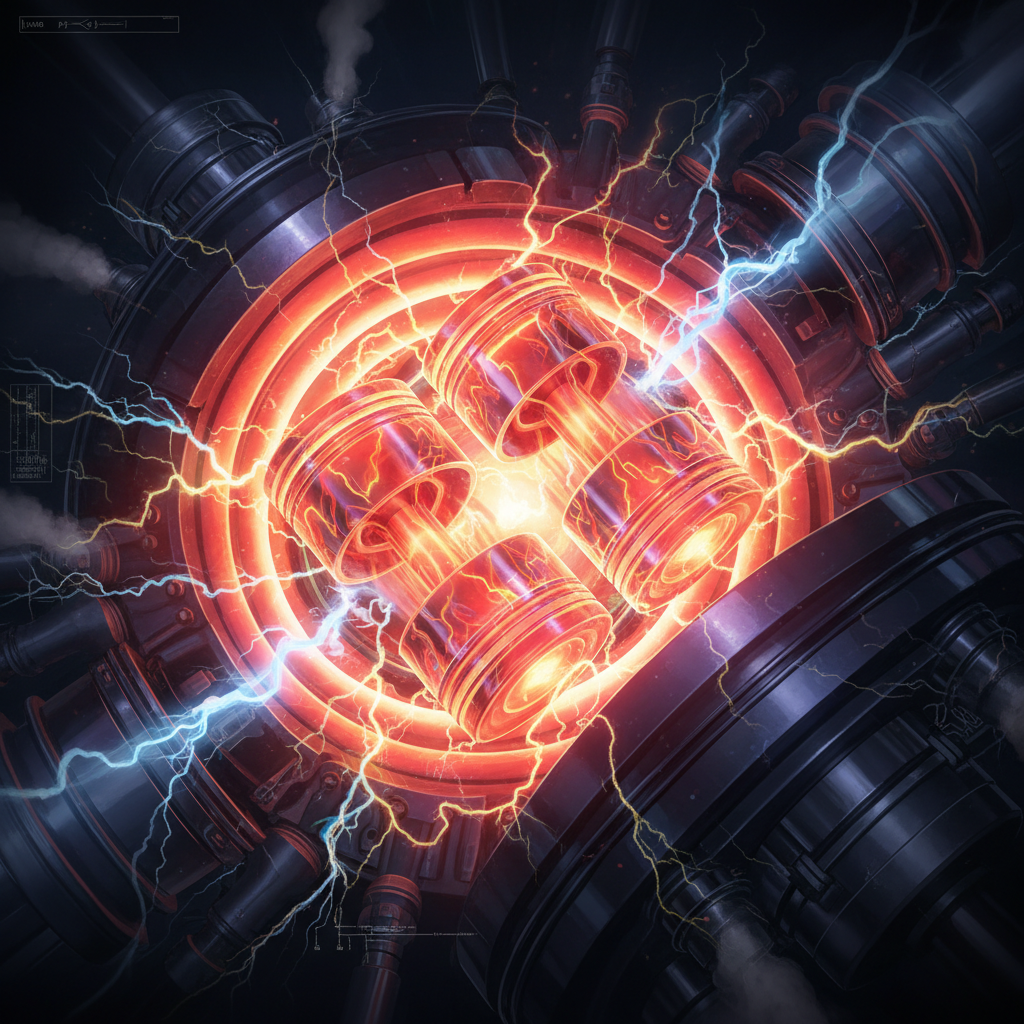
There's a reason you feel drained after hours online. It's not metaphorical. Your brain is burning glucose, your neurons are firing, your body is producing real, measurable energy that gets poured into the act of attention. That energy has to come from somewhere—from your metabolism, your reserves, your finite biological capacity.
The surveillance economy runs on this energy extraction. They've built a machine that converts human kinetic energy—the energy of your moving eyes, your scrolling fingers, your racing thoughts—into computational kinetic energy. Server farms processing your data. Algorithms updating in real-time. Stock prices rising.
You are the power source. They are the grid.
And unlike the idealized physics problems where energy is conserved in closed systems, this system is deliberately open. Your energy flows in one direction. Out of you. Into them. The second law of thermodynamics made digital: entropy increases, order concentrates at the top, and you're left holding the heat death of your attention span.
Coming to Rest
An object in motion stays in motion unless acted upon by an external force. That's Newton's first law, and it applies to you too. Once you're scrolling, you keep scrolling. Once you're engaged, you stay engaged. The platforms have removed every external force that might slow you down.
But kinetic energy can be spent. Eventually, every moving object comes to rest. The question is: do you stop because you choose to, or because you've simply run out of energy to give?
At 1100db, we think about the sound of systems—the noise they make, the frequencies they emit. Kinetic energy, when released, makes sound. It makes vibration. It makes waves that propagate outward. Your motion through digital space creates ripples, echoes, data trails that persist long after you've come to rest.
Maybe the real question isn't how much kinetic energy you're generating. Maybe it's whether you're moving because you want to, or because someone else has calculated the exact velocity that maximizes your extractable worth.
Maybe it's time to consider the physics of stillness.
<em>Data emitted: 2024. Energy state: measured. Velocity: tracked. You are here, moving, generating value with every motion. The equation is simple. The implications are not.</em>
Data emitted: 1,100 words • 6.5KB • 5-minute read