You feel it before you understand it. That sudden lurch when your phone vibrates. The mental whiplash of switching between tabs. The way your focus snaps from one thing to another, never gliding, always jerking.
In physics, we call this jerk. Not the person cutting you off in traffic. Not the ex who never texted back. But the rate of change of acceleration. The derivative of acceleration with respect to time. The thing that makes roller coasters nauseating and car crashes lethal.
Your digital life is engineered for maximum jerk.
The Third Derivative
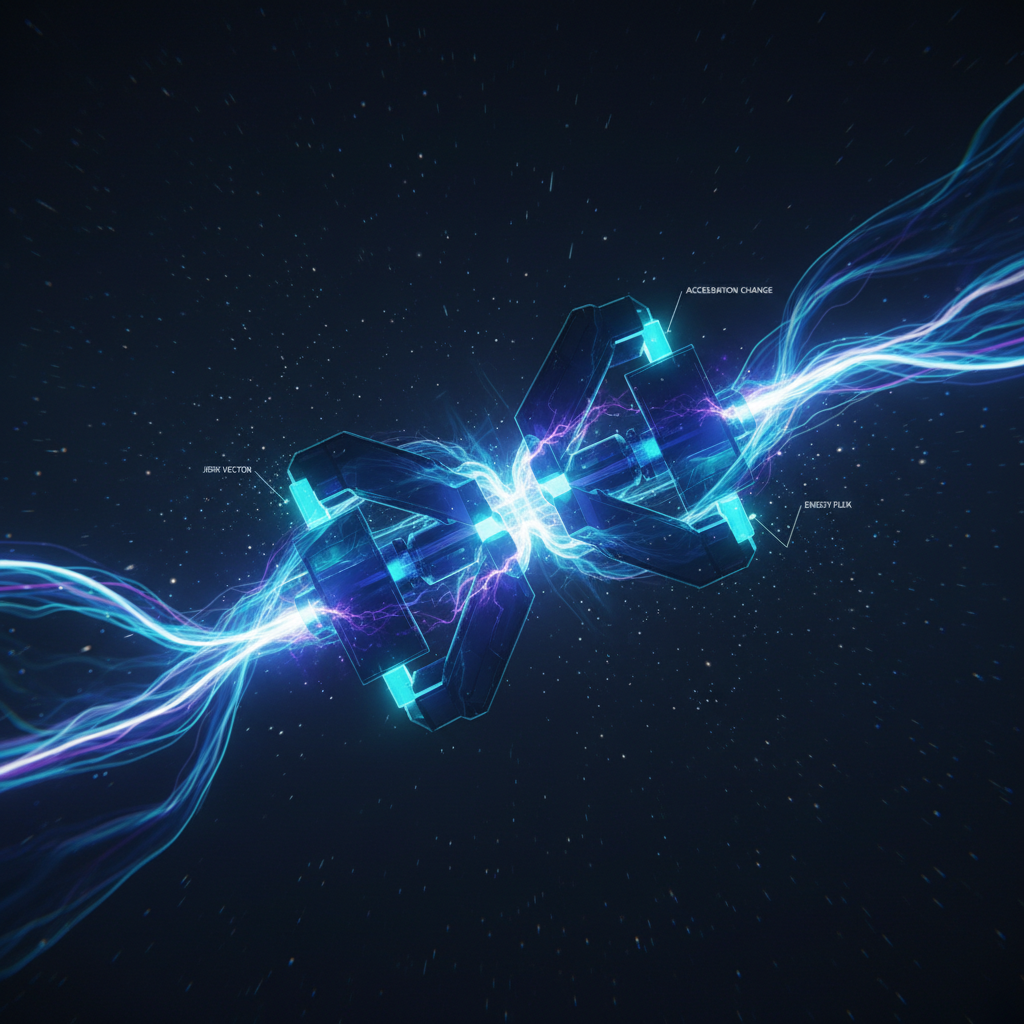
Position. Velocity. Acceleration. You learned these in high school physics. An object's location, how fast it's moving, how quickly that speed changes. Clean. Sequential. Each one the derivative of the last.
But there's a fourth layer. Jerk is the derivative of acceleration—the rate at which acceleration itself changes. It's measured in meters per second cubed, which sounds like mathematical abstraction until you experience it in your body.
When an elevator starts moving, you feel acceleration. When that acceleration increases suddenly—when the elevator jerks into motion—you feel jerk. Your inner ear protests. Your stomach drops. Your body knows something violent just happened to your momentum.
Engineers minimize jerk in transportation systems because humans hate it. Smooth acceleration curves. Gradual transitions. The difference between a luxury car and a jalopy is often just jerk control.
But in your digital experience? Jerk is the point.
Notification Whiplash
Every notification is a jerk event. Not just an interruption—a sudden change in the acceleration of your attention. You're reading an article, your focus building momentum, when your phone buzzes. Your attention doesn't just stop. It doesn't even just decelerate. The deceleration itself changes instantly.
This is why notifications feel physically jarring. Why you can feel them in your chest, your shoulders, your jaw. Your attention has inertia, and jerk is what happens when that inertia meets an immovable force.
The platforms know this. They've measured your response time to the millisecond. They've A/B tested notification timing, vibration patterns, sound frequencies. They've optimized for maximum jerk because jerk creates urgency, and urgency creates engagement.
Smooth transitions don't monetize. You need to be yanked from one state to another. Your attention needs to snap, not drift. Because in that moment of disorientation, in that fraction of a second where your brain scrambles to reorient, you're vulnerable. Suggestible. Ready to click.
The Jerk Economy
Surveillance capitalism runs on jerk. The entire infrastructure is designed to create sudden changes in your attentional acceleration. Autoplay videos that start without warning. Infinite scroll that loads new content in unpredictable bursts. Algorithm updates that suddenly change what you see.
Consider TikTok. Every swipe is a jerk event. You're not scrolling through a feed with predictable acceleration. You're being yanked through a series of attention states, each one optimized to be as different from the last as possible. Maximum jerk. Maximum disorientation. Maximum engagement.
The algorithm learns your jerk tolerance. How much sudden change you can handle before you disengage. It finds the edge and keeps you there, right at the boundary between stimulation and overwhelm.
In classical mechanics, excessive jerk damages machinery. Bearings wear out. Joints fail. Structures crack. The same principle applies to human attention. You can feel it, can't you? The way your focus has become brittle. The way you can't sustain smooth concentration anymore. The way everything feels like a series of jolts.
Measuring What Breaks You
There's a reason roller coasters are designed with jerk limits. Too much and people get injured—not from the speed or the acceleration, but from the sudden changes in acceleration. Whiplash. Concussion. Structural damage to the body.
Your attention has jerk limits too. But unlike roller coasters, your digital experience has no safety regulations. No maximum jerk thresholds. No smooth transition requirements.
Instead, the platforms measure how much jerk you can take and then serve you slightly more. They track your engagement patterns, your scroll behavior, your notification response times. They build a model of your attentional physics and then optimize for maximum extractable jerk.
Every data point is a measurement of your breaking point. How many interruptions before you close the app? How many context switches before you lose the thread? How much cognitive whiplash can you endure while still clicking ads?
They know your jerk tolerance better than you do.
Smooth Motion as Resistance
You remember what it felt like, don't you? To move smoothly through a thought. To read a book without your attention lurching every few minutes. To have a conversation without checking your phone.
That wasn't just peace. That was physics. Low jerk. Continuous acceleration. Your attention building momentum gradually, naturally, without violent interruptions.
The platforms have trained you to crave jerk. To feel bored when things move smoothly. To need that constant snap of reorientation. They've recalibrated your internal jerk threshold until smooth motion feels like stagnation.
But your body still remembers. That's why deep work feels so good when you achieve it. Why long walks without your phone feel restorative. Why you sleep better after a day of low jerk.
Resistance isn't about rejecting technology. It's about reclaiming smooth motion. About choosing gradual transitions over violent snaps. About protecting your attentional inertia from constant disruption.
The Sound of Sudden Change
1100 decibels would be a pressure wave so intense it would create a black hole. A sound so violent it would tear apart the fabric of spacetime. Pure jerk at a cosmic scale.
Your notifications aren't that loud. But they're trying to be. Every ping is an attempt to create maximum jerk in your attention. To snap you out of one state and into another with as much violence as the platform can get away with.
The question isn't whether you can survive this. You can. Humans are remarkably adaptable. The question is what you become in the process of adapting. What happens to a mind that never experiences smooth acceleration anymore. That only knows jerk.
You already know the answer. You're living it. Every time you can't finish a thought. Every time you reach for your phone without deciding to. Every time your attention snaps to something you didn't choose.
That's not distraction. That's jerk. And it's measured in meters per second cubed, extracted in real-time, optimized for maximum yield.
<em>Data emitted: notification_count, scroll_velocity, attention_jerk_coefficient, engagement_whiplash_index, smooth_motion_duration, context_switch_frequency</em>
Data emitted: 1,100 words • 6.5KB • 5-minute read