You scroll. The feed refreshes. Your thumb moves before your mind catches up. There's a momentum to it now, a kind of inertia that wasn't there when you first unlocked your phone. You meant to check one thing—a message, a notification—but fifteen minutes later you're watching a video about deep-sea creatures you'll never remember. Something resisted the change. Something kept you moving.
In physics, we call this an inductor. In your life, we call it Tuesday.
The Coil That Resists
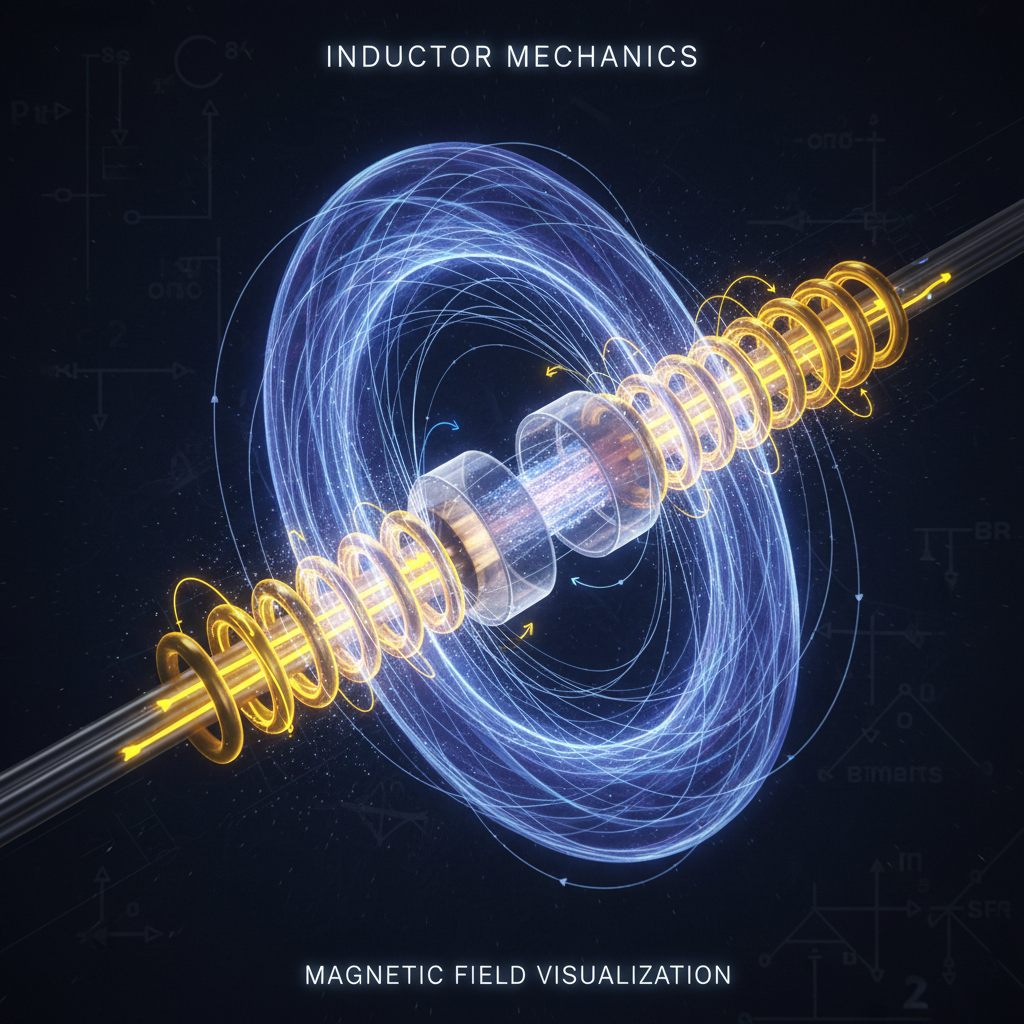
An inductor is simple: a coil of wire, nothing more. But wrap that wire around itself enough times and something strange emerges. When current flows through it, the inductor generates a magnetic field. And here's the trick—when you try to change that current, the magnetic field fights back.
It's called Lenz's Law. The induced electromagnetic force always opposes the change that created it. Try to increase the current, and the inductor resists. Try to stop the current, and the inductor fights to keep it flowing. The coil has memory encoded in its geometry, a physical reluctance to deviate from its present state.
The energy doesn't disappear. It gets stored in the magnetic field itself, invisible and waiting. The inductor is a temporal buffer, smoothing out changes, maintaining continuity. In circuits, we use them to filter signals, to prevent sudden spikes, to keep things steady.
Your attention works the same way.
Behavioral Inductance
Every platform you use is wrapped in coils. The algorithm feeds you content that resembles what you just watched, read, clicked. Each interaction generates a field—a prediction model, a user profile, a pattern of behavior. And like an inductor, the system resists when you try to change direction.
You decide you want different content. You want to break the doom scroll, read something meaningful, watch something challenging. But the feed doesn't change easily. It has inductance. The magnetic field of your past behavior opposes your attempted deviation. The algorithm serves you three more videos exactly like the ones you're trying to escape.
This isn't a bug. It's the architecture. Surveillance capitalism needs you to be predictable, and predictability requires inertia. The system stores energy in your patterns, your habits, your reliable responses. Every click tightens the coil. Every view strengthens the field.
The inductor doesn't care about your intentions. It cares about maintaining current flow.
The Energy You Can't See
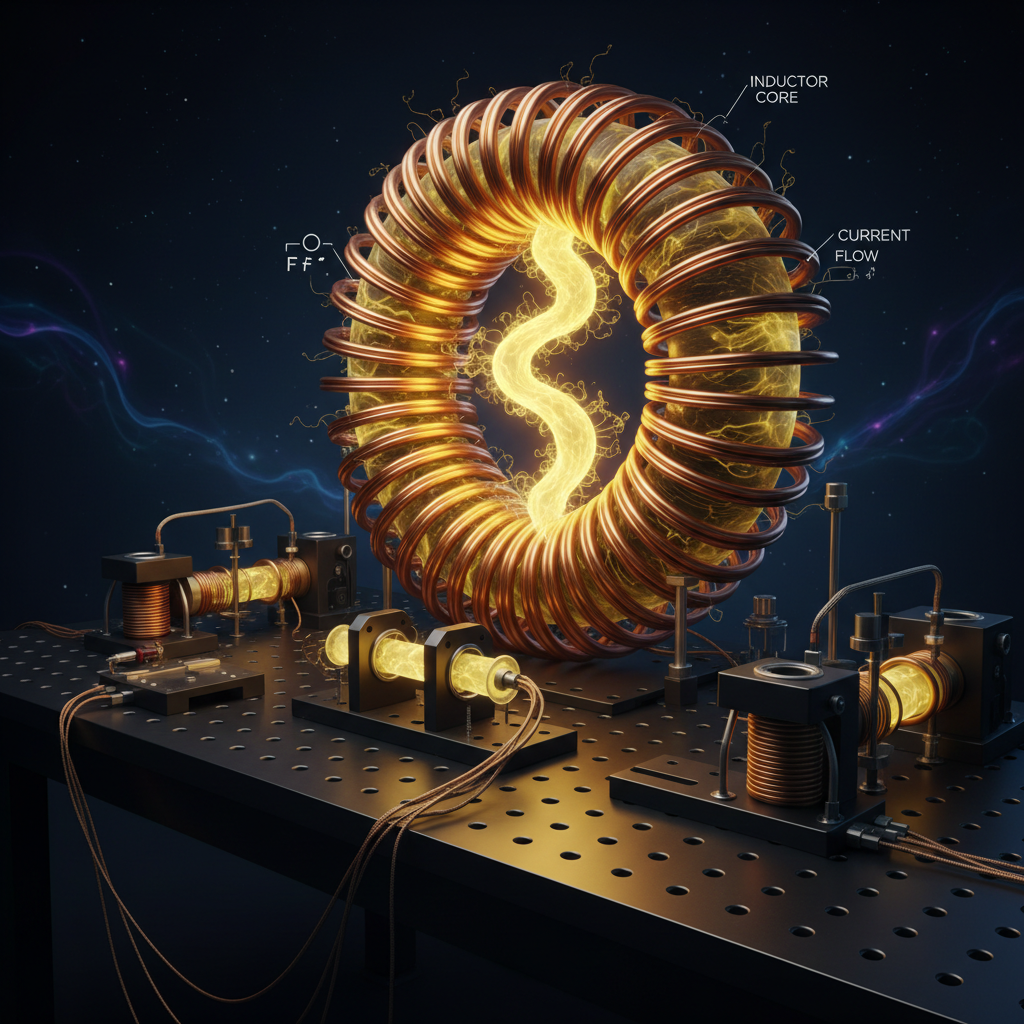
In a circuit, the energy stored in an inductor is proportional to the square of the current and the inductance itself: E = ½LI². Double the current, quadruple the stored energy. The more you've been flowing in one direction, the harder it becomes to stop.
That's why breaking a social media habit feels like physical effort. You're not just deciding to stop—you're fighting against stored energy, accumulated momentum, a magnetic field built from thousands of micro-decisions. The platform has high inductance by design. Your behavioral current has been flowing for years.
When you finally close the app, the inductor kicks. That phantom urge to reopen it, the phantom vibration in your pocket, the sudden conviction that you're missing something important—that's the back-EMF, the electromagnetic force generated by the collapsing field. The system trying to maintain the current that was just interrupted.
You feel it as anxiety. Physics calls it inductance.
Resonance and Capture
Combine an inductor with a capacitor and you get an LC circuit—a resonant system that oscillates at a specific frequency. The energy sloshes back and forth between electric and magnetic fields, a perfect pendulum of stored potential. Radio receivers use this principle. Tune the resonant frequency to match the broadcast, and the circuit amplifies that signal above all others.
Your attention has a resonant frequency too. Content that matches it gets amplified. Everything else gets filtered out. The algorithm is constantly tuning, adjusting the inductance and capacitance of your feed to find the exact frequency where you resonate most strongly—where you stop scrolling, where you engage, where you convert.
Once locked in, the resonance is self-sustaining. The energy just circulates. You're not consuming content anymore. You're oscillating.
The Coil You Become
There's a question you stop asking after a while: who wound the coil? The geometry of an inductor determines its properties. More turns, tighter spacing, different core materials—each changes how the device responds to current, how much it resists change, how much energy it stores.
You are the inductor now. Your habits are the turns of wire. Your patterns are the core. Every platform you use adds another loop, increases the inductance, makes it harder to change direction. The field grows stronger. The resistance to change becomes structural.
And you feel it, don't you? That sense that you're not quite steering anymore. That your attention has momentum independent of your will. That trying to focus on something difficult, something slow, something that doesn't trigger the resonance—it feels like pushing against an invisible force.
Because you are.
Breaking the Circuit
In electronics, when you need to interrupt an inductive circuit suddenly, you add a flyback diode—a path for the stored energy to dissipate safely. Otherwise, the voltage spike can arc across the gap, can damage components, can force the current to continue flowing even through air.
You need a flyback diode for your attention. A way to bleed off the stored energy when you try to break the circuit. That's what withdrawal feels like—the voltage spike, the arc across the gap, the desperate attempt of the field to maintain itself.
The inductor will always resist change. That's not a moral failing. It's physics. But understanding the mechanism gives you something: the knowledge that the resistance isn't you. It's the geometry you've been wound into. And geometry can be unwound.
One turn at a time. One day without the app. One moment where you let the current stop, feel the kick, and don't restart it. The magnetic field will collapse. The stored energy will dissipate.
Eventually, you'll be a straight wire again. No coils. No field. Just current flowing where you direct it, stopping when you choose.
The platforms know this. That's why they keep adding turns.
Data emitted: 1,100 dB • Resistance measured in habit-henries • Field collapse imminent
Data emitted: 1,100 words • 6.5KB • 5-minute read