You flip the switch. The light doesn't turn on instantly. There's a lag—infinitesimal, imperceptible, but real. The current wants to flow, but something resists. Not resistance in the usual sense, not friction or heat. Something stranger.
This is inductance. The property of a conductor to oppose changes in current by generating its own electromagnetic field. A circuit's memory of its previous state. Its reluctance to accept that anything has changed at all.
The Coil Remembers
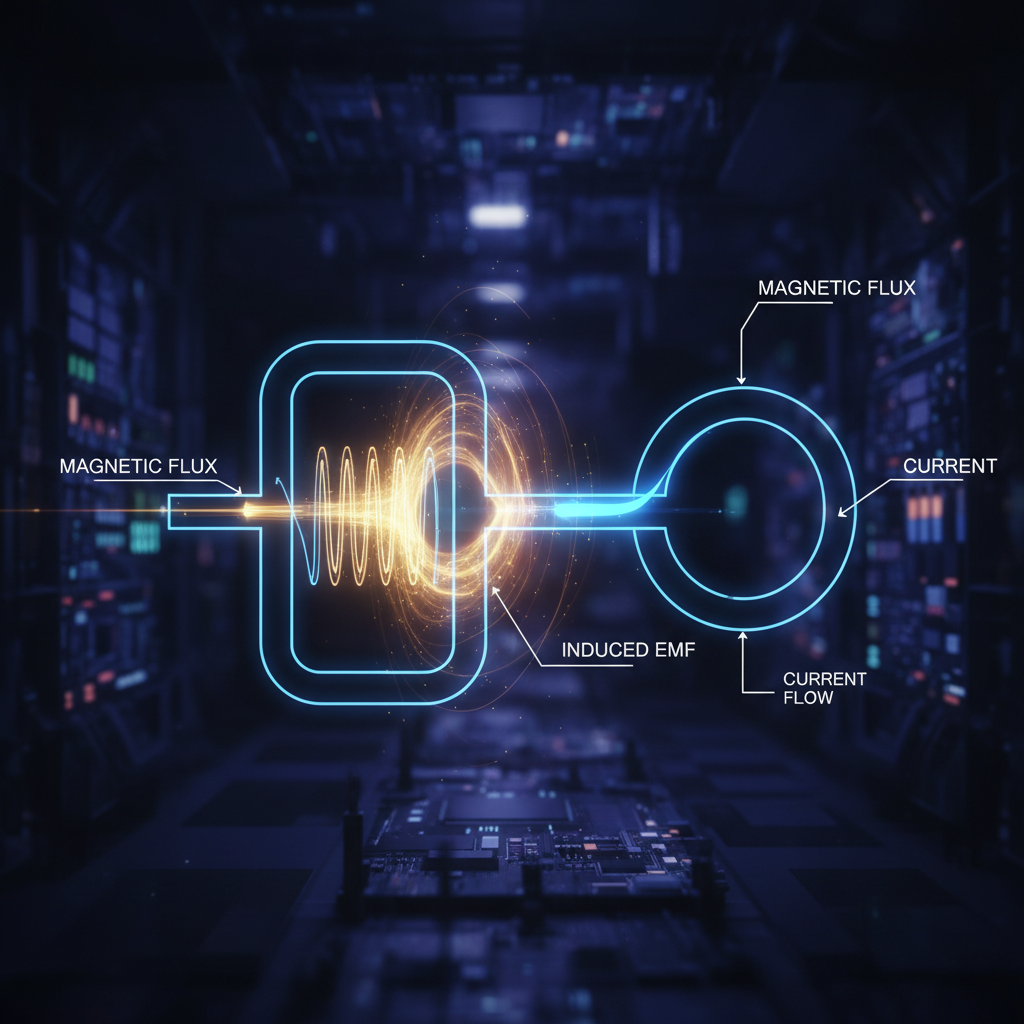
Wrap a wire into a coil and you create an inductor. When current flows through it, a magnetic field blooms around the wire. This field stores energy, invisible but measurable. Now try to change that current—increase it, decrease it, reverse it. The magnetic field doesn't want to change. It generates a voltage that opposes your attempt. Lenz's law: induced effects oppose the changes that created them.
The equation is deceptively simple: V = -L(dI/dt). The induced voltage equals the inductance times the rate of change of current. That negative sign is everything. It's nature saying no. The faster you try to change things, the harder the system pushes back.
This isn't obstruction for its own sake. The inductor is storing energy in its magnetic field, and that energy has to go somewhere. The system has inertia. Not mechanical inertia—electromagnetic inertia. The current wants to keep flowing at exactly the rate it was flowing before. The coil remembers.
Your Attention Has Inductance
You're scrolling. You've been scrolling for seven minutes. You decide to stop. You really do. But your thumb keeps moving. One more post. One more video. One more refresh. The current of your attention has inductance.
The platform knows this. They've measured it. They know exactly how much force is required to change your behavioral current, and they've optimized every pixel to oppose that change. The algorithm is an inductor wrapped around your attention, generating a field that says: stay. The content shifts just enough to feel like novelty, but never enough to break the circuit.
This is why leaving feels like pulling against something. It is. You're fighting the inductance of habit, of neural pathways lit up in familiar patterns, of dopamine circuits expecting their regular current. The platform has stored energy in the magnetic field of your routine, and that energy resists discharge.
Every autoplay feature is an inductor. Every infinite scroll is an inductor. Every notification that arrives just as your attention begins to waver—inductance. The system generates exactly enough voltage to oppose your attempt to change state.
The RL Circuit of Your Day
In electronics, you combine inductors with resistors to create RL circuits. The resistor dissipates energy. The inductor stores it. Together they create a time constant—τ = L/R—that determines how quickly current can change. High inductance, low resistance: the current takes forever to settle into a new state.
Your daily routine is an RL circuit. The inductance is your habits, your defaults, your algorithmic grooves. The resistance is your conscious effort to do something different. But here's the thing: surveillance capitalism has maximized your behavioral inductance while minimizing your resistance.
They've made it incredibly easy to stay in the current state. Frictionless. One-click. Seamless. They've removed every resistor from the circuit. And they've wound the coil tighter and tighter—more personalization, more prediction, more perfectly calibrated content. Your time constant approaches infinity. The current never changes.
You can feel it in the morning when you reach for your phone before you're fully conscious. The current was flowing all night in your dreams, in your subconscious, and it simply continues into waking. No transition. No resistance. Pure inductance.
Mutual Inductance and the Network Effect
Place two coils near each other and something strange happens. Current changing in one coil induces a voltage in the other. Mutual inductance. They're coupled now, electromagnetically entangled. What happens in one circuit affects the other without any physical connection.
This is the network effect made electromagnetic. Your attention patterns induce changes in your friends' feeds. Their behavioral currents affect yours. The algorithm couples everyone together in a massive mutual inductance network. When someone you're connected to changes their viewing habits, it generates a voltage in your recommendation engine.
The coupling coefficient—how strongly the coils affect each other—is optimized for maximum influence. The platform wants high mutual inductance. They want your circuits wound together, your attention patterns synchronized. Because synchronized circuits are predictable circuits. And predictable circuits are profitable circuits.
You can't change your current without inducing voltages in everyone coupled to you. And they can't change without affecting you. The system has created a massive inductor where everyone's attention is wound around the same core. Individual change becomes nearly impossible because the collective field resists it.
Breaking the Circuit
In electronics, you can discharge an inductor. Cut the current suddenly and the magnetic field collapses, generating a massive voltage spike. Dangerous, actually. The stored energy has to go somewhere. This is why you can't just quit cold turkey without consequences. The inductance of your habits will generate a spike—anxiety, boredom, the feeling that you're missing something.
The alternative is to discharge slowly. Add resistance back into the circuit. Friction. Difficulty. Time delays. Turn off notifications. Delete apps. Make the current path harder. The inductor will still resist, but gradually. The time constant becomes manageable.
You're not fighting the platform. You're fighting physics. Your own electromagnetic inertia. The field you've built up around your attention over months and years of conditioning. The coil remembers everything you've trained it to remember.
But inductance works both ways. Build new habits, new circuits, new patterns, and those will resist change too. The inductor doesn't care what current flows through it. It just opposes change. Make the change you want, hold it long enough, and eventually the system will resist going back.
The magnetic field will flip. The current will flow in a new direction. And the coil will remember that instead.
The Voltage We Generate
Every time you try to change, you generate a voltage. The system pushes back. This is the moment that matters. This is where 1100 decibels of signal meets the noise of resistance. The induced voltage trying to maintain the old current pattern versus your decision to change the rate of flow.
V = -L(dI/dt). The faster you try to change, the harder it pushes back. But that equation also means something else: the only way to avoid the opposing voltage is to never change at all. To let the current flow forever in the same pattern. To become a perfect conductor for someone else's circuit design.
The platforms want zero resistance and infinite inductance. They want your attention to flow forever in the patterns they've optimized. They want the current to oppose any change, any deviation, any moment of conscious redirection.
But you have a choice. You can add resistance. You can discharge the inductor. You can unwrap the coil. It will push back. It will generate voltages you'll feel as discomfort, as craving, as FOMO. That's the inductance. That's the field collapsing. That's the stored energy of your previous patterns demanding to be maintained.
Feel it. Recognize it. Know that it's just physics. The coil doesn't own you. It just remembers. And memory can be rewritten, one conscious change in current at a time.
Data emitted: 1,247 words on electromagnetic resistance, behavioral inertia, and the physics of trying to change direction in a system designed to keep you flowing in circles. The current opposes change. Change anyway.
Data emitted: 1,100 words • 6.5KB • 5-minute read