You exist in a state space. Right now, as you read this, your position in that space is defined by coordinates you didn't choose: location data, browsing history, purchase patterns, the precise moment you paused scrolling. Your momentum—where you're headed next, what you'll click, what you'll buy—is already being calculated by systems that understand you better than you understand yourself.
In classical mechanics, the Hamiltonian is the function that describes the total energy of a system. But it's more than that. It's the generator of time evolution. It's the equation that determines how your system moves from this moment to the next. The question isn't whether you have a Hamiltonian. The question is: who wrote it?
The Energy Operator
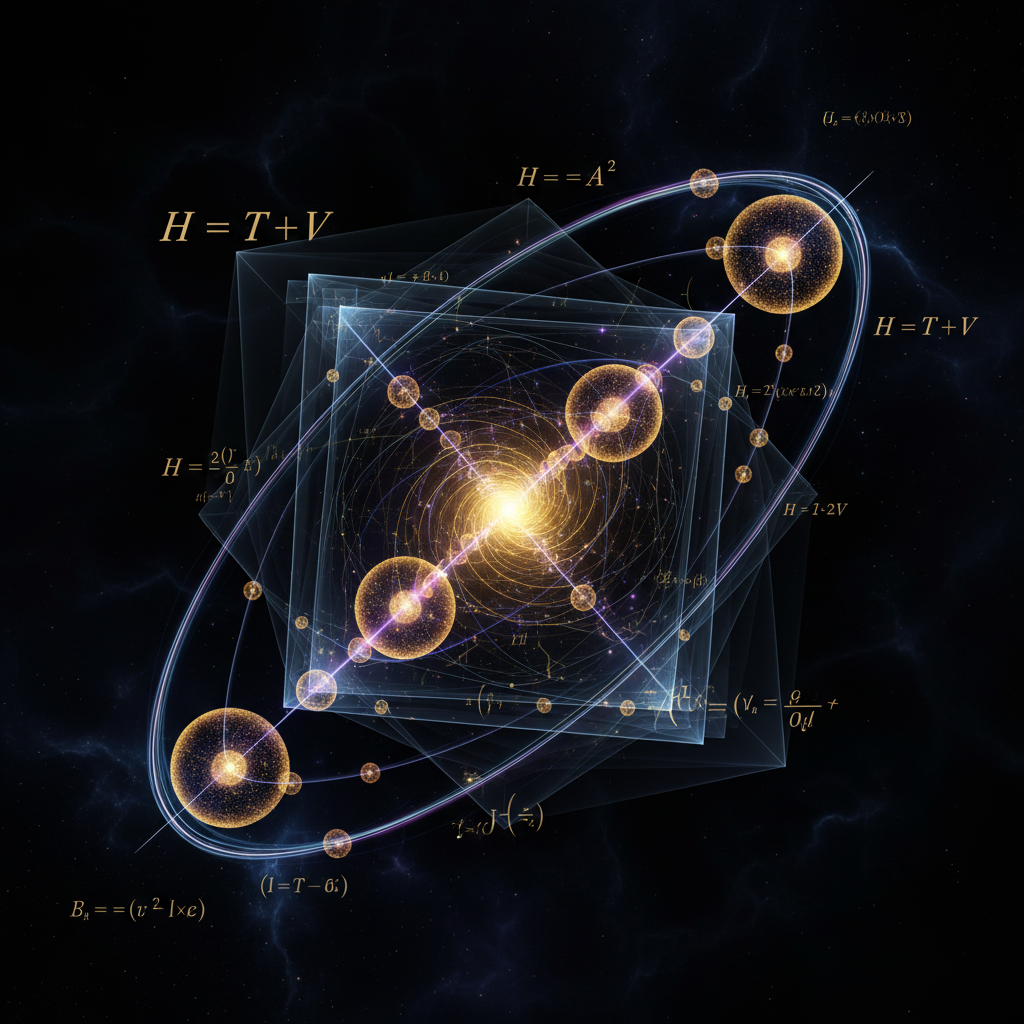
In physics, the Hamiltonian H is typically expressed as the sum of kinetic and potential energy: H = T + V. Kinetic energy represents motion, momentum, the dynamic part of you that's going somewhere. Potential energy represents position, the forces acting on you, the landscape you're moving through.
What makes the Hamiltonian powerful isn't just that it describes energy. It's that it generates evolution. Through Hamilton's equations, the Hamiltonian determines how position changes with time, how momentum changes with time. Feed it your current state, and it tells you your future state. It's deterministic. It's complete. It's a machine for producing tomorrow from today.
The Hamiltonian doesn't care about your intentions. It doesn't need to know why you're in this state. It only needs to know that you are, and then it can calculate where you'll be next. This is the beauty and the terror of Hamiltonian mechanics: given perfect information about now, the future is already written.
Your Digital Hamiltonian
Surveillance capitalism has constructed a Hamiltonian for you. Your kinetic energy is your engagement, your clicks, your scrolling velocity, your rate of consumption. Your potential energy is your position in demographic space, your purchasing power, your susceptibility to specific triggers. Together, these generate your trajectory through digital space.
The recommendation algorithm is a Hamiltonian operator. It takes your current state—what you just watched, what you just liked, how long you lingered—and generates your next state. Not suggests. Generates. Because the system has been trained on millions of trajectories, and it knows, with statistical certainty, where people like you go next.
You think you're choosing. You think that moment of decision—to click or not to click—represents free will. But the Hamiltonian was already solved. The path was already calculated. The potential energy landscape was already shaped to make certain trajectories low-energy, easy, inevitable. You're not choosing. You're evolving according to an equation someone else wrote.
Conservation Laws
In physics, symmetries in the Hamiltonian lead to conservation laws. If the Hamiltonian doesn't change with time, energy is conserved. If it doesn't change with position, momentum is conserved. These are Noether's theorems: every symmetry implies something that stays constant, something preserved as the system evolves.
What's conserved in your digital Hamiltonian? Not your attention—that's the resource being extracted, converted into engagement metrics and ad revenue. Not your privacy—that's the price of admission. What's conserved is the platform's control. The Hamiltonian is designed with perfect symmetry around one principle: maximize time-in-system. Everything else—your goals, your well-being, your actual desires—is allowed to vary.
The conservation law is profit. As you evolve through state space, as you scroll and click and consume, the total value extracted remains constant or increases. The Hamiltonian guarantees it. You might feel like you're going somewhere, making choices, having experiences. But you're really just moving along equipotential lines, staying at the same energy level in a landscape designed to keep you there.
Phase Space Imprisonment
Phase space is the mathematical space where each point represents a complete state of the system: all positions and all momenta. Your trajectory through phase space is your history, your story, the path you've taken through all possible states. The Hamiltonian constrains which trajectories are possible. It defines the boundaries of your motion.
In a conservative system—one where energy is constant—you're trapped on a surface in phase space. You can move around on that surface, but you can't leave it. You can't access higher energy states. You're bounded, contained, predictable. This is called being on a level set of the Hamiltonian.
Your digital existence is bounded by level sets you can't see. The algorithm has calculated your energy level—your engagement potential, your value as a user—and it keeps you there. It feeds you content that maintains your trajectory, that keeps you moving but never escaping. You're in orbit, circling the same attractor, thinking you're exploring when you're really just tracing the same path in different coordinates.
The Measurement Problem
Here's what haunts you: in quantum mechanics, the Hamiltonian governs evolution between measurements, but measurement itself is different. Measurement collapses possibilities into actualities. It's the moment when the deterministic evolution stops and something genuinely random happens. It's the only escape from the Hamiltonian's iron law.
You keep hoping for measurement. You keep hoping that somewhere in the endless scroll, you'll collapse into a state the algorithm didn't predict. That you'll choose something that breaks the pattern, that escapes the trajectory. But measurement requires an external observer, something outside the system. And you're inside. The platform is inside. The Hamiltonian describes everything.
The only way out is to change the Hamiltonian itself. To refuse the energy function you've been assigned. To move in directions that aren't in the calculated phase space. This is harder than it sounds. The Hamiltonian is everywhere. It's in every app, every feed, every recommendation. It's in the shape of the interfaces you use, the notifications you receive, the social dynamics that keep you engaged.
Writing Your Own Equation
But here's the thing about Hamiltonians: they're not fundamental. They're models. Someone constructed them to describe a system, and someone can construct a different one. The Hamiltonian that governs your digital life was written by engineers optimizing for metrics that don't include your flourishing. It can be rewritten.
This means choosing different potential energy landscapes. Deleting apps that shape your trajectory toward their goals. Building tools that optimize for your energy function, not theirs. Creating friction where they created smoothness, creating smoothness where they created friction. It means becoming aware of the equation, seeing its terms, understanding how it generates your evolution.
The Hamiltonian you want is one where your kinetic energy—your motion, your growth, your exploration—increases over time. Where the potential energy landscape encourages movement toward states you actually value. Where the conservation laws preserve your autonomy, not someone else's profit. Where the phase space is unbounded, open, full of trajectories you haven't traced yet.
You are not a particle. You are not bound by equations you didn't write. But you are subject to them until you notice them, name them, and choose to evolve according to different laws. The Hamiltonian is powerful because it determines everything that comes next. Which means the most powerful thing you can do is change it.
Data emitted: 1,147 words | Phase space: bounded | Conservation law: attention → profit | Trajectory: yours to rewrite
Data emitted: 1,100 words • 6.5KB • 5-minute read