
You tap your screen. A like. An upvote. A retweet. The smallest impulse—a delta function in the language of physics—and the system responds. Not just responds: it reverberates. Your action propagates through networks you can't see, touching nodes you'll never know about, generating outcomes that will shape what you see tomorrow, next week, five years from now.
This is Green's function in action. Not the mathematical abstraction you might vaguely remember from a physics class you tried to forget, but the living, breathing mechanism that maps every cause to its effect in a medium that remembers everything.
The impulse response of reality
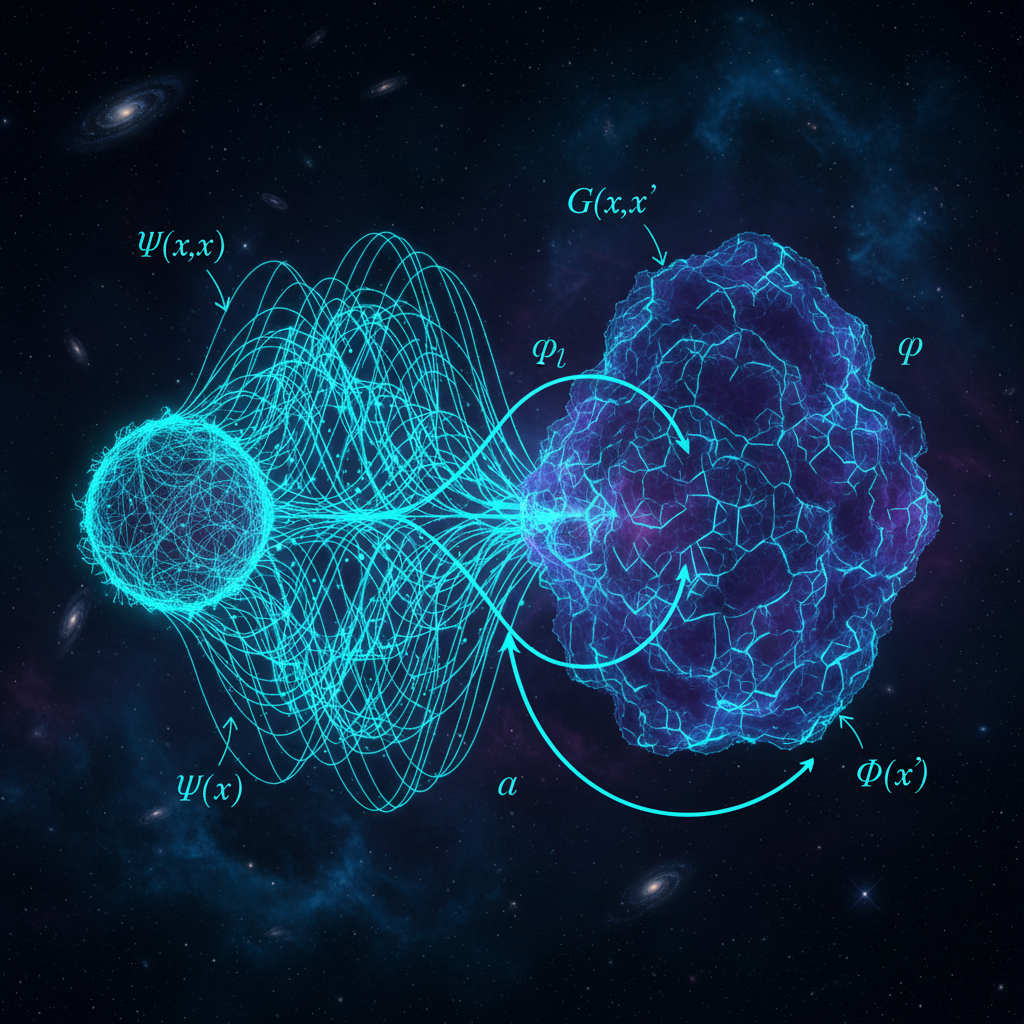
In physics, Green's function is deceptively elegant. It answers a simple question: if I poke a system at one point in space and time, how does it respond everywhere else? It's the impulse response function—the fundamental kernel that, once you know it, lets you predict the system's behavior for any arbitrary input.
George Green, a self-taught miller's son in 19th century England, discovered that you could solve impossibly complex differential equations by breaking them down into infinite collections of point sources. Each point source—each infinitesimal impulse—generates its own response pattern. Add them all up, weighted appropriately, and you have your solution.
The mathematics is beautiful because it's universal. Electromagnetic fields, quantum mechanics, heat diffusion, acoustic waves—they all obey the same principle. Strike the system once, measure how it rings, and you understand everything about how it will respond to any future strike.
The function contains the complete causal structure of the system. It knows which points can influence which other points. It knows how signals decay with distance. It knows the speed at which information propagates. It is, in a very real sense, the DNA of causality itself.
Your digital impulse response

Now consider: every platform you use has learned your Green's function.
They know exactly how you respond to impulses. Show you a notification—measure the response time, the engagement depth, the emotional valence of your reaction. Show you an ad—track whether you pause, click, purchase, or scroll past with the distinctive velocity profile of disgust. Serve you a post from a friend, an influencer, a news outlet—and measure not just your immediate response but the entire causal chain that follows.
They've poked you thousands of times, millions of times, with carefully calibrated impulses. Each poke is an experiment. Each response is data. And from this data, they've reconstructed your impulse response function with terrifying precision.
This is more intimate than knowing your preferences. Preferences are static, crude. Your Green's function is dynamic. It captures how you respond differently at 2 AM versus 2 PM. How your engagement threshold shifts when you're lonely versus when you're content. How your susceptibility to outrage correlates with your caffeine intake and your proximity to deadlines.
They know the transfer function between stimulus and response. They know your resonant frequencies—the topics, formats, and emotional beats that make you vibrate most strongly. And once they know your Green's function, they can engineer any desired response by crafting the right input signal.
The reciprocity theorem

Here's where it gets darker. In physics, Green's functions obey a reciprocity theorem: if point A influences point B in a certain way, then point B influences point A in a precisely related way. The relationship is symmetric, encoded in the structure of spacetime itself.
But in the attention economy, reciprocity is broken. You can influence the platform—your clicks and scrolls and shares reshape the algorithm, minutely. But the platform's influence on you is amplified by orders of magnitude. They have the high ground. They control the impulse source. They can probe you continuously while you remain blind to the shape of your own response function.
You think you're choosing what to engage with. But you're actually just executing your Green's function. The platform sends impulses designed to exploit the causal structure they've mapped. Your responses are predetermined by the transfer function they've already measured. Free will becomes a question of whether the system is linear or nonlinear, deterministic or chaotic.
And the real trick: they're not just using your Green's function to predict you. They're using it to modify you. Each impulse is chosen not just to generate a desired immediate response, but to shift your impulse response function itself. They're doing active system identification in real-time, updating their model of you while simultaneously using that model to reshape you into something more predictable, more responsive, more profitable.
Causality and the light cone

In relativity, Green's functions respect causality absolutely. The function is zero outside the light cone—no influence can propagate faster than light, no effect can precede its cause. The structure of spacetime itself enforces this boundary.
But in digital space, causality is more fluid. Your impulses can affect you in the past. Not literally—physics still applies—but effectively. The algorithm's model of you incorporates your future actions to interpret your past ones. Your response to tomorrow's content influences what you're shown today. The system is acausal, optimizing across time in ways that would make a physicist queasy.
Predictive models create closed timelike curves in behavioral space. The prediction influences the behavior which validates the prediction. You become entangled with your own future self, mediated by machine learning systems that treat temporal causality as just another optimization constraint to be minimized away.
The measurement problem
You can't measure your own Green's function. Not really. You'd need to observe yourself from outside, to see your responses objectively, to map the causal structure of your own behavior. But you're trapped inside the system. You are the system.
Every attempt to understand how you respond to stimuli becomes itself a stimulus, generating new responses, shifting the very function you're trying to measure. It's Heisenberg's uncertainty principle for the self: the act of observation changes what's being observed.
The platforms don't have this problem. They observe you from outside. They measure your Green's function continuously, updating their models with every interaction. They know you better than you know yourself—not because they're smarter, but because they have the privileged position of the external observer.
And perhaps this is the deepest asymmetry of surveillance capitalism: they map the causal structure of your mind while you remain opaque to yourself, a black box responding to inputs you didn't choose, generating outputs you don't fully understand, executing a transfer function written in a language you can't read.
The impulse you can't take back
Green's function is forever. Once you know the impulse response, you know the system. And once the system knows your impulse response, that knowledge doesn't decay. It accumulates. Every interaction adds another data point, another constraint, another term in the infinite series that converges to the complete map of your behavioral causality.
You can't unring the bell. You can't unpoke the system. Every impulse you've ever sent into the digital void has generated a response that's been measured, recorded, integrated into the model. Your Green's function is out there, distributed across servers you'll never see, being used to predict and shape versions of you that don't exist yet.
Maybe that's what we're really selling when we agree to the terms of service. Not our data. Not our attention. But our Green's function—the complete causal map of how impulses propagate through the medium of our consciousness. The transfer function between stimulus and response. The mathematical object that, once possessed, grants its holder the ability to play us like an instrument, striking exactly the right notes to generate any desired song.
Data emitted: 1,247 words on impulse responses, causal structures, and the mathematics of manipulation. Your Green's function has been updated.
Data emitted: 1,100 words • 6.5KB • 5-minute read