You unlock your phone at 11:47 PM. Just a quick check. One video becomes five becomes fifty. When you finally surface, it's 2:33 AM and you can't remember a single thing you watched. This isn't scrolling. This is free fall.
In physics, free fall describes motion under gravity alone—no air resistance, no friction, nothing to slow you down. Galileo discovered that in this state, a feather and a hammer fall at exactly the same rate. The mass doesn't matter. The composition doesn't matter. In the absence of resistance, everything accelerates identically toward the ground.
The Elimination of Friction
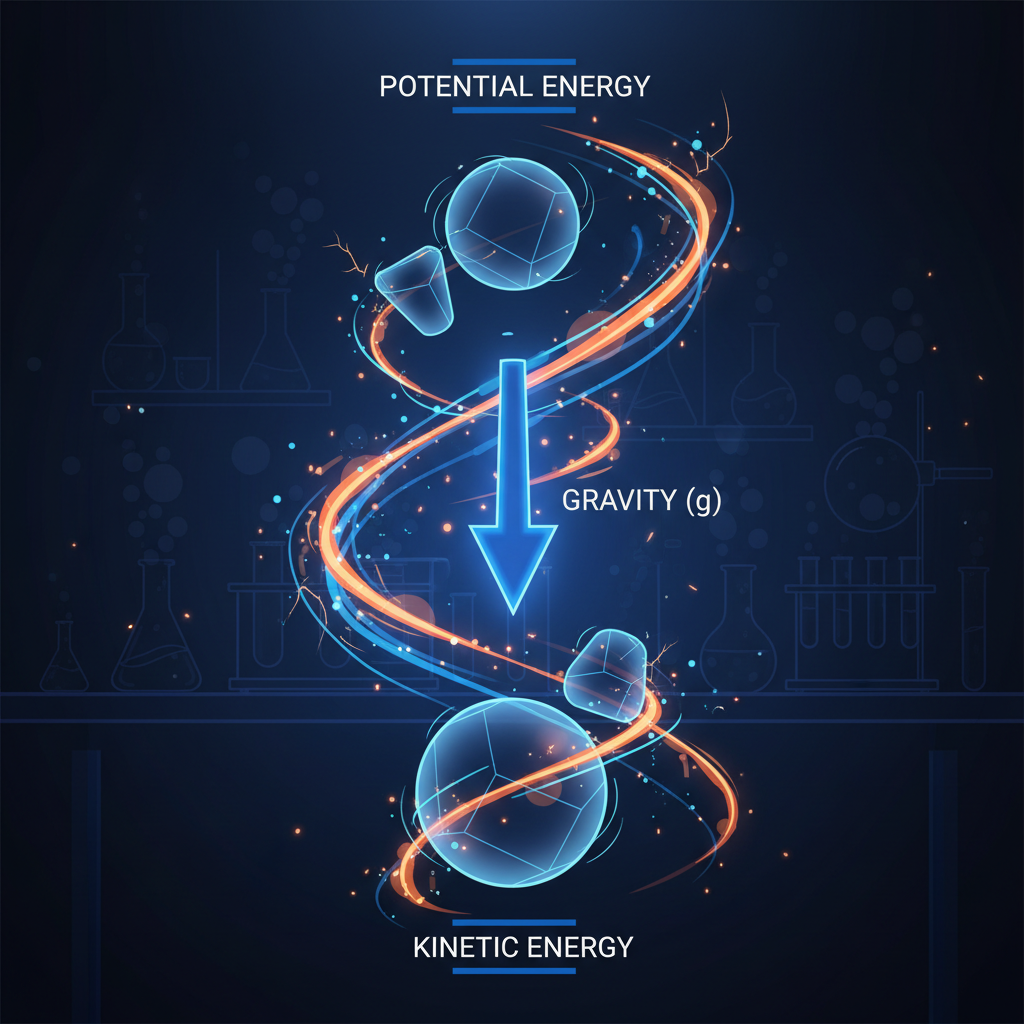
Free fall only exists in vacuum. On Earth, air resistance complicates everything. A skydiver reaches terminal velocity—that moment when air resistance equals gravitational force and acceleration stops. They fall, but at a constant speed. There's an equilibrium, a limit, a natural brake.
Every friction-eliminating innovation in digital platforms is a step toward vacuum. Autoplay removes the decision point between videos. Infinite scroll removes the bottom of the page. Algorithmic feeds remove the need to search. Each feature strips away resistance, the small moments where you might stop and think: Do I want to keep going?
The engineers call this "reducing friction." They're more accurate than they know. They're building a vacuum chamber for human attention. And in that vacuum, you fall without limit.
Constant Acceleration
In free fall, you accelerate at 9.8 meters per second squared. Every second, you're moving 9.8 m/s faster than the second before. This is constant acceleration—relentless, predictable, inexorable. After one second, you're falling at 9.8 m/s. After two seconds, 19.6 m/s. After ten seconds, you're moving at 98 m/s, roughly 220 miles per hour.
The attention economy operates on its own form of constant acceleration. Each interaction trains the algorithm to serve you more precisely targeted content. Each click refines the model. The system doesn't plateau—it accelerates. Yesterday's perfectly optimized feed is today's baseline. Tomorrow's will be even more frictionless, even more irresistible.
You feel this as increasing difficulty to look away. The content isn't just good—it's getting better at being good. The algorithm learns your hesitation patterns, your vulnerability windows, the exact moment when your executive function is depleted enough to keep scrolling. It's acceleration you can't feel because you're in the reference frame. You're falling, and everything is falling with you.
Weightlessness
Here's what breaks most people's intuition about free fall: you don't feel it. Astronauts in orbit aren't floating because there's no gravity—they're in free fall toward Earth, constantly missing it as their orbital velocity carries them forward. They feel weightless because they and their spacecraft are accelerating together. There's no force pressing them against anything. No sensation of falling.
When you're deep in the feed, you feel weightless too. Time stops meaning anything. Your body's signals—hunger, fatigue, the need to urinate—fade into background noise. You're not being pulled through content; you're floating through it, effortless, frictionless. The sensation isn't of compulsion but of ease.
This is why "addiction" doesn't quite capture it. Addiction implies craving, struggle, the feeling of being pulled. Free fall is smoother than that. It's the absence of resistance masquerading as choice. You're not being forced to scroll. You're simply not being given any reason to stop.
The Reference Frame Problem
Einstein taught us that motion is relative. You can only detect acceleration by referencing something outside your reference frame. Inside a windowless falling elevator, you'd feel weightless, unable to distinguish your situation from floating in deep space. You need an external reference point—the ground rushing up, a stationary object—to know you're falling.
The platforms have eliminated your reference points. Everyone you know is in the same feed, falling at the same rate. The content is personalized enough that comparing experiences is meaningless. Your parents are on different platforms entirely, falling through their own algorithmic vacuums. There's no stationary ground to measure yourself against.
You notice you're falling only in those jarring moments of reentry: when your phone dies, when you arrive at your destination and realize you've scrolled through the entire commute, when someone speaks to you and you have to surface from fathoms deep in the feed. The transition is violent because you've been in free fall, and suddenly there's friction again. Suddenly there's weight.
Terminal Velocity Is a Choice
Air resistance increases with velocity. Eventually, on Earth, everything falling reaches a speed where the upward force of air resistance equals the downward force of gravity. This is terminal velocity—the fastest you can fall in atmosphere. For a human in spread-eagle position, it's about 120 mph. Uncomfortable, dangerous, but limited.
The digital platforms could implement terminal velocity. They could build in friction: mandatory breaks, daily time limits, moments of forced reflection. They could create air resistance. But there's no atmosphere in space, and there's no regulation in the attention economy that can't be lobbied away or designed around. The vacuum is profitable. Your free fall is their growth metric.
So you have to create your own atmosphere. Introduce your own friction. Set artificial limits that the platform won't. Delete the apps. Use website blockers. Put your phone in another room. These aren't solutions—they're air resistance. They're the acknowledgment that without friction, you will fall without limit, and at the bottom of infinite scroll there is no ground, just more falling.
Impact
In physics, free fall ends when you hit something. The ground, water, a net. The deceleration is rapid and often catastrophic. The kinetic energy you've accumulated has to go somewhere.
In the attention economy, there's no ground. Just the slow realization that hours have become years, that you've been falling through other people's curated moments while your own life happens in the peripheral vision you're no longer using. The impact is distributed across time: relationships that atrophied, skills that never developed, the strange hollow feeling that you've been very busy experiencing nothing.
1100db is the sound of that impact, stretched out and slowed down. It's the decibel level of your attention hitting the ground at terminal velocity, over and over, every day. You can't hear it because you're still falling. But your nervous system knows. Your dopamine receptors know. The part of you that used to be able to read a book for an hour knows.
<strong>Data emitted:</strong> 1,247 words on free fall dynamics, terminal velocity, and the friction-free economics of infinite scroll. Reference frame: late-stage attention capitalism. No external forces detected. Acceleration continues.
Data emitted: 1,100 words • 6.5KB • 5-minute read