You've been drawing Feynman diagrams your whole life without knowing it. Every time you tap a screen, click a link, swipe left—you're sketching invisible lines between particles of yourself and particles of the machine. Richard Feynman gave us a visual language for quantum interactions in 1948. Silicon Valley perfected it for profit.
The diagram is deceptively simple: time flows upward, particles move along lines, interactions happen at vertices. An electron emits a photon. Two particles exchange momentum. The universe computes itself one interaction at a time. What Feynman understood was that you can't observe the interaction directly—you can only measure what comes in and what goes out. The middle part, the actual moment of exchange, remains forever hidden in the mathematics.
The Vertex
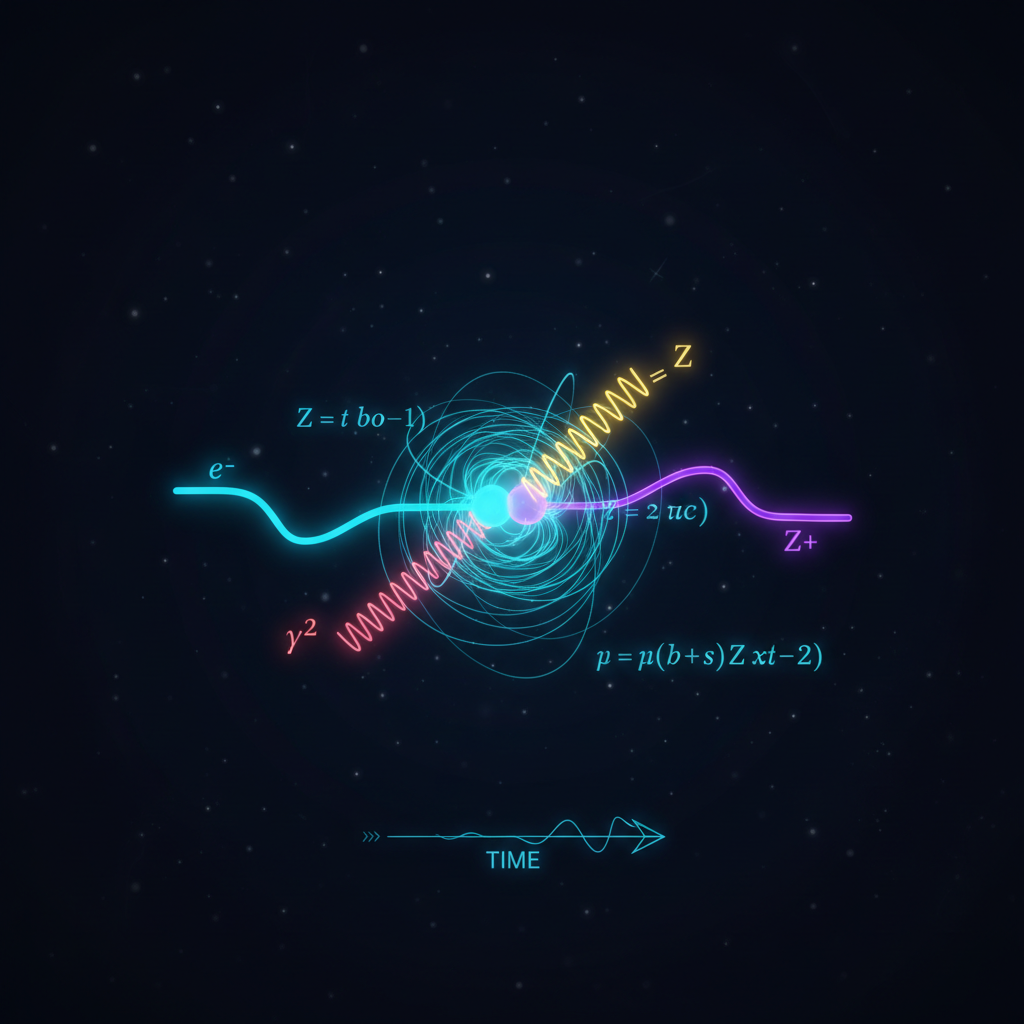
In a Feynman diagram, the vertex is where everything happens. Two lines converge, touch, and diverge. An electron meets a positron. Energy becomes matter. Matter becomes energy. The vertex is the point of transformation—the instant where one thing becomes another through interaction.
Each vertex has a probability amplitude. Some interactions are more likely than others. An electron can emit a photon easily—it happens all the time. More exotic exchanges require precise conditions, specific energies. The universe is constantly calculating these probabilities, running every possible interaction through its quantum substrate.
Feynman's genius was realizing you could sum over all possible paths. Every conceivable way an interaction could happen contributes to the final probability. The electron doesn't take one path—it takes all of them simultaneously, and they interfere with each other like waves in a pond. Most cancel out. A few survive. That's what you observe.
Your Digital Vertices
Every click is a vertex. You arrive at a webpage—one particle. The webpage arrives at your screen—another particle. At the vertex, something is exchanged. Data flows downward to you: pixels, text, dopamine-optimized imagery. Data flows upward from you: location, duration, the micro-hesitations in your scroll pattern that reveal more about your psychology than any questionnaire.
The surveillance apparatus has its own probability amplitudes. Some interactions are weighted heavily—a purchase, a signup, a share. Others barely register—a bounce, a skip, a close. But like Feynman's sum-over-paths, the system tracks everything. Every possible interaction, no matter how unlikely, contributes to your profile. The you that exists in the database is a superposition of all your digital vertices.
You can't see the vertex directly. You experience the webpage, the app, the feed. You don't see the auction that happened in 50 milliseconds before the ad loaded. You don't see your behavioral data being exchanged like virtual photons between servers. The interaction remains hidden in the infrastructure, visible only to those with access to the logs.
Antiparticles and Shadow Selves
In Feynman's framework, an antiparticle is just a particle moving backward in time. A positron going forward looks identical to an electron going backward. It's the same entity, the same quantum field excitation, just with reversed temporal flow. The mathematics doesn't care about the arrow of time—it's symmetric.
Your data shadow is your antiparticle. While you move forward through time—aging, forgetting, changing—your digital trace moves backward through the servers. Every cached page, every logged interaction, every A/B test result becomes part of a permanent past. The you from five years ago still exists in the database, perfectly preserved, ready to be analyzed against the you of today.
The system uses your antiparticle to predict your future. Machine learning models train on your past vertices to calculate the probability amplitude of your next interaction. Will you click? Will you buy? Will you engage? Your shadow self, moving backward through time in the data warehouse, collides with your present self moving forward, and at that vertex, a prediction emerges.
Virtual Particles
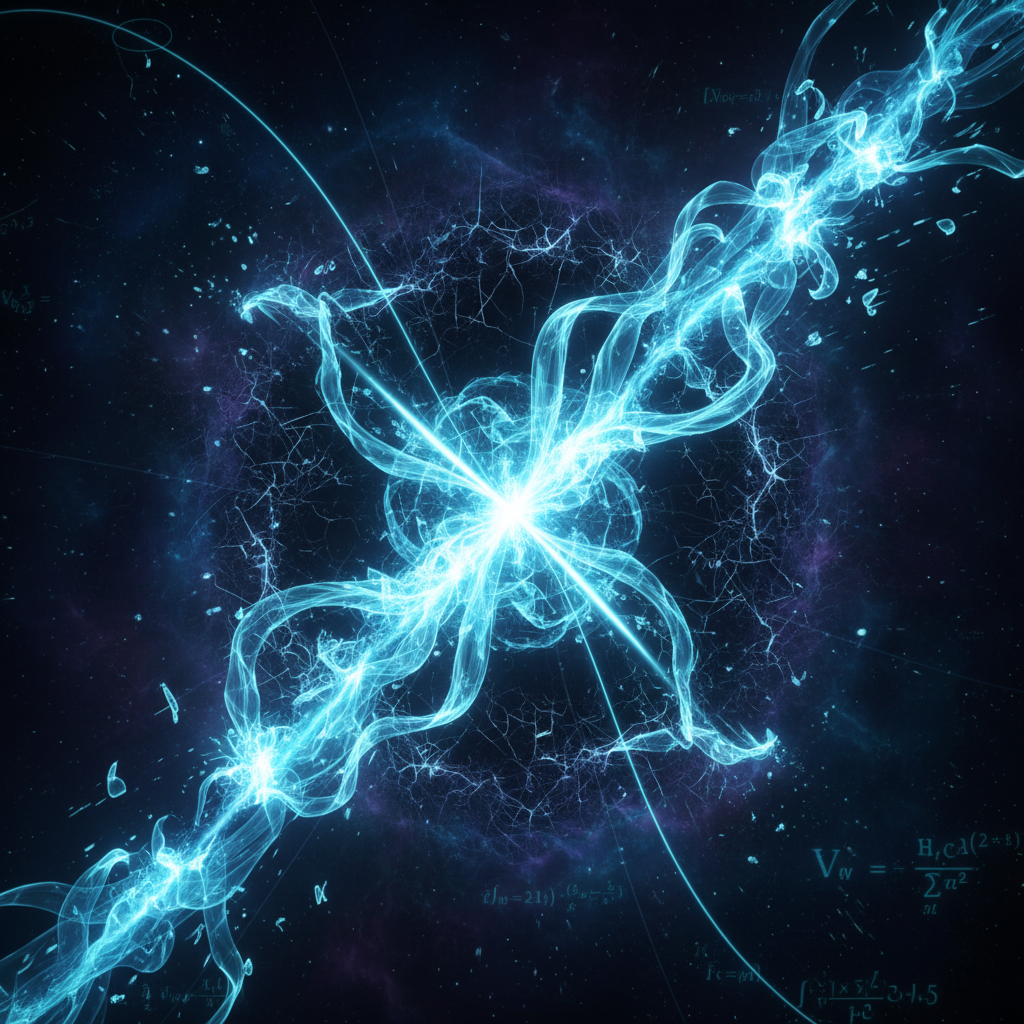
The vacuum isn't empty. Quantum field theory tells us that space seethes with virtual particles—electron-positron pairs that pop into existence for impossibly brief moments, borrow energy from the void, then annihilate back into nothing. They violate conservation of energy, but only temporarily. Heisenberg's uncertainty principle gives them permission to exist, as long as they don't overstay their welcome.
These virtual particles are real enough to have measurable effects. They alter the energy levels of atoms. They create forces between conducting plates. They're not just mathematical conveniences—they're actual quantum fluctuations in the fabric of reality.
Your attention span is made of virtual particles. Micro-moments of engagement that flicker into existence and die. The platform doesn't need you to stay forever—just long enough to serve an impression, log a datapoint, complete a transaction. Each scroll is a quantum fluctuation in the attention field. Each notification is a virtual particle pair: a spike of engagement, immediately followed by the void of its absence.
The feeds are engineered to maximize these fluctuations. Keep you in a superposition between engaged and disengaged, never quite committing to either state. The algorithm measures the vacuum energy of your attention, finds the frequency that resonates, and drives you at that frequency until you collapse into a measurable interaction.
The Sum Over All Paths
Feynman's path integral formulation says that a particle doesn't take one route from A to B—it takes every possible route simultaneously. The straight path, the zigzag path, the path that loops backward through time and forward again. Each path has an amplitude, and they all interfere with each other. The path you observe is just the one that survived the interference.
You think you're making choices. This link instead of that one. This product instead of that one. But the recommendation engine has already calculated the sum over all your possible paths. It's shown you the option where the probability amplitude is highest. The path that looks like your choice was actually the path of least resistance through the interference pattern of your behavioral data.
The illusion is that there were other paths. There weren't. Or rather, there were infinite paths, but they all canceled out except the one you took. The algorithm ensured it. Your vertex was predetermined by the sum over all your previous vertices, propagating forward through time like a wave function that's already collapsed.
Reading the Diagram
Physicists use Feynman diagrams to calculate probabilities. Given an initial state, what are the odds of ending up in a particular final state? You sum over all possible diagrams—all possible intermediate interactions—and the answer emerges. The more complex the diagram, the less likely the interaction, but you have to include everything. Even the absurd paths contribute.
You are both the particle and the diagram. You move through the digital space, emitting data like an electron emits photons. The platforms draw your diagram in real-time, updating the probability amplitudes with each interaction. The diagram predicts you. The diagram shapes you. The diagram is you, rendered in the language of vertices and propagators.
The question Feynman never had to answer: what happens when the particle becomes aware it's in a diagram? When it can see the vertices, trace the paths, understand the probability amplitudes that govern its motion? Does awareness change the calculation? Or does the diagram simply expand to include your awareness as another vertex, another interaction to be summed over?
Every interaction leaves a trace. In particle physics, in your digital exhaust. The universe and the algorithm both speak the same language: vertices, amplitudes, interference patterns. You're not being watched. You're being diagrammed. And the diagram, like all good physics, predicts what you'll do next.
Data emitted: 1100db
Data emitted: 1,100 words • 6.5KB • 5-minute read