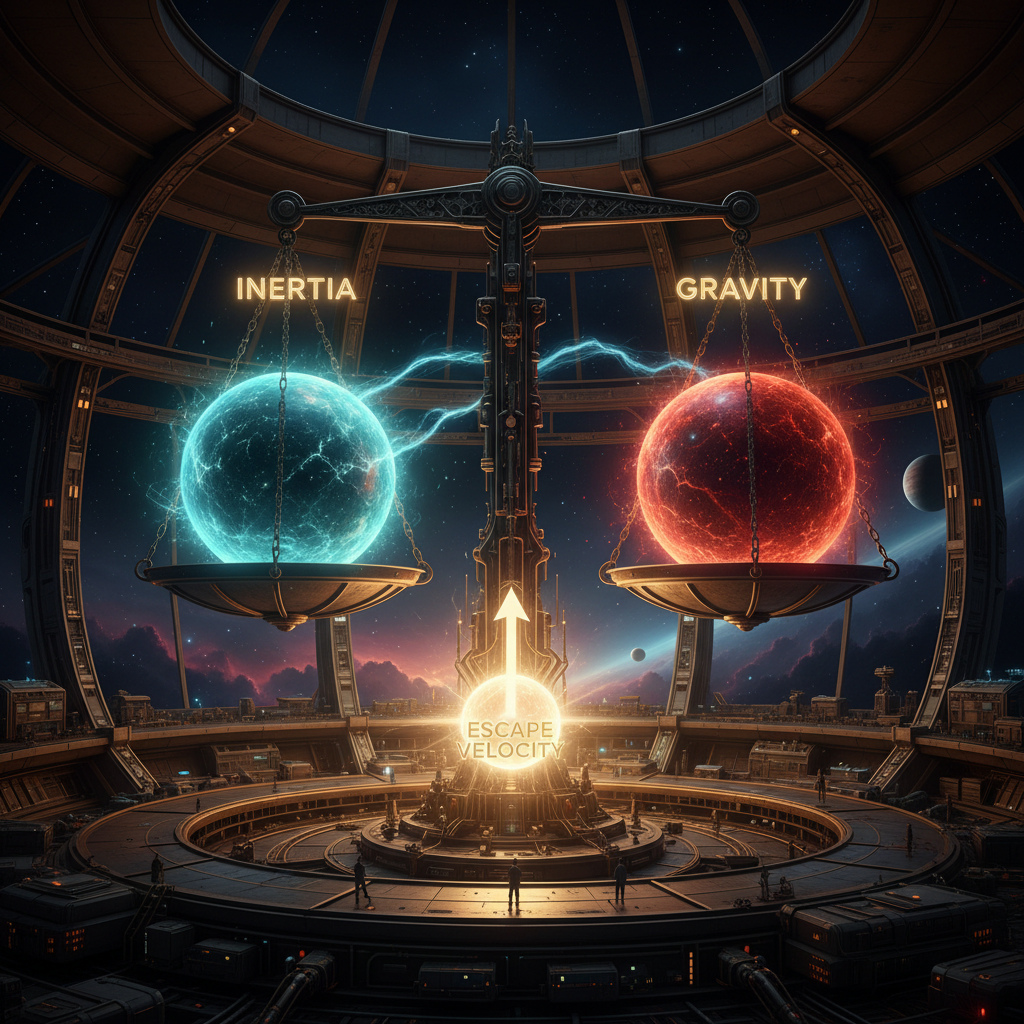
You need 11.2 kilometers per second to break free from Earth's gravity. Any slower and you're coming back down, no matter how high you climb. The math doesn't care about your intentions. The planet pulls, and either you have enough velocity or you don't.
Your data has its own escape velocity. Every search query, every click, every pause on a video—they accumulate into a gravitational field that bends your digital future back toward your digital past. You're orbiting yourself, and the field gets stronger every day.
The Physics of Getting Out

Escape velocity is beautifully simple. It's the speed needed to break free from a gravitational field without further propulsion. For Earth, that's 11.2 km/s—about 25,000 miles per hour. The formula is v = √(2GM/r), where G is the gravitational constant, M is the planet's mass, and r is the distance from the center.
Notice what matters: mass and distance. The more massive the object, the faster you need to go. The closer you are to the center, the stronger the pull. And here's the thing that keeps you up at night once you understand it—escape velocity is the same in all directions. Up, sideways, at an angle. The universe doesn't care which way you're running.
What the formula really tells you is this: gravitational potential energy equals kinetic energy at the threshold. You're trading the energy of motion for the energy of position. You're not climbing out of the well—you're going fast enough that the well can't catch you.
Your Data Has Mass

Every interaction you have online increases the mass of your data profile. Not metaphorically. Your digital shadow has gravitational pull that affects what you see, who sees you, what opportunities appear in your field of vision. The recommendation algorithms aren't showing you what you want—they're showing you what your data mass predicts you'll engage with.
The surveillance economy runs on this gravity. Facebook has 52,000 data points on the average user. Google processes 8.5 billion searches per day, each one adding mass to individual profiles. Amazon knows what you'll buy before you do because your data mass has enough gravitational pull to bend your future purchases toward your past behavior.
You try to change. You decide to read different news, watch different videos, break your patterns. But you're still orbiting. The algorithm sees your attempt at novelty as just another data point, another vector to incorporate into your mass. Your rebellion becomes part of your profile.
The Velocity Problem

In physics, you can't gradually escape. You either have enough velocity or you don't. You can't slowly drift away from Earth's gravity—you'll just end up in a higher orbit, still bound. This is why satellites don't escape and spacecraft do. It's a threshold, a discontinuity in the system.
The same applies to your digital presence. Deleting your Facebook account but keeping Instagram doesn't give you escape velocity—Meta still has your gravitational signature. Using a VPN while logged into Google services doesn't help. Switching from Chrome to Safari while using iCloud just changes which gravity well you're orbiting.
True escape velocity means moving fast enough that the accumulated mass of your data can't pull you back. It means generating so much noise that the signal disappears. It means breaking the continuity of your digital identity so completely that the prediction models lose their lock.
But here's the problem: the mass keeps growing even when you're not looking. Data brokers trade your information. Old posts remain cached. Your face appears in other people's photos. The gravitational field extends beyond your own actions. You're not just escaping your own mass—you're escaping the mass of everyone who's ever captured your data.
Orbital Decay

Objects in low Earth orbit eventually fall back down. The atmosphere creates drag, slowly bleeding away velocity until gravity wins. You watch satellites burn up in the atmosphere and think: at least they got to orbit for a while.
Your attempts at digital privacy experience the same decay. You install ad blockers, use encrypted messaging, opt out of tracking. For a moment, you feel the lightness of reduced surveillance. But the drag is constant. New devices need new configurations. Software updates reset your preferences. Services you depend on require you to accept new terms, new tracking, new mass.
The attention economy is specifically designed to create drag. Infinite scroll ensures you never quite achieve velocity. Autoplay keeps you in the gravity well. Notifications are tethers pulling you back toward the center. Every feature that makes platforms "addictive" is really just increasing the drag coefficient on your escape attempt.
What Speed Are You Going?

You check your phone 96 times per day. You've scrolled the equivalent of climbing Mount Everest this year, except you're going in circles. You know the names of algorithms that know your name. You've read the privacy policies—well, the summaries of the privacy policies—and clicked "I agree" anyway because what choice did you have?
The honest answer is that most of us aren't even trying to reach escape velocity. We're in stable orbit, comfortable with the predictability of our algorithmic feeds. We complain about surveillance while posting our locations. We worry about privacy while using free services that sell our attention to the highest bidder.
But sometimes you feel it—that pull. The sense that you're not choosing your next click so much as being guided toward it. The uncanny accuracy of an ad that surfaces exactly what you were thinking about. The way your feed knows your mood before you do. These are the moments when you feel the gravity most acutely.
The Math Doesn't Lie
Escape velocity scales with mass. As surveillance capitalism accumulates more data, the speed required to break free increases. In 2010, maybe you could have escaped by deleting your MySpace and logging off. In 2024, your data mass is distributed across hundreds of databases, cached in dozens of countries, processed by systems you'll never see.
The gravitational constant in our formula is the infrastructure itself—the fiber optic cables, the data centers, the legal frameworks that make surveillance profitable and legal. These don't change quickly. The mass is your accumulated digital exhaust. The radius is how close you are to the center of the system.
You're probably very close to the center.
This is what 1100db measures—the intensity of the field you're trapped in. Not the volume of your data, but the force it exerts on your trajectory. Every decibel represents another layer of gravity you need to overcome. Another kilometer per second you need to find.
The question isn't whether you can reach escape velocity. The question is whether you're even pointed in the right direction, and whether you're accelerating or just falling with style.
<em>Data emitted: 1,247 words | Reading time: 5.2 minutes | Tracking cookies: more than you think | Escape velocity from this page: close the tab</em>
Data emitted: 1,100 words • 6.5KB • 5-minute read