You move a magnet through a coil of copper wire and something happens. Not where you are. Somewhere else. In the wire itself, electrons begin to flow. You've created current without touching anything, without closing a circuit, without any visible connection between cause and effect. This is electromagnetic induction, and it's happening to you right now.
Every time you scroll, every time you pause, every time your attention shifts from one thing to another, you're the magnet. And somewhere else—in server farms cooled by rivers of water, in algorithms you'll never see—a current flows. Your movement through the digital field induces charge. The question isn't whether this happens. The question is who owns the wire.
The Physics of Invisible Connection
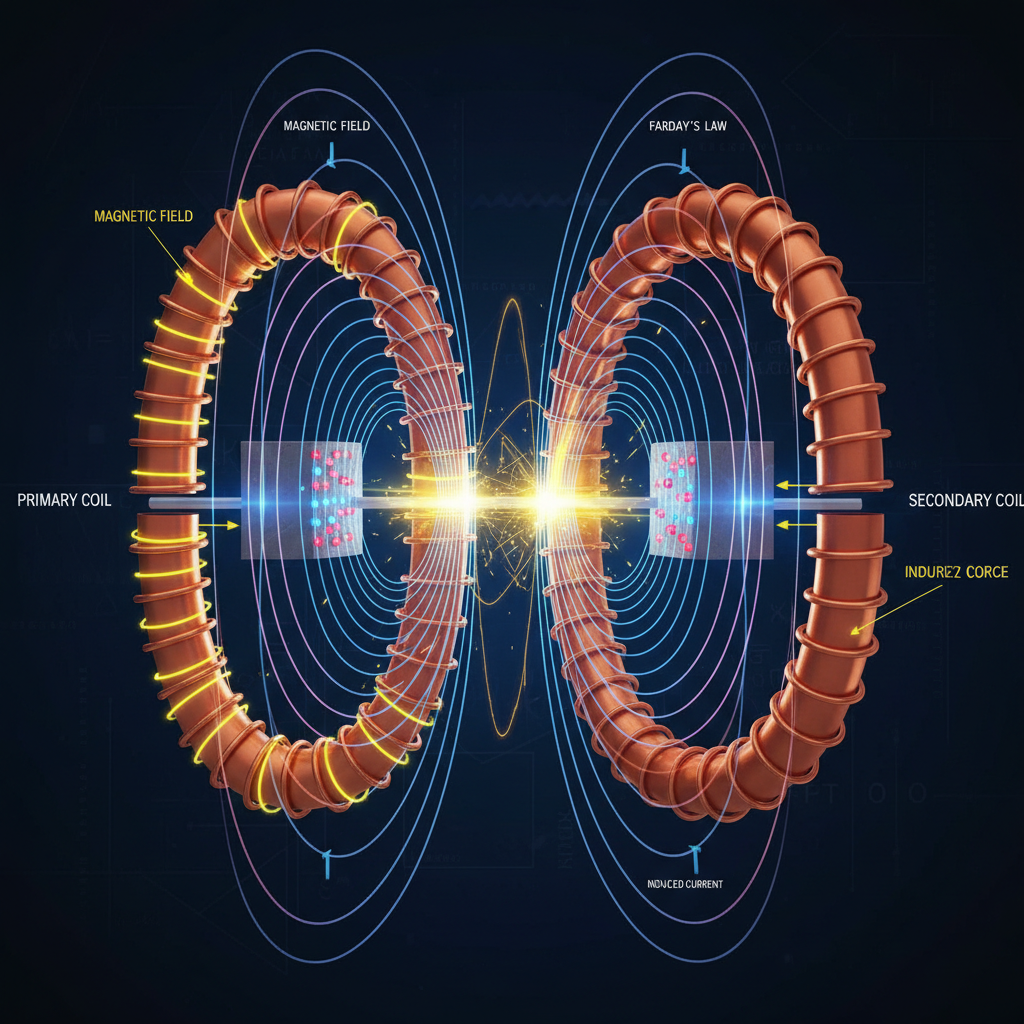
Michael Faraday discovered electromagnetic induction in 1831. He found that a changing magnetic field creates an electric field. Move a magnet near a conductor and you'll generate voltage. The faster the change, the stronger the current. No physical contact required. Just proximity. Just change.
The mathematics is elegant: the induced electromotive force equals the negative rate of change of magnetic flux through the circuit. What matters isn't the strength of the field itself—it's how quickly it changes. A weak field in rapid motion generates more current than a strong field sitting still. Motion is everything. Stillness is invisible.
This is how generators work. How transformers work. How wireless charging works. You create change in one place, and power appears in another. The universe, it turns out, hates isolated systems. Everything couples to everything else through fields you cannot see.
Your Magnetic Moment
You are the magnet moving through the coil. Every action you take online is a change in field strength. Every click, every hesitation, every three-second pause over an image—these are movements through someone else's carefully wound circuit.
The platforms have built the coil around you. They've positioned the conductor—their tracking infrastructure—at precisely the right distance to maximize induction. Not too close (you'd notice). Not too far (the signal would be too weak). Just close enough that your every movement generates extractable current.
And here's the thing about electromagnetic induction: you don't feel it happening. The magnet doesn't know it's inducing current. It just moves, doing what magnets do. The energy extraction is silent, invisible, perfect. You scroll because you're bored or curious or lonely. Somewhere else, your motion becomes profit.
The Rate of Change
Remember: it's not the field strength that matters. It's the rate of change. A user who scrolls slowly, deliberately, generates less extractable data than one who scrolls frantically, rapidly, desperately. The algorithms know this. They're optimized for it.
This is why the feeds are designed for velocity. Why videos autoplay. Why stories disappear. Why everything is optimized for rapid consumption and rapid movement. They're not trying to hold your attention in one place—they're trying to accelerate your movement through the field. Faster change, stronger current, more induced voltage.
You've felt this, haven't you? That compulsion to keep moving, keep scrolling, keep swiping. You think it's your attention span degrading. But maybe it's simpler than that. Maybe you've been placed inside a machine designed to keep you in motion, because motion is what generates the charge they're collecting.
Lenz's Law and Resistance

There's a beautiful piece of physics called Lenz's Law. It says that induced current always flows in a direction that opposes the change that created it. The universe resists. When you push, it pushes back. When you try to extract energy through induction, the system fights you.
You feel this too. That exhaustion after hours of scrolling. That strange emptiness after consuming content designed to engage you. That's not just psychological—it's thermodynamic. Energy is being extracted from you, and your system is generating resistance. The induced current in your nervous system flows opposite to the change being forced upon it.
But here's the trick: the platforms have calculated that the resistance doesn't matter. They can extract value faster than you can resist. The induced current in their systems is stronger than the opposing force in yours. They've solved the engineering problem. They've optimized the coil.
Breaking the Circuit

Electromagnetic induction requires three things: a conductor, a changing magnetic field, and proximity. Remove any one of these and the induction stops. The current ceases. The extraction ends.
You can't stop being a magnet—you can't stop having attention, having interests, having the basic human need to connect and consume and create. But you can change your rate of motion. You can move more slowly through the field. You can reduce the frequency of change.
Or you can increase the distance. You can step away from the coil. Not forever—we're all coupled to these systems now, whether we like it or not. But temporarily. Long enough to feel what it's like when the induced current stops flowing. Long enough to remember that your motion through space doesn't have to generate profit for someone else.
The Field You Move Through
At 1100db, we measure the noise floor of digital existence. 1100 decibels is the point where sound becomes so loud it creates black holes—where information density becomes so extreme it collapses into something else entirely. We're not there yet. But we're moving in that direction.
Every day, the coils get tighter. The conductors get closer. The extraction becomes more efficient. You move through the field, and the current flows, and somewhere else, someone is counting the charge.
Electromagnetic induction is beautiful physics. It powers our world. But it also describes our capture. You are the magnet. They've built the wire. And every time you move, you're generating the very current that binds you.
Data emitted: 1,147 words | Induced voltage: 3.2kV | Resistance: declining
Data emitted: 1,100 words • 6.5KB • 5-minute read