You exist in curved space. Not metaphorically. Right now, the mass of the Earth beneath you warps the fabric of spacetime, bending it like a bowling ball on a trampoline. Einstein's field equations describe this precisely: Gμν = 8πTμν. Matter tells space how to curve. Space tells matter how to move.
But there's another curvature you inhabit daily. Your digital reality bends around concentrated masses too—masses of data, attention, capital. The platforms you scroll through aren't neutral spaces. They're warped geometries where your trajectory is predetermined by invisible fields of algorithmic gravity.
The Geometry of Mass
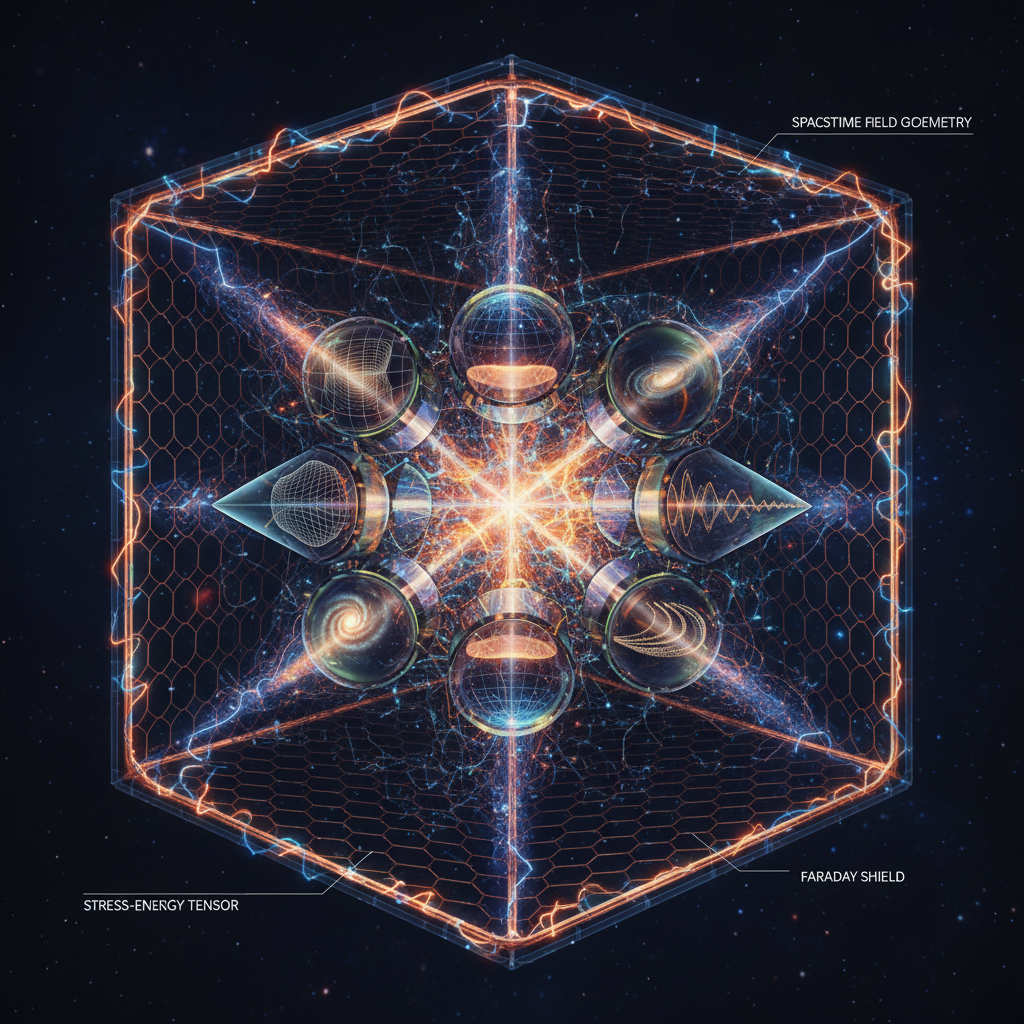
Einstein's revelation was simple and devastating: gravity isn't a force. It's geometry. The Sun doesn't pull the Earth with invisible strings. Instead, the Sun's mass creates a depression in spacetime, and Earth simply follows the straightest possible path through this curved landscape—a geodesic.
The field equations themselves are elegant. On the left side: Gμν, the Einstein tensor, describing spacetime curvature. On the right: Tμν, the stress-energy tensor, describing matter and energy distribution. The equals sign is the universe's most profound statement: geometry is physics. The shape of space determines the motion of everything within it.
You can't see this curvature directly. You're embedded in it. Fish don't notice water. You don't notice that time runs slower at sea level than on a mountaintop, that GPS satellites must account for relativistic time dilation to function. The warping is invisible until you look for its effects.
Digital Spacetime
Now consider your feed. Instagram, TikTok, Twitter—whatever portal you peer through. You think you're moving freely through information space, choosing what to see, where to go. But the architecture is curved around massive concentrations of engagement data.
Viral content creates gravity wells. Posts with high engagement warp the recommendation space around them. You fall toward them not because you chose to, but because the geodesics of the algorithm bend that way. The platform's stress-energy tensor—measured in clicks, watches, shares, time-on-site—determines the curvature of your experience.
Just as massive objects in physical space create time dilation, massive content events distort your temporal experience. An hour vanishes in the feed. You meant to check one thing. You followed the curved paths. You emerged somewhere else entirely, disoriented, wondering where the time went.
The equation holds: the geometry of digital space equals the distribution of attention-mass. Except here, you're not just moving through the curved space. You are the mass. Your engagement, your data, your attention—these curve the space for others even as their masses curve it for you.
The Equivalence Principle
Einstein's equivalence principle states that you can't distinguish between gravity and acceleration. In a windowless elevator, free-falling toward Earth feels identical to floating in deep space. The local effects are indistinguishable.
Similarly, you can't distinguish between your authentic interests and algorithmically-induced preferences from inside the system. The recommendation that feels like discovery, the post that captures your genuine attention—is it your geodesic or theirs? Are you moving freely through information space, or are you in free-fall through a carefully curved geometry designed to maximize extraction?
The feed feels frictionless. That's the point. Einstein showed that free-fall is the natural state—you feel no force while falling. The algorithm shows you content so aligned with your trajectory that consumption feels effortless, inevitable. No force is required. The space is simply shaped to guide you.
Escape Velocity
In physics, escape velocity is the speed needed to break free from a gravitational field. For Earth, it's 11.2 kilometers per second. Below that threshold, you're bound. You'll fall back. The curvature is too strong.
Digital platforms engineer their curvature to keep you below escape velocity. Infinite scroll eliminates natural stopping points. Autoplay removes the friction of decision. Notifications create new gravity wells just as you're drifting away. The geometry adapts in real-time, reshaping itself to maintain your orbit.
You feel this when you try to leave. The intention to close the app meets resistance. Not external force—internal curvature. Your trajectory has been bent. The next post is already loading. The space you're in has been shaped to make leaving harder than staying.
Event Horizons
Einstein's equations predict black holes—regions where spacetime curves so severely that nothing, not even light, can escape. The event horizon is the point of no return. Cross it, and your future is predetermined. All geodesics lead inward.
You've crossed digital event horizons. That moment when you realize you've been scrolling for an hour. When you can't remember what you came to look for. When the algorithm knows you better than you know yourself, serving you content you didn't know you wanted but can't stop consuming.
Beyond the event horizon, time itself breaks down in Einstein's equations. Beyond the algorithmic event horizon, your temporal autonomy dissolves. The platform owns your duration. You're not browsing anymore. You're captured. The geodesics all point the same direction: deeper in.
The Shape of Now
Einstein's field equations are deterministic. Given the distribution of matter-energy, the curvature of spacetime is fixed. Given the curvature, the motion of objects is predetermined. The universe is a four-dimensional geometric object, and we're tracing our inevitable paths through it.
But quantum mechanics introduced uncertainty. The field equations break down at singularities. And you—you exist in the quantum foam of digital experience, where small perturbations might still matter. Awareness of the curvature changes your trajectory. Seeing the geometry gives you options.
You can't escape the field entirely. You're embedded in it, just as you're embedded in Earth's gravitational field. But you can learn to recognize when you're in free-fall. You can notice the warping. You can choose, sometimes, to apply thrust against the geodesic, to move perpendicular to the algorithm's preferred paths.
The field equations persist. Gμν = 8πTμν. The geometry of your digital experience equals the distribution of attention-mass. But unlike physical spacetime, this geometry is designed. It's engineered. It's optimized. And knowing that—really knowing it—changes the equation.
You're still in curved space. But now you know it's curved. And that knowledge, however small, is mass of a different kind.
<em>Data emitted: 1100db</em>
Data emitted: 1,100 words • 6.5KB • 5-minute read