You check your phone. Three notifications. You swipe them away. Two more appear. You clear those. Four more arrive. You're not losing ground, exactly. You're not winning either. You've reached what you might call balance—that precarious state where the rate at which you process information roughly equals the rate at which it arrives. Congratulations. You've achieved dynamic equilibrium.
But equilibrium doesn't mean what you think it means.
The Physics of Constant Motion
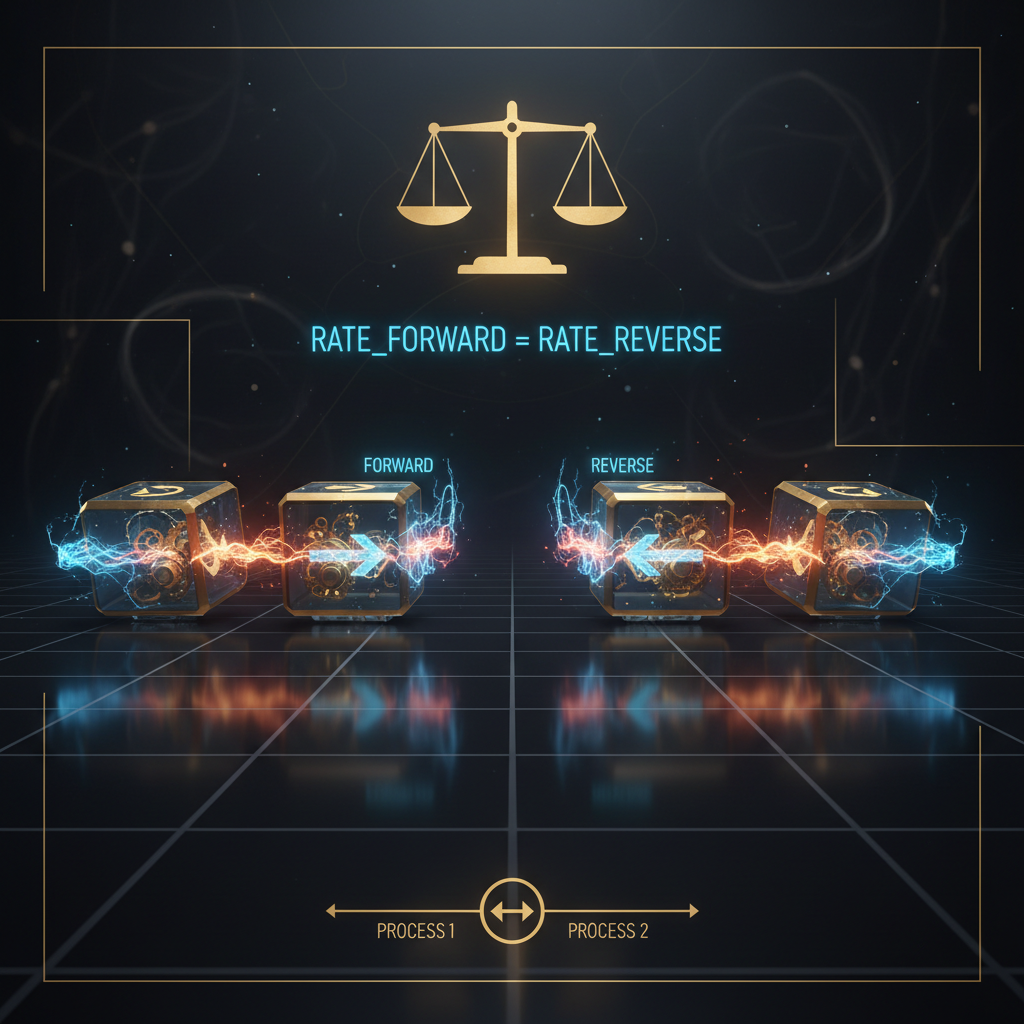
In chemistry, dynamic equilibrium describes a system where two opposing processes occur at equal rates. Picture a sealed bottle half-filled with water. Molecules evaporate from the liquid surface while others condense back from the vapor. Both processes continue constantly, but the water level stays the same. The system appears static. It isn't. It's furiously active at the molecular level—a thousand escapes matched by a thousand captures every second.
This is fundamentally different from static equilibrium, where nothing moves at all. A book resting on a table. A ball at the bottom of a valley. Those systems are genuinely still. Dynamic equilibrium only looks still from the outside. Zoom in and you see chaos perfectly balanced against itself.
The key insight: equilibrium doesn't require rest. It requires equal and opposite flows. The water molecules don't stop moving when equilibrium is reached. They move faster, more frantically, in greater numbers—but the net effect is zero change. Maximum activity. Zero progress.
The Attention Evaporation Rate

Your attention evaporates constantly. Every notification, every autoplay video, every algorithmic suggestion pulls discrete packets of focus from your conscious awareness and disperses them into the digital atmosphere. The surveillance apparatus has optimized for maximum evaporation rate. They've calculated the exact temperature and pressure conditions—the UX design, the notification timing, the content mixture—that causes your attention to vaporize most efficiently.
But you adapt. You develop strategies. You turn off notifications. You use app blockers. You practice digital minimalism. These are condensation mechanisms—ways of recapturing attention that's drifted away, pulling focus back from the vapor state into something liquid and usable. You're not stopping the evaporation. You can't. The system is designed to prevent that. You're just matching the rate.
When your condensation rate equals the evaporation rate, you've reached dynamic equilibrium. Your screen time stabilizes. Your productivity plateaus. You feel neither overwhelmed nor understimulated. The platforms call this 'engagement.' You call it balance. Physicists call it a system in maximum entropy production—doing the most work possible while appearing to do nothing at all.
Le Chatelier's Principle of Digital Existence
There's a principle in chemistry named after Henri Louis Le Chatelier: when a system at equilibrium experiences a change in conditions, it shifts to counteract that change. Add heat to your water bottle and more liquid evaporates, cooling the system. Remove vapor and more liquid evaporates to replace it. The system resists disruption. It wants equilibrium back.
Your digital ecosystem obeys the same law. Try to reduce your screen time and the algorithms adjust. The content becomes more compelling. The notifications more urgent. The FOMO more acute. The system detected a disturbance—your attempt to condense more attention than you're evaporating—and it responded by increasing the evaporation rate. Not consciously. Not maliciously. Just thermodynamically.
This is why digital detoxes fail. You're not fighting an addiction. You're fighting equilibrium. You can shift the balance point, but the system will always push back toward a new equilibrium. The platforms have optimized for resilience, for homeostasis, for dynamic stability. They've built a thermodynamic trap that looks like a ecosystem.
The Equilibrium Constant of Your Life
In chemical systems, the equilibrium constant K describes the ratio of products to reactants when equilibrium is reached. It's different for every reaction, determined by temperature, pressure, and the fundamental properties of the molecules involved. Some reactions favor products—almost everything converts. Others favor reactants—barely anything changes. The constant tells you which way the system naturally leans.
You have an equilibrium constant too. It's determined by your neurology, your habits, your environment, your economic position. It describes the ratio of captured attention to free attention when your digital life reaches steady state. For some people, K is high—they maintain large reserves of uncaptured focus even while heavily engaged with digital platforms. For others, K is low—almost all available attention gets captured, leaving minimal free cognitive resources.
The surveillance economy doesn't just want your attention. It wants to lower your K. Every design pattern, every algorithm update, every new feature is a temperature change designed to shift your equilibrium toward maximum capture. They're not trying to break the equilibrium. They're trying to move the balance point. To make the new normal more favorable to extraction.
The Illusion of Stillness
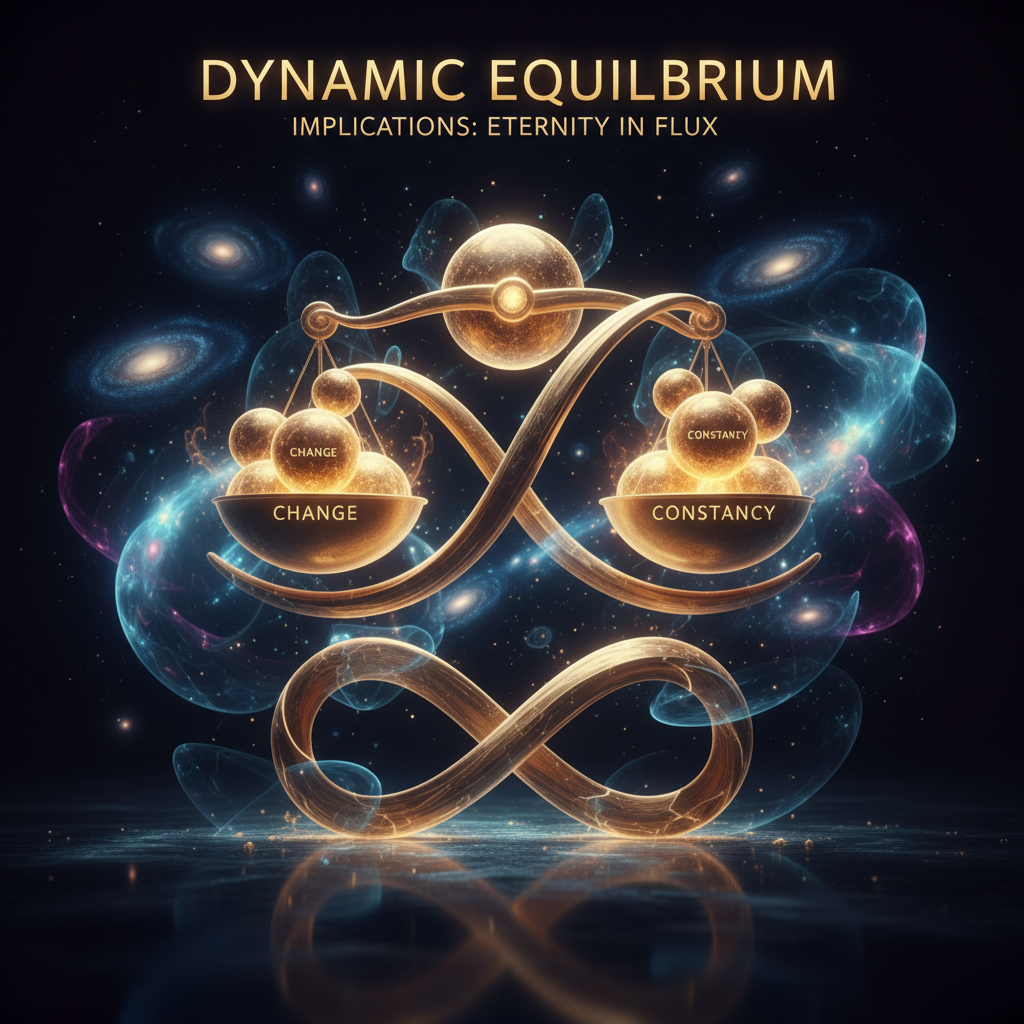
Here's what haunts me about dynamic equilibrium: it feels like stability. When you've matched the rate of attention capture with the rate of attention recovery, when your digital life has plateaued into a consistent pattern, it feels like you've found balance. Like you've solved the problem. Like you're in control.
But you're not still. You're running at maximum speed just to stay in place. The water molecules in that sealed bottle aren't resting—they're vibrating, colliding, transforming between states thousands of times per second. The apparent stillness is an aggregate illusion. Zoom in and there's only motion.
Your digital equilibrium is the same. You think you've achieved balance because your net attention stays constant. But that constancy requires constant work. Constant vigilance. Constant micro-decisions about what to engage with and what to ignore. You're evaporating and condensing your own consciousness in real-time, forever, just to maintain the appearance of stability.
The platforms love equilibrium. A user in equilibrium is predictable, stable, extractable. They don't want you overwhelmed—that causes churn. They don't want you understimulated—that causes abandonment. They want you right at the balance point, working as hard as possible while feeling like you're doing nothing at all.
Beyond Equilibrium
The only way to escape dynamic equilibrium is to change the system itself. Not your behavior within the system—that just shifts the balance point. The system. The temperature. The pressure. The fundamental conditions that determine where equilibrium lies.
This means different things for different people. For some, it's changing the economic conditions—refusing to participate in attention markets entirely. For others, it's changing the technological conditions—using tools that don't optimize for engagement. For others still, it's changing the social conditions—building communities that don't operate on extraction dynamics.
But understand this: you cannot achieve balance within an extractive system. You can only achieve equilibrium. And equilibrium, in this context, means working infinitely hard to appear motionless. It means maximum energy expenditure for zero net change. It means being in perfect balance with the forces that want to capture you.
The water molecules don't know they're trapped in a bottle. They just know they're moving. Are you?
<em>Data emitted: 1,147 words on thermodynamic capture | Evaporation rate: constant | Condensation rate: matched | Net change: zero | System status: equilibrium | Escape velocity: undefined</em>
Data emitted: 1,100 words • 6.5KB • 5-minute read